Virus caught in the act of infecting a cell
January 11, 2013
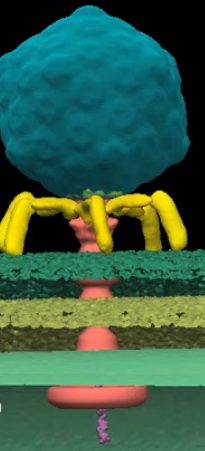
T7 virus injects its DNA into a cell in this frame from an animation (credit: Bo Hu)
The detailed changes in the structure of a virus as it infects an E. coli bacterium have been observed for the first time.
To infect a cell, a virus must be able to first find a suitable cell and then eject its genetic material into its host.
This robot-like process has been observed in a virus called T7 and visualized by Ian Molineux, professor of biology in the College of Natural Sciences at The University of Texas at Austin, and colleagues at The University of Texas Health Science Center at Houston (UT Health) Medical School.
When searching for its prey, the virus briefly extends — like feelers — one or two of six ultra-thin fibers it normally keeps folded at the base of its head.
Once a suitable host has been located, the virus behaves a bit like a planetary rover, extending these fibers to walk randomly across the surface of the cell and find an optimal site for infection — the first experimental evidence for this.
At the preferred infection site, the virus goes through a major change in structure in which it ejects some of its proteins through the bacterium’s cell membrane, creating a path for the virus’s genetic material to enter the host.
After the viral DNA has been ejected, the protein path collapses and the infected cell membrane reseals.
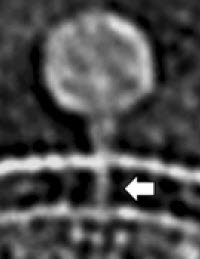
Cryo-electron tomography image of T7 virion (credit: Bo Hu et al./Science Xpress)
“Although many of these details are specific to T7, the overall process completely changes our understanding of how a virus infects a cell,”.said Molineux.
This is also the first time that scientists have made actual images showing how the virus’s tail extends into the host — the very action that allows it to infect a cell with its DNA.
The researchers used a combination of genetics and cryo-electron tomography to image the infection process. Cryo-electron tomography is a process similar to a CT scan, but it is scaled to study objects with a diameter a thousandth the thickness of a human hair.
Molineux’s co-authors are Bo Hu, William Margolin and Jun Liu from UT Health.
Comments (11)
by Jerry Martin
As already noted, this is well known among microbiologist and only the photomicrograph is unique. Also keep in mind that this type of bacteriophage is interesting in its’ uniqueness. Most bacteriphages and all mammalian and plant viruses to my knowledge do not have this tail structure and do not infect cells in this mechanistic matter. Exceptions are interesting but do not define the norml
by Ralph Dratman
Scary, and also amazing to think that such a small organism… or is it a device… can be apparently so capable.
by Mr.X
@Ralph: Maybe the difference between organism (organon- old greek for tool) and a device (funny word, btw) is only “verbal” !?
Of course, in contrast to man-made devices, biological machines (aka organisms) brought about by evolutionary processes probably lack a teleological raison d’être…
by eldras
I urge caution in medicine. the body is colony of symbiotic antonymous systems.
Halting viruses entering the cell may cause other havoc.
by Dr.Pratt
Kind of sexual….
by Mr.X
There are rumors you could see it blush when it realized it was under supervision…
by C. K.
Beautiful animation of a bacteriophage pooping inside an E. Coli bacterium!
by Bart Likes
I can see this machine being replicated in the next few years by some lab creating a new way to deliver and monitor cures. Maybe even using the nucleotide building blocks (earlier report) to manufacturer this nano robot and fully programmable.
by Larry Coleman
Bart, bacteriophages (of which this is one kind) have been used for almost 100 years. They replicate themselves because they’re naturally occurring viruses, so there’s no need to manufacture them. They’ve already been used for years and years as genetic modification deliverymen.
The news in this story is that someone caught an actual picture of the phage at work, but introductory genetics textbooks have pictures of them free floating or on the surface of a cell after injection and have since at least when I took college genetics a decade ago. In fact, the Hershey-Chase experiment which settled that DNA is the substance that is responsible for heredity was conducted over sixty years ago (1952–before the structure of DNA was even discovered!) and relied on bacteriophages.
So your first “prediction” is correct, although you have successfully predicted the past.
by Stephen Nielsen
This is so awesome – a major discovery with wide ranging implications.
These days, another such discovery will be made tomorrow .
by IBTESHAM
Really its amazing & very good topic to think or discuss.Animation helps to understand the phenomena.