Watson provides cancer treatment options to doctors in seconds
February 11, 2013
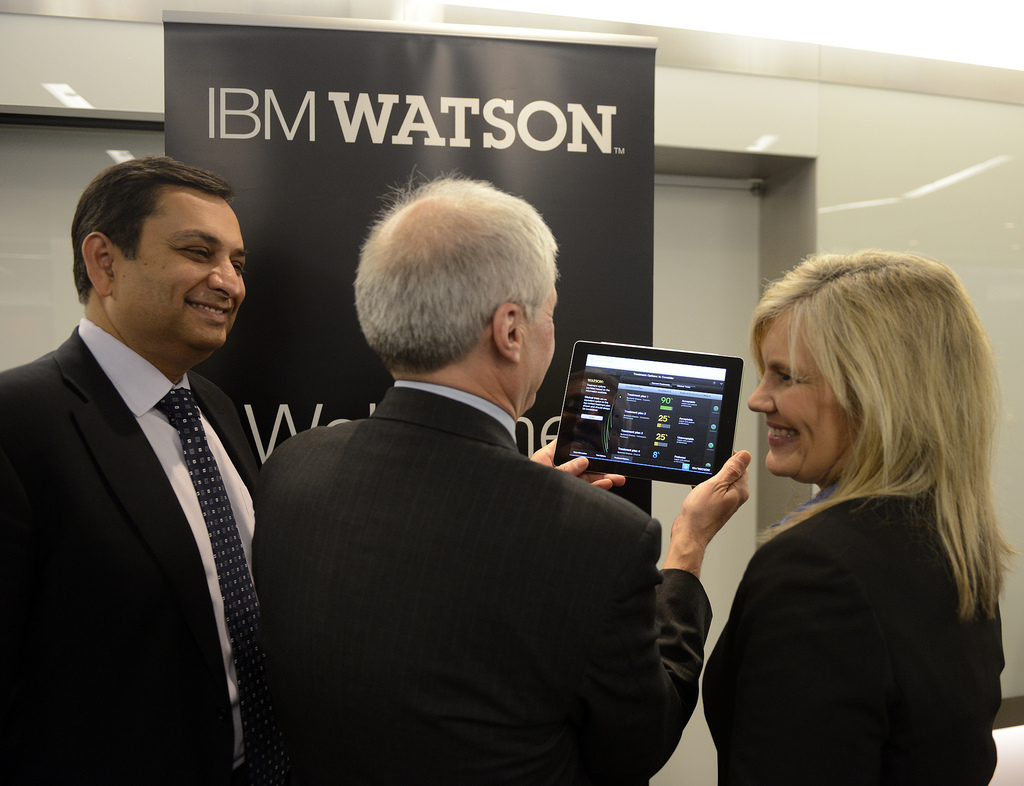
Manoj Saxena, left, IBM General Manager, Watson Solutions, Mark Kris, MD, Chief of Thoracic Oncology, Memorial Sloan-Kettering Cancer Center, and Lori Beer, WellPoint’s Executive Vice President of Specialty Businesses and Information Technology use the new Watson-based cognitive computing product for oncology (credit: IBM)
IBM and Memorial Sloan-Kettering Cancer Center unveiled Friday the first commercially developed Watson-based cognitive computing breakthroughs.
These innovations stand alone to help transform the quality and speed of care delivered to patients through individualized, evidence based medicine, says IBM.
For more than a year, IBM has partnered separately with WellPoint and Memorial Sloan-Kettering to train Watson in the areas of oncology and utilization management.
During this time, clinicians and technology experts spent thousands of hours “teaching” Watson how to process, analyze and interpret the meaning of complex clinical information using natural language processing, all with the goal of helping to improve health care quality and efficiency.
Advancing oncology through evidence-based medicine
To date, Watson has ingested more than 600,000 pieces of medical evidence, two million pages of text from 42 medical journals and clinical trials in the area of oncology research. Watson has the power to sift through 1.5 million patient records representing decades of cancer treatment history, such as medical records and patient outcomes, and provide to physicians evidence based treatment options all in a matter of seconds.
In less than a year, Memorial Sloan-Kettering has immersed Watson in the complexities of cancer and the explosion of genetic research which has set the stage for changing care practices for many cancer patients with highly specialized treatments based on their personal genetic tumor type.
Starting with 1,500 lung cancer cases, Memorial Sloan-Kettering clinicians and analysts are training Watson to extract and interpret physician notes, lab results and clinical research, while sharing its profound expertise and experiences in treating hundreds of thousands of patients with cancer.
“It can take years for the latest developments in oncology to reach all practice settings. The combination of transformational technologies found in Watson with our cancer analytics and decision-making process has the potential to revolutionize the accessibility of information for the treatment of cancer in communities across the country and around the world,” said Craig B.Thompson, M.D., President of Memorial Sloan-Kettering Cancer Center.
“Ultimately, we expect this comprehensive, evidence-based approach will profoundly enhance cancer care by accelerating the dissemination of practice-changing research at an unprecedented pace.”
The Maine Center for Cancer Medicine and WESTMED Medical Group are the first two early adopters of the capability. Their oncologists will begin testing the product and providing feedback to WellPoint, IBM and Memorial Sloan-Kettering to improve usability.
Improving patient care
Throughout WellPoint’s utilization management pilot, Watson absorbed more than 25,000 test case scenarios and 1,500 real-life cases, and gained the ability to interpret the meaning and analyze queries in the context of complex medical data and human and natural language, including doctors notes, patient records, medical annotations and clinical feedback.
In addition, more than 14,700 hours of hands-on training was spent by nurses who meticulously trained Watson. Watson continues to learn while on the job, much like a medical resident, while working with the WellPoint nurses who originally conducted its training.
Watson started processing common, medical procedure requests by providers for members in WellPoint affiliated health plans in December, and was expanded to include five provider offices in the Midwest. Watson will serve as a powerful tool to accelerate the review process between a patient’s physician and their health plan.
Watson-powered health innovations
As a result, IBM, Memorial Sloan-Kettering and WellPoint are introducing the first commercially based products based on Watson. These innovations represent a breakthrough in how medical professionals can apply advances in analytics and natural language processing to “big data,” combined with the clinical knowledge base, including genomic data, in order to create evidence based decision support systems. These Watson-based systems are designed to assist doctors, researchers, medical centers, and insurance carriers, and ultimately enhance the quality and speed of care.
The new products include the Interactive Care Insights for Oncology, powered by Watson, in collaboration with IBM, Memorial Sloan-Kettering and WellPoint. The WellPoint Interactive Care Guide and Interactive Care Reviewer, powered by Watson, designed for utilization management in collaboration with WellPoint and IBM.
New interactive care insights for oncology
- The cognitive systems use insights gleaned from the deep experience of Memorial Sloan-Kettering clinicians to provide individualized treatment options based on patient’s medical information and the synthesis of a vast array of updated and vetted treatment guidelines, and published research.
- A first of-its-kind Watson-based advisor, available through the cloud, that is expected to assist medical professionals and researchers by helping to identify individualized treatment options for patients with cancer, starting with lung cancer.
- Provides users with a detailed record of the data and information used to reach the treatment options.
- Oncologists located anywhere can remotely access detailed treatment options based on updated research that will help them decide how best to care for an individual patient.
New WellPoint Interactive Care Guide and Interactive Care Reviewer
- Delivers the first Watson-based cognitive computing system anticipated to streamline the review processes between a patient’s physician and their health plan, potentially speeding approvals from utilization management professionals, reducing waste and helping ensure evidence-based care is provided.
- Expected to accelerate accepted testing and treatment by shortening pre-authorization approval time, which means that patients are moving forward with the first crucial step toward treatment more quickly.
- Analyzes treatment requests and matches them to WellPoint’s medical policies and clinical guidelines to present consistent, evidence-based responses for clinical staff to review, in the anticipation of providing faster, better informed decisions about a patient’s care.
- WellPoint has deployed Interactive Care Reviewer to a select number of providers in the Midwest, and believes more than 1,600 providers will be using the product by the end of the year.
Comments (17)
by Bri
Check out in the video the difference in the statements by the doctor and the IBM representative. The rep says that Watson is a tool to assist the doctor. The doctor says that Watson addresses the diagnosis the same way he does. Reviewing possible diagnosis’s and assigning a probability to each possible conclusion. At this point it’s like an autopilot. It can fly the plane, we just keep the pilot there in case of problems. Watson could probably diagnose the illness better than the doctor, we keep him there to reassure that there are no problems. It’s still all about the money. Watson serves the health care provider, not the doctor or the patient. Eventually the patients will be empowered with there own Watsons. Then holistic medicine and other alternatives will be included in Watsons data base.
by matthew
You are correct Bri. In fact, using AI to improve and optimize diagnosis was tried a long time ago but was rejected by doctors, and whomever else is involved in that decision process.
I think it would be great to compare the old AI efforts at diagnosis to Watson in order to better understand the errors of doctors.
by MikeB
And a timely study completes:
http://newsinfo.iu.edu/news/page/normal/23795.html
by MrPrescott
how and when can I bitTorrent a Watson feed :-p
by AG
The picture is hilarious!… the top level managers and business people undoubtedly know nothing about operating Watson-enabled software.
As someone else said – where are the engineers? This glamorization of the top of the pyramid is a problem in our society!
by matthew
There is no shortage of demand of business leaders that also understand science and engineering. Check out BLS.gov. Also, you are right, frequently they do not have a clue and yet somehow companies limp along. All hail our new overlords, the scientists and engineers, that only reject objective values to get along with out theist friends. If there could be a science of values the technocrats will take over the world. China is trying.
by MLB
A double edged sword- while providing valid data driven information to physicians today for patient care; it could easily morph into prescriptive direction to the physician, perhaps eliminating the specific patient’s individual needs as factors in treatment plans. Look only to the changes in Medicare and insurers formularies this past January.
by beatriz valdes
This is what I have been urgint in different blogs! Scientists who have reached an important point in their areas, need to plug in to the most powerful computers -Watson is perfect-, to speed up the process so these advances can benefit patients much sooner. What good is it to keep reading about incredible discoveries, new paths, etc., to cure cancer, Alzheimer, et al, if they will remain years, maybe decades away? Join forces with the best technology I say!
by Bennie Beaver
I’m still not convinced that in a for-profit health care system much will change in cost. I repeat myself: If doctors, hospital, clinic, and specialist make you well, they could go broke! Do we really imagine that doctors want fewer patients. We better hope that somewhere-somehow competition puts more and more doctors and hospitals, etc. out of business, or America, and the world will go broke.
by Bruce Wright
I don’t follow your logic. I’ve known a large number of doctors, both personally and professionally, and I can’t remember a single time when any of them would have preferred managing something as a chronic condition rather than an outright cure. There’s certainly a possibility that as technology continues to improve, there will be less need for health care because so many things will become curable, but that’s still some ways off; right now, we have a need for more medical professionals, not fewer.
Moreover, what’s likely to happen (at least in the short run) is that illnesses affecting the largest number of patients will tend to get the most attention and will probably be cured first, and then the less-common ones. There’s no indication that this will change much in the next, say, twenty years – only which diseases are “curable” and which can be “managed” and which are intractable will change, not the basic structure of the system. Perhaps in forty years, given current technological trends, things will start to change – but then just about everything else will be changing, too.
In a society in which most major diseases are conquered, there may still be things for health professionals to do: for example, working on extreme life extension or enhancements to our biological minds and bodies.
I just don’t see it as being likely that the medical profession will try to suppress advances; rather, the problem is going to be managing them. For example, the current legal requirements for drug trials are very expensive and time-consuming. It’s quite possible that as computer technology and simulation improves, many of these requirements will become obsolete, since many basic questions (safety, for example) might be able to be determined fairly quickly without clinical trials. I’d guess that once that kind of technology starts to become available, the medical and research communities will embrace it; our problem will be that government will not, since they’re often much more conservative and out-of-touch with technology than the people who actually use it. Unfortunately the current structure of things like drug trials is now codified by government – the least responsive entity in our society for anything having to do with technology.
by smb12321
It’s embarrassing to have to tell you this but it is those profits that make Watson’s medical interface possible. Our “profit system” funds research in all areas. If not convinced, check out patents awarded and note that almost all come from systems allowing profit. I really can’t imagine anyone calling for a reduction in health care personnel with the addition of 40 million new patients next year. I don’t get it.
by ProfessorZ
I love the picture, they clearly have no idea what they’re even looking at. Too bad there’s only pics of bureaucrats, no shots of the engineers who actually created the system.
by Bri
My man Watson in the field!!!!
by MikeB
Did you pick up on “… accelerate the review process between a patient’s physician and their health plan” and “… for clinical staff to review…” Frightening, because there is a clear statement that this is about _business_ and there is no authority given to the system, therefore decisions will continue with the same biases as currently exist. This shouldn’t be surprising; the medical profession is a staggeringly slow adopter of technology. In fact, it is so resistant that this can only be seen as a business ploy. While Watson has/gives access to tremendous amounts of information, it remains that a human must still access that information and then use it. Three final saddening observations: a) Watson is only as good as the information it is given, information that must necessarily reflect the biases of the body that decides what is input. b) Watson was very good on Jeapordy where all the questions had answers; health care (and medicine in general) has no pat answers. c) Watson is simply a recent manifestation of the ‘expert system’ paradigm, a paradigm that was shown to be a dismal failure in the 80′s.
by Tom B.
I saw no mention of nutritional or psychological impacts on treatment efficacy. Apparently, when western medicine builds oncology AI, they hide a whole bunch of relevant facts to ensure that their creation won’t come to the “wrong conclusions.”
by WLGJR
“psychological impact” is really intriguing.
It would be great if organizations like DARPA should devote more resource on the research about the Placebo effects and other similar processes.
If we optimally take advantage of such effects, we can enhance human beings to an incredible degree.
“when western medicine builds oncology AI …”
Will this new AI system, if the ignored “relevant facts” are included, conclude that Chinese herbal medicine and ayahuasca are (at least partially, like their practitioners claim) right?
Well, I believe there is a possibility.
by ChrisF
Once this tech gets really good (perhaps 5 years from now ?), it’s going to wipe out millions of healthcare jobs. Yet another step towards a jobless future. Who’d ever want to trust their lives to a fallible human doctor again ? Imagine when this sort of tech is available to every human on the planet via the internet… incredible.