Wave-particle duality visualized in quantum movie
March 27, 2012
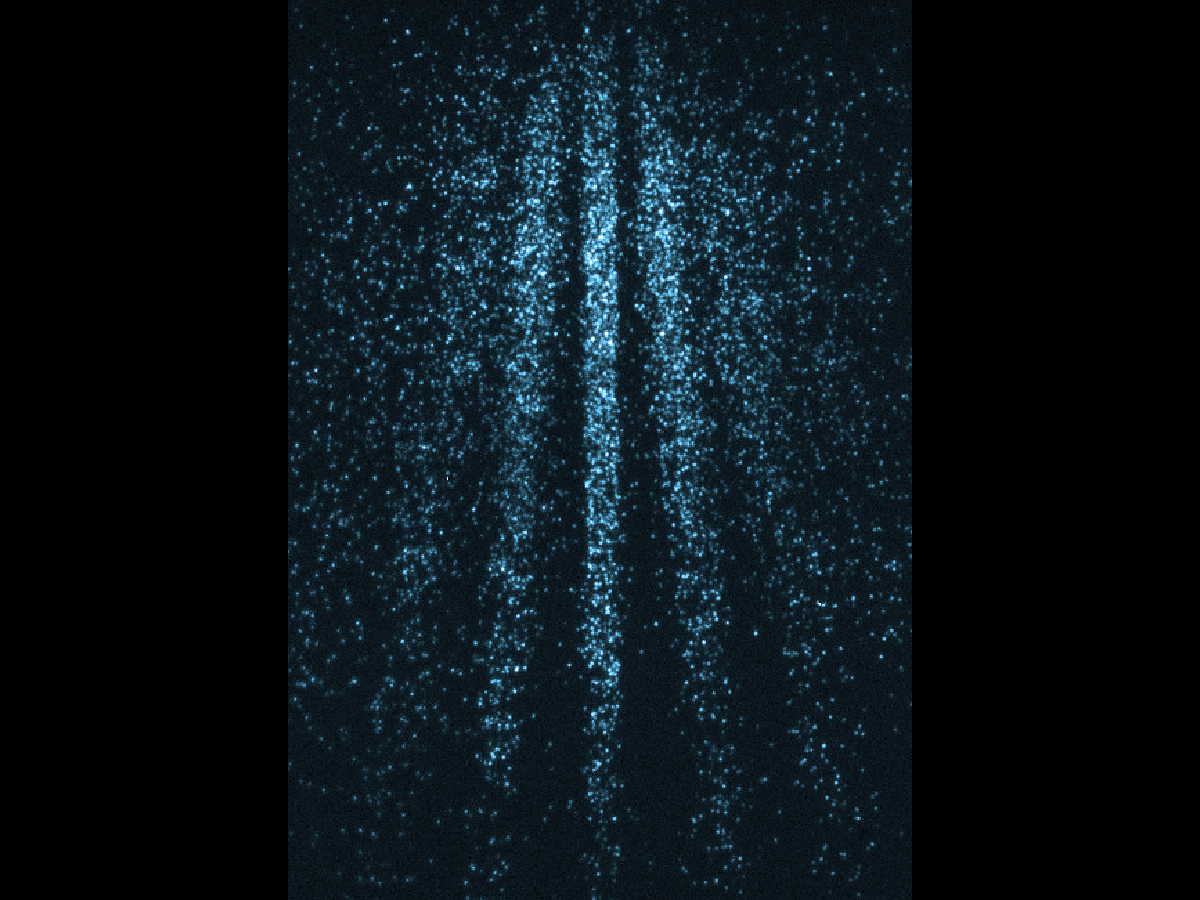
Quantum interference pattern from phthalocyanine molecules (credit: Juffmann et al./Nature Nanotechnology)
An international team of scientists has shot a video that shows the build-up of a matter-wave interference pattern from single dye molecules. The pattern is so large (up to 0.1 mm), it can been seen with a video camera.
The video visualizes the dualities of particle and wave, randomness and determinism, and locality and delocalization in an intuitive way.
Physicist Richard Feynman once claimed that interference effects caused by matter-waves contain the only mystery of quantum physics, as he explained in another video (below).
Understanding and applying matter waves for new technologies is also at the heart of the research pursued by the Quantum Nanophysics team around Markus Arndt at the University of Vienna and the Vienna Center for Quantum Science and Technology.
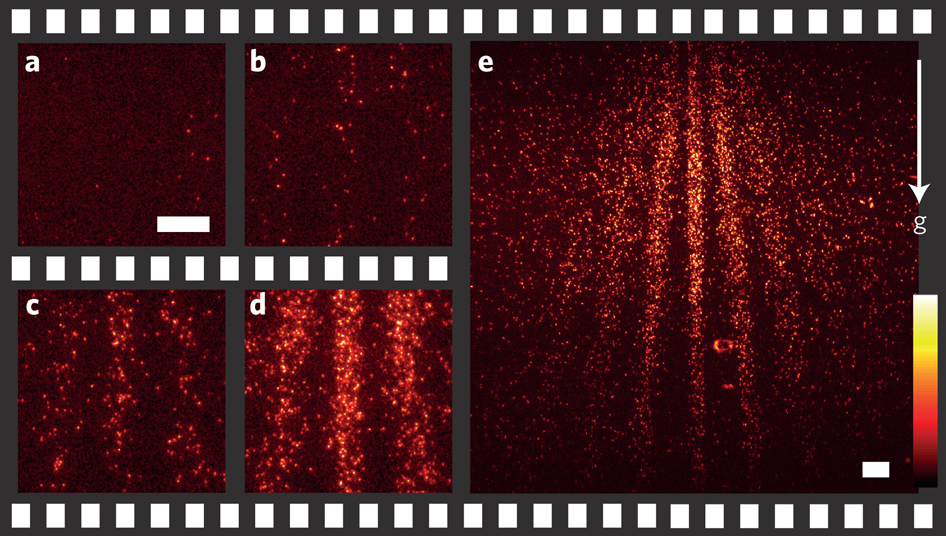
This is a high-tech version of the double slit experiment, which illustrates wave-particle duality. The wave nature of matter causes the dye molecules passing through the nano grating to interfere, producing the bright and dark vertical bands seen in the video — a result that would not be expected for discrete particles. However, the molecules are always detected as discrete particles (the dots seen in the video).
A quantum premiere with dye molecules as leading actors
The video shows the build-up of a quantum interference pattern from stochastically arriving single phthalocyanine fluorescent-dye molecules after they traversed an ultra-thin nanograting. These represent the most massive molecules in quantum far-field diffraction so far.
The researchers used a spatially resolving fluorescence microscope whose sensitivity is so high that each molecule can be imaged and located individually with an accuracy of about 10 nanometers.
In these experiments, van der Waals forces between the molecules and the gratings pose a particular challenge. These forces arise due to quantum fluctuations and strongly affect the observed interference pattern. To reduce the van der Waals interaction, the scientists used the 10 nanometers gratings.
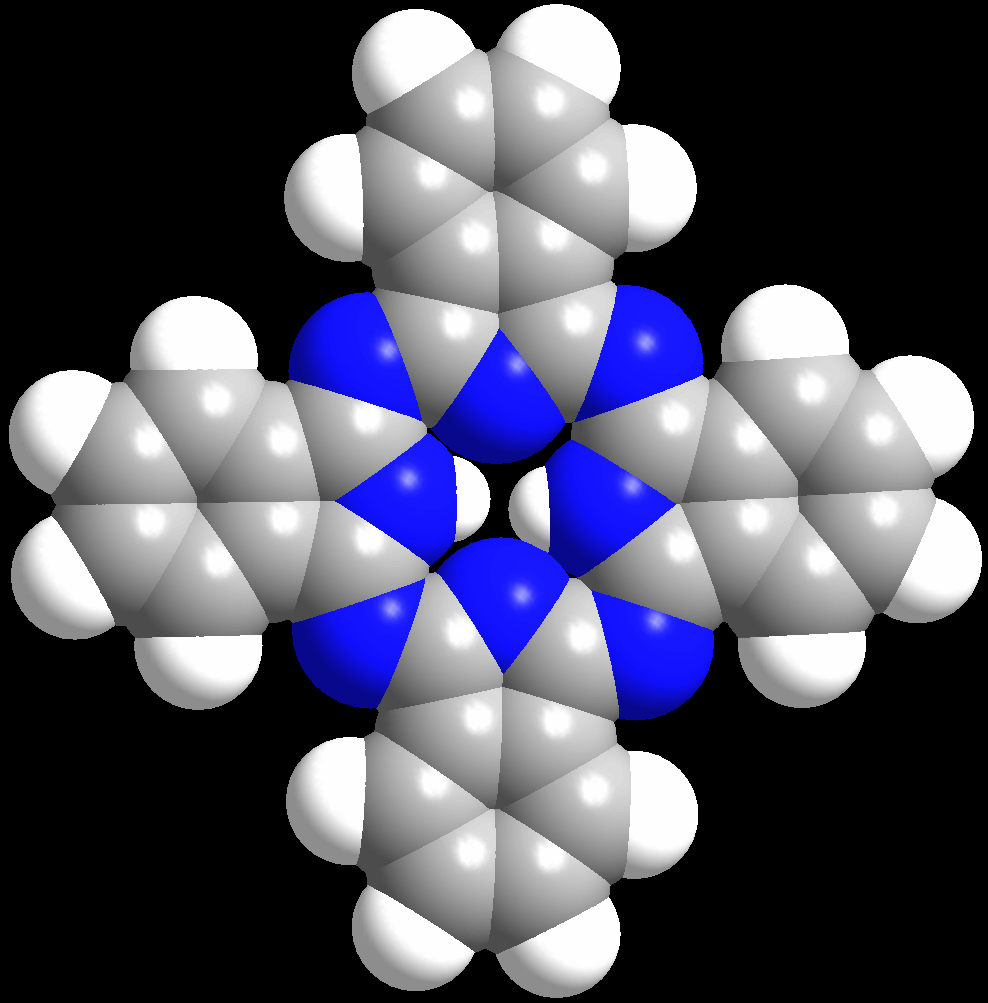
The chemical structure of the phthalocyanine dye molecule (credit: Juffmann et al./Nature Nanotechnology)
These new technologies for generating, diffracting and detecting molecular beams will be important for extending quantum interference experiments to more and more complex molecules and for atomic interferometry, according to the researchers.
The experiments reveal the single-particle character of complex quantum diffraction patterns on a macroscopic scale that is visible in real time. The experiments also allow for studying molecular properties of solids and point the way towards future diffraction studies of atomically thin membranes.
Ref.: Thomas Juffmann, et al., Real-time single-molecule imaging of quantum interference, Nature Nanotechnology, 2012; [DOI: 10.1038/NNANO.2012.34] (open access)
In this video, Richard Feynman explains the interference effects caused by matter-waves in the classical double slit experiment.

Comments (9)
by Eric S Reiter
Recent correspondence with the author. Please read my letter below first. ER
____________________
Dear Mr. Reiter,
concerning your considerations:
1) The equations are of course right, but our source emits molecules in
all directions. Thus a flight parabola is defined by three source, the
grating (which is only written onto a 100µm high window) and the height on
the detection plane. Thus it is wrong to simply enter the distance
source-detection plane into the calculations, since in the plane of the
grating all molecules pass at the same height.
2) Your observatin is right. The high intensity of the higher interference
orders is due to the van der Waals interaction between the molecules and
the grating wall. This is mentioned several times in our paper.
3) Please don’t forget, that also the grating is only 100µm high and that,
especially for the slow molecule, the projection is a non valid
approximation.
4)I don’t agree. Regarding the high transversal coherence in our
experiment the shape of the fringes is in agreement with the theoretical
predictins.
Best regards,
Thomas Juffmann
On Di, 22.05.2012, 01:54, Eric Reiter wrote:
> Dear Dr Juffmann
>
>
> Regarding your recent article, “Real-time single-molecule imaging of
> quantum interference,” I have performed calculations on your data that do
> not make sense to me.
>
> 1) Let’s calculate the fall of a particle. We can use (1/2)gt^2, where t
> = time = distance/velocity. For a fast particle Hfast =
> (9.8/2)(2m/340m/s)^2 = 169×10^-6 meters. For a slow particle Hslow =
> (9.8/2)( 2m/140m/s)^2= 1×10^-3 meters. Hslow – Hfast = 830 micrometers.
> But you show only 240 micrometers. Therefore the difference in falls
> should be 3.4 times larger than you show.
>
>
> 2) I used a multiple slit diffraction simulation tool to test what the
> intensity profiles should be. I found your first order fringes were a few
> times brighter than they should be for the given wavelength/slit-width and
> wavelength/slit-spacing ratios. The the tool I used is
> http://wyant.optics.arizona.edu/multipleSlits/multipleSlits.htm. Though
> this tool has fewer slits than yours, I found this did not change the
> intensity ratios.
>
>
> 3) Given the dimensions of your instrument, the velocity resolution should
> cover 0.43 of the sensor plane by the following calculation: The slit
> height is 100 micrometers, and the projection to the sensor plane should
> make this 2/(2 – 0.56) larger, that is 138 micrometers at the sensor
> plane. But the sensor plane is 320 micrometers high. Since 138/320 =
> 0.43, a particle of any given velocity could land anywhere in a vertical
> segment of height that is 0.43 of the screen height. So the first order
> fringes should have been very noticably widened as the fringes descend, by
> this apparently poor velocity resolution.
>
>
> 4) In the published movies of the detector plane, the intensity profiles
> of the fringes have edges that seem to rise and fall too abruptly. Also,
> the intensity profile of each fringe, especially the central fringe, in
> the movie looks flat. Fringes should have peak-like profiles. The fact
> that the peaks appear in fig 4c is irrelevant since they are a result of
> integrating offset overlapping square shaped fringes between the dashed
> yellow lines.
>
> Unless I have made several silly errors, there is something going on other
> than quantum interference. Please consider a control test to eliminate
> the possibility that you are looking at a shadow pattern that has been
> magnified by a charge deflection effect at the slits. It would be very
> easy for the slits to become charged to deflect dye particles in a manner
> similar to a cylindrical lens. A simple test would be to introduce a
> voltage control wire to the slits. An even simpler test would be to shade
> half of the slit array to see if a half side of the fringe pattern
> disappears. Whether or not a focus effect was like a positive or negative
> lens, half of the fringe pattern would disappear. A focused shadow would
> explain the anomalies I point out.
>
> Thank you for your consideration and I hope to hear from you.
> Eric S Reiter
> Unquantum Laboratory
by donjoe
“There is nothing intuitive about a claim that particles diffract. It is a paradox.”
It is, but the paradox is simply due to our wrong notion of “particles”, that those little balls we think matter is made of are something real rather than just a way to interpret the effects/behaviours of something more fundamental.
by Eric S Reiter
I wrote to the authors and here is their reply. I made a mistake; the flux rate is low as evidenced by the caption for their Fig. 3. However, it is a complete mystery how they would complicate and get around my velocity spread objection. It is also a mystery how they can talk of 0.1 molecules in the experiment. My original letter to them is at bottom.
__________________________
Dear Mr. Reiter,
You’re right that the finite height of both our source and our grating
lead to a finite velocity distribution on the screen. If you do the full
calculations, you will find, that the measured velocity distributions as a
function of height on the detection screen are in agreement with theory.
The experiment was repeated for several source dimensions and did yield
the expected results.
The molecular flux was quite low. On the average there were only 0.1
molecules on their way from the source to the detection screen.
Our results are not in agreement with any shadow image one could expect
from classical trajectories.
best regards,
Thomas Juffmann
On Mi, 4.04.2012, 09:46, Arndt Markus wrote:
>
>
> Von: Eric Reiter [mailto:unquant@yahoo.com]
> Gesendet: Mittwoch, 04. April 2012 09:35
> An: Arndt Markus
> Betreff: Control test needed
>
> Dear Marcus Arndt
> Your experiment looks impressive at first glance. However, if
> we assume the source emits molecules with any reasonable
> angular spread, the 100 micrometer grating height determines
> the projection to the sensor screen, and that sets the
> velocity res
_____________________________________________
Dear Marcus Arndt
Your experiment looks impressive at first glance. However, if we assume the source emits molecules with any reasonable angular spread, the 100 micrometer grating height determines the projection to the sensor screen, and that sets the velocity resolution in the vertical dimension. The family of different particle velocities would land in an vertical range smeared over the sensor screen and there would be no velocity resolution. However, we see what looks like velocity resolution from non-parallel fringes, at only 10 micrometer of vertical spread. From the geometry of your instrument it does not make sense to see such velocity resolution. This experiment requires a control test with the first slit narrowed to lower the flux rate. A lowered flux would have less molecules to attract each other, and would focus the beam less. It seems the molecules are attracting each other to focus the beam. Also, if there is molecular attraction, the fringes would be made farther apart at a lowered particle flux. It looks like you are viewing shadows of the grating, and not quantum interference.
Eric S Reiter
Unquantum Laboratory
by Eric Reiter
The molecule is tens of nanometers, not .1mm. I studied the paper and this subject extensively, and did original work in it. There are other ways of explaining this particular experiment. It could be particles in a self focusing beam. The slits can be casting shadows and the particles can be polarized and attract each other electrically because there is a high flux. The control experiment would be to lower the flux rate and see if the bands shift. There is nothing intuitive about a claim that particles diffract. It is a paradox. I can explain, in relation to my original experiments, electron and light duality, and even atom duality with the loading theory. But this looks like an artifact being measured. Eric S Reiter
by Editor
Eric: The .1 mm refers to the pattern. I revised the text to make that more clear. I would be interested in learning more about your research. (editors@kurzweilai.net)
by Eric Reiter
There is a font problem in the offprint where micro shows up as m in several places. The pattern is in micrometers also. I did 8 years of experiment and theory on this important wave-particle issue, all available on my unquantum.net site. With gamma-rays from spontaneous decay from Cd-109, it emits one at a time. A gamma-ray should go one way or another at a beam splitter, except by chance. This is a fundamental definition of the way a photon should work, accepted by Quantum Mechanics. I show the flaw of QM by detecting gamma-rays that split and go to two detectors at rates greatly exceeding the chance rate, which is easily calculated from the rate at each detector and the time resolution of the experiment. I also did similar beam-split experiments with alpha-rays, the helium nucleus. I explain these refutations of QM with the loading theory. The wave splits, loads to a threshold at the detector, and shows itself as if a particle landed. I have what looks like the only serious challenge to QM. My challenge includes theory, experiment, history, and practical applications. The loading theory was considered long ago (Lenard, Planck, Sommerfeld, Debye, Millikan,…) but was rejected by mainstream physicists with much misunderstanding. Thank you Very much for your interest.
by Editor
“font problem …where micro shows up as m”: OK, we’ll use micron from now on
by A Friend
This video has been removed by the user? Why is this story still posted?
by Editor
Thank for the alert. I just updated the news item with a direct link to the original video on the http://www.quantumnano.at site. (We didn’t post the video on YouTube.)