Well-connected brains make you smarter in older age
May 24, 2012
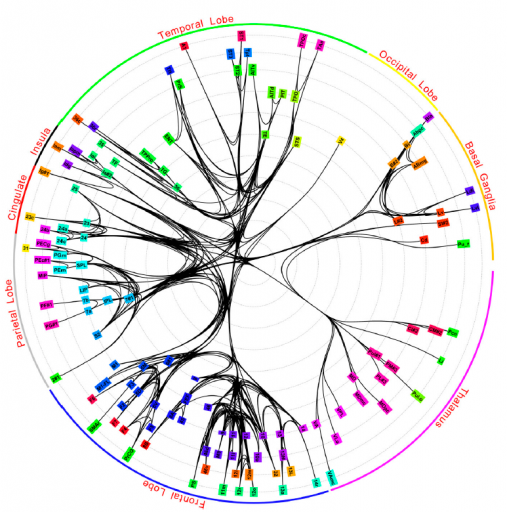
Core subnetwork (PNAS)
Older people with robust brain “wiring” — nerve fibers that connect different, distant brain areas — can process information quickly and that this makes them generally smarter, University of Edinburgh research suggests.
According to the findings, joining distant parts of the brain together with better wiring improves mental performance, suggesting that intelligence is not found in a single part of the brain.
However a loss of condition of this wiring or “white matter” — the billions of nerve fibers that transmit signals around the brain — can negatively affect our intelligence by altering these networks and slowing down our processing speed. The research shows for the first time that the deterioration of white matter with age is likely to be a significant cause of age-related cognitive decline.
The research team used three different brain imaging techniques in compiling the results, including two that have never been used before in the study of intelligence. These techniques measure the amount of water in brain tissue, indicate structural loss in the brain, and show how well the nerve fibers are insulated.
The researchers examined scans and results of thinking and reaction time tests from 420 people in the Lothian Birth Cohort of 1936, a group of nearly 1100 people whose intelligence & general health have been tracked since they were 11.
The research was part of the Disconnected Mind Project, a large study of the causes of people’s differences in cognitive aging, led by Professor Ian Deary and funded by Age UK.
“Our results suggest a first plausible way how brain structure differences lead to higher intelligence,” Study author Doctor Lars Penke said. “The results are exciting for our understanding of human intelligence differences at all ages. They also suggest a clear target for seeking treatment for mental difficulties, be they pathological or age-related. That the brain’s nerve connections tend to stay the same throughout the brain means we can now look at factors that affect the overall condition of the brain, like its bloody supply.”
Professor Deary said that uncovering the secrets of good thinking skills in old age is a high priority. “The research team is now looking at what keeps the brain’s connections healthy. We value our thinking skills, and research should address how we might retain them or slow their decline with age.”
Doctor Mark Bastin, who co-authored the study, said “These findings are exciting as they show how quantitative brain imaging can provide novel insights into the links between brain structure and cognitive ability. This is a key research area given the importance of identifying strategies for retaining good mental ability into older age.”
Professor James Goodwin, Head of Research at Age UK, said: “This research is very exciting as it could have a real impact on tackling mental decline in later life, including dementia. With new understanding on how the brain functions we can work out why mental faculties decline with age in some people and not others and look at what can be done to improve our minds’ chances of ageing better.”
Ref.: L Penke, S Muñoz Maniega, M E Bastin, M C Valdés Hernández, C Murray, N A Royle, J M Starr, J M Wardlaw, I J Deary, Brain white matter tract integrity as a neural foundation for general intelligence, Molecular Psychiatry, 2012, DOI: 10.1038/mp.2012.66
Comments (6)
by Phil Osborn
Sounds like ToastMasters should be right up there. The challenges of putting on a talk or presentation or being called with no notice at all to stand and deliver a one-minute speech on a random subject must have some influence on the brain. Plus, it’s really fun (or really scary, your mileage may vary), and fun stuff is known to be generally healthy. It also suggests brain exercises that require coordinating different areas of the brain, such as reciting poetry or singing or working through a differential equation while having sex or dancing. There was actually something in the news about some new fad called “dance-walking.” Of course, going overboard might bring experiences of quite another bent, involving big guys in white jackets. And, there is also the fact that the man who invented LSD for Sandoz lived to be about 100 years old, as I recall, only dying recently, and after ingesting hundreds of doses of LSD, which should have driven him insane, if the authorities are to be believed, but instead he appeared to be quite together and lucid, right up to the end. Perhaps more investigation into the ’60′s favorites for consciousness expansion is due?
by Vin
We are both younger than Kurzweil :D. Also perhaps wits can be ‘recovered’ in future. Didn’t De Grey say its likely the first 1000 yr old was 60 in 2009?
by Stuart
I wonder if there is any indication that such connections can be built during a person’s early years through the right type of education. And then, what kind of education techniques would be most effective. And finally, how could we get schools to adopt such changes give the usual institutional inertia.
by Luigi Cappel
This is very interesting and perhaps it is outside of the scope of this piece of research, but would have liked to see some mention of recovery and reconnection of those brain areas. I understand many studies have shown that it is possible to reconnect and reintegrate segments of the brain and increase dendrite connections for those who perhaps haven’t been using them as much as they could. Also using left right brain activities such as music, sport etc.
by Phil Osborn
One of my first thoughts on reading the article was that if you inserted grids of passive connectors at points around the brain, you would be creating an overlay of “small world” networks. The existing brain structures could ignore it, perhaps, or work around it but whatever random paths were generated might also give a competitive advantage to the evolution of particular lucky integrations, shortening the number and length of connections. I know that I have certain words stored in places I can’t reach – at all, I suspect in some cases. In other cases, I have to hold a pointer in conscious memory, consisting of an image or data object, until I can dredge up the intermediate connections. Typically, only by first substituting another word – unrelated but with a similar sound – can I trigger the path to the word I want. And its always the same word path, but in even the next few seconds I can’t simply retrieve the word on its own. I still have to retrace that arbitrary connection route to get to it.
If the grids went a step further to an actual internal neural net, with a reward switch of some type that the person could use to reinforce good new connections, then the result could be a new kind of mental filing system.
by Gorden Russell
This article is all about what I really want to hear about. I am 60 years old and really want to keep my wits about me long enough to see the singularity. The year 2046 seems so far away.