When is the ideal time to study the early universe?
May 24, 2012
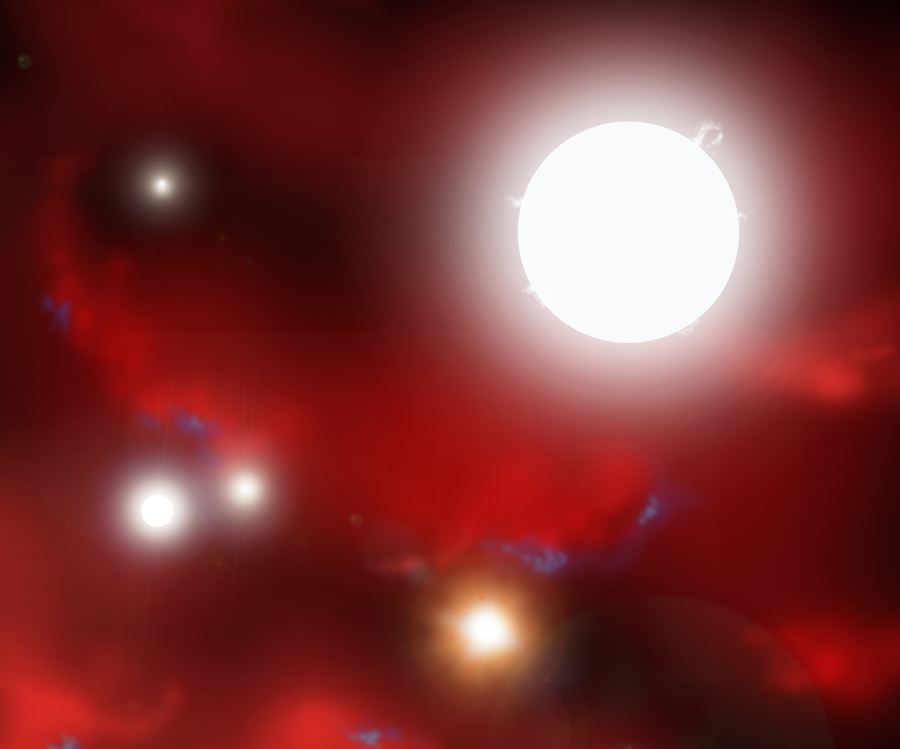
The ideal time to study the cosmos was more than 13 billion years ago, just about 500 million years after the Big Bang -- the era (shown in this artist's conception) when the first stars and galaxies began to form (credit: Harvard-Smithsonian Center for Astrophysics)
New calculations by Harvard theorist Avi Loeb show that the ideal time to study the cosmos was more than 13 billion years ago, just about 500 million years after the Big Bang — the era when the first stars and galaxies began to form.
The farther into the future you go from that time, the more information you lose about the early universe, he says.
However, modern observers can still access this nascent era from a distance by using surveys designed to detect 21-cm radio emission from hydrogen gas at those early times, Loeb says.
These radio waves take more than 13 billion years to reach us, so we can still see how the universe looked early on. “By observing hydrogen at large distances, we can map how matter was distributed at the early times of interest,” he said.
“I’m glad to be a cosmologist at a cosmic time when we can still recover some of the clues about how the universe started.”
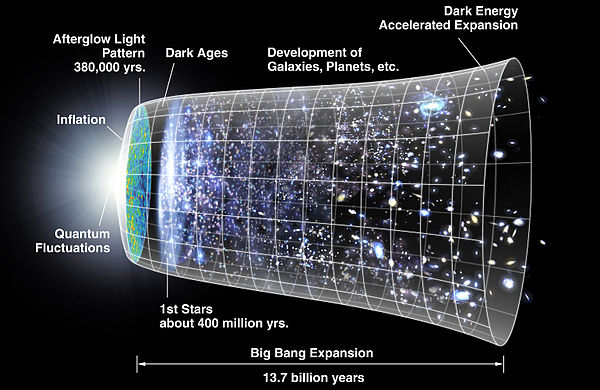
The universe is a marvelously complex place, filled with galaxies and larger-scale structures that have evolved over its 13.7-billion-year history (credit: Wikipedia Creative Commons)
Two competing processes define the best time to observe the cosmos.
- In the young universe the cosmic horizon is closer to you, so you see less. As the universe ages, you can see more of it because there’s been time for light from more distant regions to travel to you.
- However, in the older and more evolved universe, matter has collapsed to make gravitationally bound objects. This “muddies the waters” of the cosmic pond, because you lose memory of initial conditions on small scales. The two effects counter each other — the first grows better as the second grows worse.
The accelerating universe makes the picture bleak for future cosmologists. Because the expansion of the cosmos is accelerating, galaxies are being pushed beyond our horizon. Light that leaves those distant galaxies will never reach Earth in the far future.
In addition, the scale of gravitationally unbound structures is growing larger and larger. Eventually they, too, will stretch beyond our horizon. Some time between 10 and 100 times the universe’s current age, cosmologists will no longer be able to observe them.
“If we want to learn about the very early universe, we’d better look now before it is too late!” Loeb said.
Ref.: Abraham Loeb, The Optimal Cosmic Epoch for Precision Cosmology, arXiv:1203.2622v2