Whole-genome sequences of supercentenarians reveal longevity clues
April 11, 2012
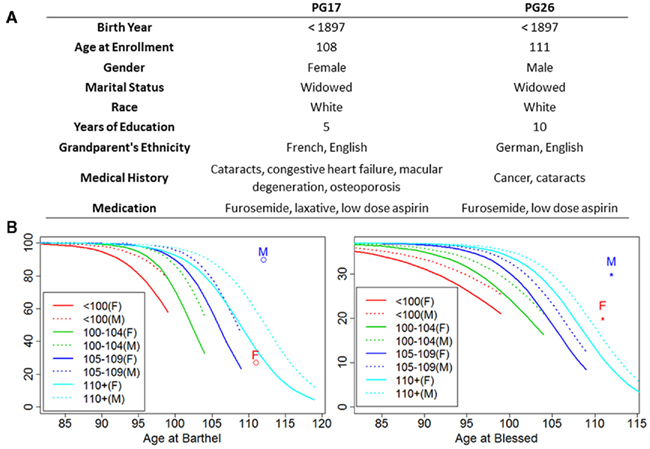
Summary of patients’ characteristics (credit: Paola Sebastiani et al./Front. Gene.)
A team of researchers has analyzed the complete genomic sequences of male and female supercentenarians, both over 114 years old.
Surprisingly, the researchers showed that the DNA sequences are largely comparable to existing non-supercentenarian genomes, and the two individuals do not appear to carry most of the well-established human longevity-enabling variants already reported in the literature.
In fact, the supercentenarians have a comparable number of known disease-associated variants relative to most human genomes sequenced to-date. However, approximately 1% of the variants these individuals possess are novel and may point to new genes involved in exceptional longevity.
“The analyses suggest that there are both common and rare longevity-associated variants that may counter the effects of disease-predisposing variants and extend lifespan,” say the researchers. “The continued analysis of the genomes of these and other rare individuals who have survived to extremely old ages should provide insight into the processes that contribute to the maintenance of health during extreme aging.”
Supercentenarians (age 110+ years old) generally delay or escape age-related diseases and disability well beyond the age of 100 and this exceptional survival is likely to be influenced by a genetic predisposition that includes both common and rare genetic variants.
Human aging is affected by genes, life style, and environmental factors, the researchers point out. The genetic contribution to average human aging can be modest, with genes explaining about 20 to 25% of the variability of human survival to the mid-eighties. But genetic factors may have greater impact on survival to the ninth through eleventh decades. Notably, exceptional longevity is rare and may involve biological mechanisms that differ from those implicated in usual human aging.
“Exceptional longevity is typically characterized by strong familiality, as well as a marked delay in disability. Studies of centenarians have provided strong evidence to support the hypothesis that a genetic contribution to human exceptional longevity is decisive, although only a small number of genetic variants with modest effects have been irrefutably linked to this phenotype. The technology of next generation sequencing provides a tool to generate data that may eventually provide an answer..
“Although these data cannot provide conclusive evidence about the genetic determination of human exceptional longevity, they are the first step toward the generation of a comprehensive reference panel of exceptionally long-lived individuals,” the report says. “The data also provide interesting insights into genetic backgrounds that are conducive to exceptional longevity and allow us to test different models of exceptional longevity.”
Ref.: Paola Sebastiani et al., Whole genome sequences of a male and female supercentenarian, ages greater than 114 years, Front. Gene., 2012 [DOI: 10.3389/fgene.2011.00090] (open access)