Why Google’s self-driving car may save lives — if all cars are computer-driven
May 11, 2012 | Source: CNN Money
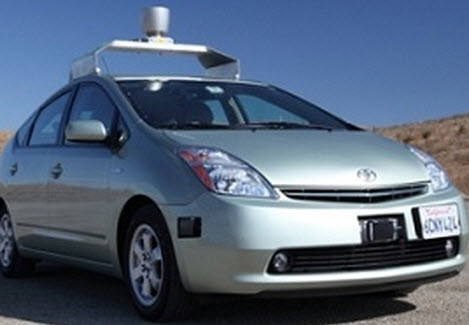
The technology behind Google’s self-driving car represents a potential leap forward in auto safety.
More than 30,000 people are killed each year in crashes despite huge advances in auto safety. The overwhelming majority of those crashes are caused by human-driver error.
Computer driven cars could reduce traffic deaths by a very significant degree, said David Champion, head of auto testing at Consumer Reports, but only if all cars are computer-driven.
“I think if all the cars were self-driving, it would be a benefit,” he said. “I think a mixture would be a bit chaotic.” That’s because humans are better at predicting the behavior of other humans than computers could ever be, he said.
“When I’m approaching an intersection, I look to see of the other driver is looking at me,” said Champion. “If he’s looking somewhere else and inching forward, I’m going to lift off the gas.”
Google’s cars, modified Toyota Priuses, are still in the testing stages and aren’t available to the public. But some so-called “driver assistance” technologies are already helping to lower traffic deaths in cars you can buy now. For example, Electronic Stability Control, which uses computers to help drivers maintain control during abrupt maneuvers, has been shown to reduce fatal crashes by as much as a third.
V2V is already in advanced stages of development by a consortium of automakers and the federal government’s National Highway Traffic Safety Administration.

Comments (24)
by Michael Janno
Adoption of this may lead to much higher accident rates. I would not want to be early adopter.
by Cam
I’m not sure why people are talking about insurance, and ownership. Perhaps ownership of the vehicle would be a thing of the past. Essentially they would just be driverless taxis. Way less cars required would also mean more lanes available in cities etc (cars could park themeselves in much tighter and not have to allow for specific vehicles to be retrieved).
by Bruce Wright
Although younger drivers might be the earliest adopters, once these are proven to be safe I wouldn’t be so sure that you’d see that much resistance from older drivers. Many elderly people today find themselves practically house or apartment bound, not because their health is too poor for them to go places, but because they no longer have good enough eyesight and reaction time to be safe driving on the highways and in many locations mass transit is not an option. I think there might in fact be great interest in such a thing from that segment of the population, though I grant that most of them are unlikely to be early adopters.
by Brian Roberts
Black boxes in cars, next gen with kill switch, and all the software to monitor you in your driverless car, and every road monitored and camera up like the U.K. Yeah, I’ll take the horse and buggy.
by codesimian
Of course its true that forcing all cars to be computer driven would eventually save lifes (when the technology is improved) for the same reason banning all manual use of computers would prevent hacking.
by Trismegistus
I think some of you are much too pessimistic.
How do you think people reacted when the car began replace horses and wagons? Many were terrified (maybe rightfully so), but the convenience of fast automobile transportation quickly overcame the old demand for horse-drawn transport.
Self-driving cars will have an early-adopter market on par with other “niche” cars like hybrids. When others begin to see the convenience and safety of these vehicles, their fears will be assuaged. The market share of self driving cars will grow signficantly, especially with younger generations.
by Dennis R.
There will be a lot of resistance to change. (How many people still don’t wear seat belts?) Fear won’t be the only impediment. Most people won’t be able to afford to switch right away. Some will probably try to mess with the system by driving their manual vehicle against traffic, just to see the self-driving cars attempt to deal with a logical error. And any sort of failure of a self-driving vehicle will undoubtedly be trumpeted by an increasingly alarmist media.
Any idea what will happen to motorcycles, mopeds and bicycles that currently share the road? How will their presence affect the self-driven vehicles? When will mass-transit (mostly buses in larger municipalities) be part of the transition?
I believe this particular element of the future will take a while to get here– which is kind of a shame.
by John Doe
Resistance is futile. If the USA were to somehow reject the idea of driverless cars, then the economic impact would be catastrophic. Other countries will adopt this technology, and when they do, they won’t be losing the 1% of GNP that is currently lost to traffic congestion, and they won’t be losing the additional 1% of GNP that is currently lost to road traffic accidents. This doesn’t even look at the immense efficiencies of having a workforce that will effectively gain an additional hour a day through not having to spend their commute time concentrating on driving.
The most startling reaction I’ve seen is from the so called “Oracle” Warren Buffett who says he wouldn’t invest because he thinks people would not trust machines to drive for them. I think this quote will be one of those quotes we look back on in mirth, like when Scientific American, in 1909, stated “That the automobile has practically reached the limit of its development is suggested by the fact that during the past year no improvements of a radical nature have been introduced.”
The future’s driverless, whether we like it or not.
by Dennis R.
Warren Buffett may be right, at least in the short term. And since Warren is in his eighties, a short-term mindset is probably appropriate…
by Thomas Jensen
I think there’s going to be considerable resitance to the implementation of driverless cars, simply because there’s a huge industry based on car accidents, like auto repair shops, lawyers, etc.
by Tim
If cars become self driving and truly that great then there would be no need for car insurance. But you KNOW that ain’t gonna happen.
by dave
Myopic, nonsensical opinion from an “expert auto tester” … thanks.
As an “expert auto tester” Mr. Champion knows that accidents more often occur at intersections… which for the computer-driven vehicle is one of the easiest-to-manage scenarios thanks to signage, signals, and the like. Proximity detection between vehicles (whether RFID, Wi-Fi, what-have-you) and all vehicles will broadcast their own locations, even if they don’t read (think “smart” license plate attached to dumb vehicle).
It is so obvious (to me at least) that future generations will look with pity on us, who lived through the “bloody highway” epoch.
by GatorALLin
….I think they could sell this idea faster if you knew you could now finish your texting and emails on the way to work now (legally and safely).
by Trismegistus
When driverless cars hit the road they will need to create a new 6-star safety rating just for them.
by Lord Penguin
If all cars were computer driven, wouldn’t a much faster speed limit be feasible?
by Dennis R.
Will self-driving cars eliminate the driver’s seat? How about the steering wheel? Rear-view mirrors? Headlights and brake lights? Windshield wipers? Windshields? Will seats still face forward, or would rear-facing seats be better? Would we need airbags? If seats were rear-facing, couldn’t the seats be airbags (always inflated)? Would we need to sit? Could we lie down or stand upright?
How fast can self-driving cars go? Wouldn’t faster cars reduce travel time and leave fewer cars on the road? Wouldn’t faster cars mean fewer trips by air? Fewer TSA pat-downs would also save travelers time at the airport, right?
Time spent driving cars is pretty much wasted unless you can multi-task effectively (you probably can’t) or unless you’re one of those people who still enjoys driving. Automation that eliminates mindless-repetitive tasks is what we’re aiming for in much of our lives and work, isn’t it? I like the idea of never having to drive myself anywhere again yet still be able to travel where I want at my convenience. And while I can see the benefits of self-driving cars I’d like the powers that be to re-imagine what a self-driving vehicle would really require.
by BraMechanic
Reminds me of the Irish joke…the country was going to switch from driving on the left to driving on the right side of the roadway. However, they planned to switch in phases. The first weekend they were going to move the trucks…
by hage
I’m confident that a fast enough computer will be much safer any human driver, even if not all cars are self-driving.
A computer can have a 360 degrees high resolution view of the world. It can react within a hundreth of a second and it can control the car with a precision we will never have. It won’t get visually impaired or drunk, it can see in the dark and it will be able to calculate velocity, acceleration and inertia of all moving objects so it can predict what will happen in the next few seconds.
It doesn’t matter that human can understand the other driver better in an intersection. The speed in those situations is so slow there is no risk for any serious accidents anyway.
by ondigo
I also predict the greatest impediment to the adoption of self-driving cars will be lawyers abetted by politicians.
by tim the realist
this will be no different that what happens now if a self parking car has an accident, or a car set on cruise control crashes. it’s just a better and better cruise control.
by ondigo
I recall hearing a radio news piece (or perhaps reading an article) about a study/simulation performed in one of the southern California universities which showed that if only 15% of cars were self-driving, then traffic jams could be almost completely eliminated. While I don’t recall if traffic fatalities were included in that study, I can’t help but think that we don’t have to get to the point where all cars are self-driving to see a substantial reduction in deaths.
by Ron Abate
Perhaps our super highways can be modified to have a lane specifically for driverless cars where the speed limit can not be exceeded. Drivers selecting this option would be required to enter their destination before entering the highway. Also, they should have the option to enter regular lanes at designated exit points.
by Singme
Think about your insurance rate after this has proven to be safe. It should go to near zero.
by Spencer
ALL CARS WILL BE CYBERMEN!