Why immersive virtual reality is the next generation of gaming: part 1
July 14, 2012 by James Iliff
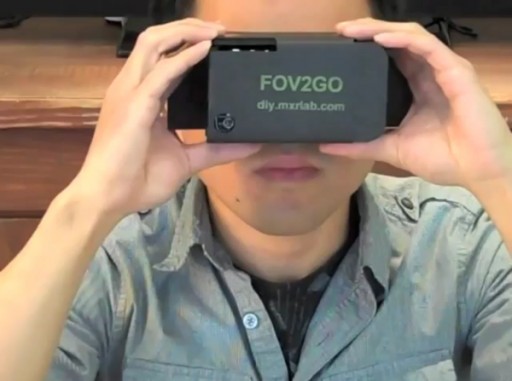
FOV2GO (credit: USC/MxR)
It’s now obvious that immersive virtual reality is finally back in the consumer market — with a vengeance.
Especially with the recent advent of FOV2GO, a free DIY portable fold-out iPhone and Android viewer that turns the smartphone screen into a 3-D VR system.
You can create one with foamboard and 2 cheap plastic lenses, and downloadable software lets you create your own virtual worlds or environments to display.
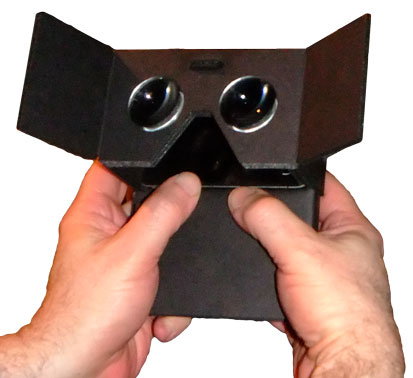
FOV2GO for iPhone (credit: USC/MxR)
(There’s also an iPad3 version.)
What made this possible: high-resolution screens and built-in gyroscopes. The retina display on the iPhone 4, for instance, provides 960×640 DVGA high resolution on a compact screen.
That means we can now construct ultra-lightweight VR head-mounted displays. The gyroscope lets the device track your head movement so you can look around in real time.
FOV2Go is actually a hardware and software kit for the creation of immersive virtual reality experiences using smartphones, tablets, and other mobile devices. More info here.
At the Maker Faire showcase of FOV2GO in May, we showed off a few apps such as Tales from the Minus Lab and Shayd Mobile, both running in the Unity3D game engine with custom C# scripts to create the side-by-side in-game camera.

Harness the power to freely shrink and grow as you explore the uncharted worlds and solve environmental physics puzzles… (credit: USC Games)
I created a Mobile version of the Shayd Virtual Reality installation. While the full installation of Shayd encompasses an entire motion capture stage and wide-FOV head-mounted display, Shayd Mobile is much simpler, utilizing the FOV2GO stereoscopic Unity package developed by Perry Hoberman.
The game could also play on an iPad 3 with very large stereoscopic lenses, allowing for a tasty field-of-view approaching 130 degrees.
Considering that the human eye sees at about 180 degrees, this was pretty realistic! You start out walking around with a flashlight in a dark office, looking for a light switch. Using other inputs on the iPad, you can click on letters on the desk and read them by lantern, or use your flashlight. Eventually you can pull out your gun and fire bullets!
The epicenter for FOV2GO (and other cool projects, including motion capture with the Kinect) is the Mixed Reality Lab (MxR), part of the Institute for Creative Technologies at the University of Southern California (USC).
But there’s something coming that’s even cooler. Much cooler.
People have always been dreaming about virtual reality since Neuromancer and Snow Crash, and in the late 90’s it really captured the public imagination. VR companies were popping up left and right, but the technology wasn’t quite there yet, and the industry crashed and burned around the same time as the dotcom bubble.
Now that it’s experiencing a resurgence fifteen years later, a ton of pseudo-VR devices are coming out that don’t really make any sense.
There’s been a ton of tinkering with controllers, motion devices, stereoscopy, and the like to make gaming a bit more interesting. Microsoft, Sony, and Nintendo have all developed devices that encourage players to get off the couch and into the action. Like the Kinect, the Playstation Move, the Wiimote, the Razer Hydra for PC, and most recently, the Wii U.
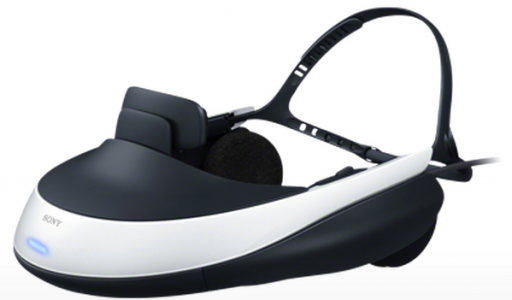
Nice try, no cigar (credit: Sony)
Sony, Vuzix, Senics, and NVIZ are all trying to push towards the consumer market, but their HMDs (head-mounted displays) — like the Sony HMZ-T1 and the Vuzix WRAP 920 — are either too expensive or too low-quality, and they have a narrow field-of-view, so you have no sense of peripheral vision.
There’s also no built-in gyroscope or head-tracking, so even if you did play a game with it, you couldn’t move your head around in the virtual environment.
These consumer HMDs feel like a floating television that you are looking at from 5 feet away. So it’s not sparking any real innovation in the games industry, or first-person shooters. Besides, if it looks just like a TV, why not just watch a TV?

Immersive virtual reality hardware
But I found something at the recent E3 Expo 2012 that I’ve been evangelizing since I was a kid. That I know in my heart of hearts is the future — the immediate future — of gaming.
Immersive virtual reality hardware — with real HMDs — has finally arrived. And it’s about to make a huge splash in the first-person shooter hardcore gaming niche.
More in my next post….
Comments (17)
by Tom Piazza
Can’t wait for part 2. The Oculus Rift is a really promising step in that direction. I feel like this greedy tendency of the consumer console market to slowly role out improvements, and new generations, of products is not a true indication of how capable we are to have this technology in the consumers hands at this very moment.
by vinny
i think bendable display will be perfect for a wrap around display
by Phillfrog
If you would like to see the 3D effect in the first video,, but don’t have a FOV2GO, simply place your hand as if you were karate chopping the video in half and put your face up to your hand. You’ll also look about as silly as using a FOV2GO, but this way you can look silly for free! :)
by Cybernettr
Wow, technology is moving soooo fast, I’m already having a hard time keeping up with it! I vaguely knew the current iPhones/iPod touches/iPads had built-in gyroscopes, but the gravity of that never really sunk in. I mean, isn’t a gyroscope a kind of spinning top, and how could that be in something as small and flat as an iPhone? Well, it turns out that it uses a special gyroscope called a microelectromechanical system (MEMS) that integrates electronic and mechanical components at a very small scale. Whether this will provide very effective VR with a fold-out viewer I don’t know, but it’s pretty amazing. You can read more about MEMS here: http://www.ifixit.com/Teardown/iPhone-4-Gyroscope-Teardown/3156/1
by xaviergalax
I think, its quite difficult to achieve stereographic display on games, but t will be great features if it will work.
by Giant Robo
actually its easy. i make video games for a living and realized immediately how I could implement this into my work… i won’t go into the details here but trust me its no problem!
very cool tech. i see something like this taking off big… someday at least.
by Matthew Fuller
Right right, as he said, “pseudo vr situation”.
by Editor
CORRECTION: Shayd Mobile was developed by James Illiff, not Perry Hoberman, who developed the FOV2GO stereoscopic Unity package (my error).
by Matthew Fuller
Wow, you really are at the edge of where VR game design may go. How do you think VR will effect game design and being engaged with the action and story of the game? What will change with current design, that just won’t work in a VR world? Also, do you think many great games will become modded to work with VR? There are HD remakes of some old school games, but they are pretty rare. How much work is needed to get a game like Assasin’s creed: brotherhood to work in VR for the occulus rift?
I hope there is a part 3!
Thanks for the info.
by James Iliff
Hey Matthew! These are some great questions. I think VR games will eliminate most non-diegetic content, such as cutscenes, HUDs, interfaces, and anything that isn’t directly part of the game world itself. VR as a medium tends to immerse you in a sense of presence – so everything that enhances your feeling of presence will change game design significantly. A lot of great first-person shooters are being modded for VR, but I doubt anything other than a first-person experience could work. Check out my other article on this exact topic, let me know what you think: http://www.jamesiliff.com/level-design-for-head-mounted-displays-mood-atmosphere-and-narrative-architecture-in-virtual-environments
by James Iliff
Hi andivar!
Thanks for the comment! It is fascinating how AR is also making great strides alongside VR, with robust AR experiences now becoming available on smart devices such as Android phones and iPads.
While it is currently possible to fight monsters and see non-player characters overlaid with the real world, it isn’t quite yet possible to augment actual people (with new clothes, styles, genres, etc). This is mostly because an external device is required to track individual people, such as a motion capture stage (optical tracking) which can get kind of expensive :/
Without positional tracking of the body, the game doesn’t know where people are, or how to put clothes on them. However the Kinect can work as a very simple optical tracking device and accomplish a lot of cool effects, like giving players weapons in an AR experience:
http://www.rockpapershotgun.com/2010/11/23/your-daily-kinect-hack-a-laser-sword/
The Matrix is the ultimate dream, and its not as far away as one would think! The VR industry is expanding rapidly, we are truly in the middle of a revolution. I look forward to hearing your thoughts on the next article :)
Cheers, -James
by Gabriel Kent
I plan on purchasing a siliconmicrodisplay ST0180 HMD.
Despite the lack of head tracking, I see many uses. For me, I am very interested in doing my work from a zero gravity chair so that I can be more comfortable. I will also be using it on my treadmill which should be pretty great.
Gaming also becomes more immersive because the virtual screen is 100 inches at 10 feet away.
According to the reviews I have read, the ST1080 beats out competitors and seems to be the first viable HMD.
by James Iliff
ST0180 sounds like a great product for your purposes.
by Matt
Hi Gabriel,
Did you try the ST1080 for this? I would like an HMD for pretty much the exact same use case. Hopefully you get emails when someone replies to your post on this forum
by andivar
Interesting stuff. I’ve been thinking it could be fun to use AR for more advanced LARPing (Live Action Roleplaying) to create a pseudo VR situation. LARP never interested me before, even with friends that love it, but if I could have a device that overlays the real world and allows me to see other players with clothing and items related to the world set and possilbly using whatever powers are available in the game as well as seeing creatures and monsters popping up in the real world that would be sort of cool. Would also probably be a good way to get us up and moving around, though it would be odd seeing people running around play acting and reacting to things that others don’t see.
On the VR front, any development is good since its been languishing for so long. A matrix type situation is still my ultimate dream but any advancement is good. I’m interested in seeing what you reveal in part 2.
by Matthew Fuller
yeah that does sound cool. But that sounds like AR, not VR. None the less, it would be very cool if AR could make us more engaged in general (at home, school, work) to make a game out of anything. Or at least more events and tasks, and problems too.
by Editor
As I understand it, the FOV2GO is actually a combination of AR and VR. VR requires 3D immersion in a virtual world, which requires stereographic display and the ability to move around in the world via head tracking, which is achieved with the iPhone’s (or other other smartphones’) gyroscope.