World’s fastest camera detects rogue cancer cells in real time
July 7, 2012
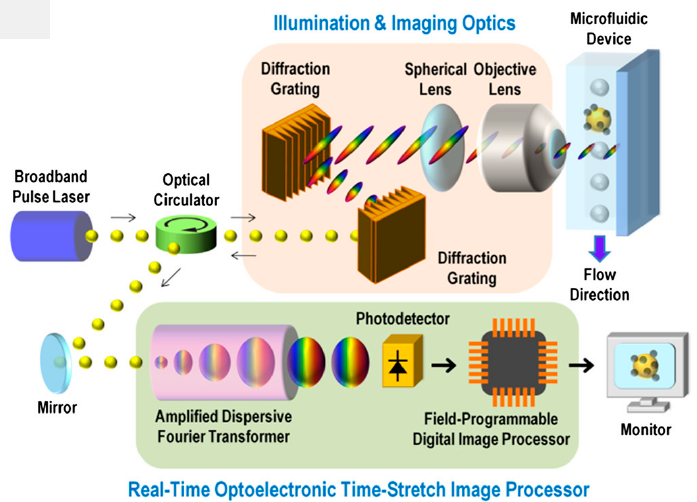
Schematic of the STEAM flow analyzer, which highlights the optical layout of the STEAM camera and real-time optoelectronic time-stretch image processor. The STEAM camera takes blur-free images of fast-flowing particles in the microfluidic device. The acquired images are optoelectronically processed and screened in the real-time optoelectronic time-stretch image processor. (Credit: Keisuke Goda et al./Proceedings of the National Academy of Sciences)
A new optical microscope developed by UCLA engineers could make it easier to distinguish and isolate rare cells from among a large population of assorted cells for early detection of disease and for monitoring disease treatments.
“To catch these elusive cells, the camera must be able to capture and digitally process millions of images continuously at a very high frame rate [36.7 MHz],” said Bahram Jalali, who holds the Northrop Grumman Endowed Opto-Electronic Chair in Electrical Engineering at the UCLA Henry Samueli School of Engineering and Applied Science. “Conventional CCD and CMOS cameras are not fast and sensitive enough. It takes time to read the data from the array of pixels, and they become less sensitive to light at high speed.”
The current flow-cytometry method has high throughput, but since it relies on single-point light scattering, as opposed to taking a picture, it is not sensitive enough to detect very rare cell types, such as those present in early-stage or pre-metastasis cancer patients.
Typically, there are only a handful of circulating cancer tumor cells among a billion healthy cells, yet they are precursors to metastasis, the spread of cancer that causes about 90 percent of cancer mortalities. Such “rogue” cells are not limited to cancer — they also include stem cells used for regenerative medicine and other cell types.
High-throughput flow-through optical microscope
To overcome these limitations, an interdisciplinary team of researchers led by Jalali and Dino Di Carlo, a UCLA associate professor of bioengineering, with expertise in optics and high-speed electronics, microfluidics, and biotechnology, has developed a high-throughput flow-through optical microscope with the ability to detect rare cells with sensitivity of one part per million in real time.
This technology builds on the photonic time-stretch camera technologycreated by Jalali’s team in 2009 to produce the world’s fastest continuous-running camera. The camera shutter speed is 27 picoseconds.
Jalali, Di Carlo and their colleagues integrated this camera with advanced microfluidics and real-time image processing to classify cells in blood samples. The new blood-screening technology boasts a throughput of 100,000 cells per second, approximately 100 times higher than conventional imaging-based blood analyzers.
Their research demonstrates real-time identification of rare breast cancer cells in blood with a record low false-positive rate of one cell in a million. Preliminary results indicate that this new technology has the potential to quickly enable the detection of rare circulating tumor cells from a large volume of blood, opening the way for statistically accurate early detection of cancer and for monitoring the efficiency of drug and radiation therapy.
“This technology can significantly reduce errors and costs in medical diagnosis, and has potential applications in urine analysis, water quality monitoring and related applications,” said lead author Keisuke Goda, a UCLA program manager in electrical engineering and bioengineering.
The study was funded by the U.S. Congressionally Directed Medical Research Programs (CDMRP) and by NantWorks LLC and the Burroughs Wellcome Fund.