World’s largest offshore wind farm generates first power
November 2, 2012
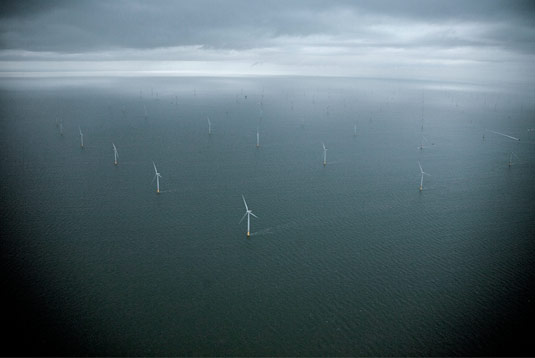
World’s largest offshore windfarm (credit: London Array Offshore Wind Farm)
The first power has been produced at the London Array Offshore Wind Farm, DONG Energy, E.ON and Masdar have announced .
The 630MW scheme, located in the Thames Estuary, will be the world’s largest offshore wind farm, with construction on schedule to be finished by the end of the year.
The 175 turbines will produce enough power to supply over 470,000 UK homes with electricity.
London Array is being built about 20km off the coasts of Kent and Essex. The wind farm will be installed on a 245 square kilometers site and will be built in two phases. Phase One will include 175 turbines with a combined capacity of 630MW. If approved, the second phase will add enough capacity to bring the total to 870MW.
Comments (14)
by Rob C
All energies come at a cost, especially in their early development stages. The advantage to renewable clean energies is the ability to gather power without depleting other natural resources and progressing those technologies further to become more efficient and more cost effective.
Even if it took 20 years to pay for itself one can bet within 10 years the technology will have improved to the point where it can be supplemented or altered to increase efficiency. Meanwhile things like oil and gasoline continue to take more to create less. It takes on average 2-3 gallons of gasoline to produce the 1 gallon people use when they fill up their tanks.
by GatorALLin
Can anyone estimate the cost, plus the upkeep costs and then divide out how much power it makes (related to costs). I just want to know how many years this wind system takes to pay for itself?? How many years down the road will it take to turn a profit (don’t count free money please).
by Renzo Canepari
I have an old Christian Science Monitor article about abandoned off shore oil platforms in the Gulf of Mexico that act as artificial reefs for barnacles, and the resultant barnacle habitat starts a food chain that then produces better fishing. I hope that the same thing will happen here. The sale of the fish/seafood would reduce the cost of the electricity.
by Sea Bass
It is true, even more so. The Gulf rigs are massive ecosystems supporting top chain predators and tons of life. Over time, these new structures would do the same, no doubt!
by Craig
I assume it produces a peak of 630MW so average will be lower, say 200MW (making this up) x 24 hours = 4,800MWhrs per day/470,000 homes would be roughly, 10kwh per day, does this sound right?
by Vin
yah, I agree with this estimate too.
by Tom Moriarty
Plus the offshore farm will produce some electricity 7/24. I am sure that the developers have done their homework on that. England is not a sunny place for 200+ days a year.
by Vin
Forgive any silly mistakes or naivete, but 630/470~1.4 , so is this article informing me a house in UK uses on average 1.4 KW of power (so i guess for say 10 hour daily use its 14 KWh worth of energy?). That’s quite interesting, they could generate that by using a private 2KW solar system, that costs about 5 grand each? (so about £2.5 billion for 470,000 houses) Hmm, I wonder how much phase one of this scheme cost?
by Gorden Russell
You forget that England is famous for its rain. You will get more wind than sun in the Thames Estuary.
by Richard Kessinger
The best long term alternative is to get really creative in ways to reduce all forms of electricity consumption per person. We are spending too much time and effort and money on the supply side rather than the demand side. Do we really need 300 to 500 electronic devices and systems in every home and office in the entire world?
by Vin
Yes good point. Still, even if solar is less productive, as long as its productive enough (2kw on average is or ‘soon will be’ achievable virtually anywhere?). And another advantage, it can be sourced, controlled and customised locally and probably a bit more convenient than moving-part local turbines too. Disclaimer: i do not sell solar panel systems :D
by personX
well.. except the sun doesn’t really shine in the UK.
by Bill Woods
The London Array (phase 1) is supposed to have cost about £1.7B, and expected produce about 2.1 TW-h per year (an average power of about 240 MW). Divided by 470k, that’s 4480 kW-h per year = 12 kW-h per day. In Britain, a 2 kW solar array would probably average about 5 kW-h per day.
by Vin
cool. Thanks Bill.