X-51A WaveRider expected to fly at 3,600 mph in key test Tuesday
August 14, 2012
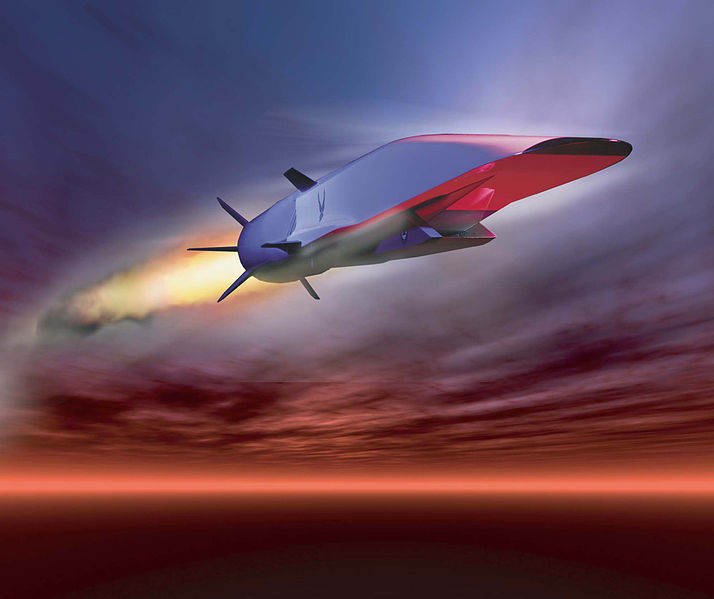
The unmanned experimental aircraft X-51A WaveRider is expected to fly above the Pacific Ocean near Point Mugu at Mach 6 — at 3,600 mph — for 300 seconds Tuesday, Los Angeles Times reports.
A passenger aircraft traveling at that speed could fly from Los Angeles to New York in 46 minutes.
Aerospace engineers say that harnessing technology capable of sustaining hypersonic speeds is crucial to the next generation of missiles, military aircraft, spacecraft — and even passenger planes. The cruiser’s scramjet engine has virtually no moving parts.
The Pentagon believes that hypersonic missiles are the best way to hit a target in an hour or less. The only vehicle that the military currently has in its inventory with that kind of capability is the massive, nuclear-tipped intercontinental ballistic missile.
Other means of hitting a distant target, such as cruise missiles and long-range bomber planes, can take hours to reach their destination.

Comments (10)
by Editor
The flight test failed. Here’s the USAF statement:
“The X-51A Waverider successfully launched from an Air Force B-52 bomber over Point Mugu Naval Air Warfare Center Sea Range Aug. 14 at approximately 11:36 a.m. PST.
The X-51 safely separated from the B-52 and the rocket booster fired as planned. However after 16 seconds, a fault was identified with one of the cruiser control fins. Once the X-51 separated from the rocket booster, approximately 15 seconds later, the cruiser was not able to maintain control due to the faulty control fin and was lost.
“It is unfortunate that a problem with this subsystem caused a termination before we could light the Scramjet engine,” said Charlie Brink, X-51A Program Manager for Air Force Research Laboratory. “All our data showed we had created the right conditions for engine ignition and we were very hopeful to meet our test objectives.”
Program officials will now begin the process of working through a rigorous evaluation to determine the exact cause of all factors at play.
One of the four X-51A vehicles remains. AFRL officials have not decided when or if that vehicle will fly at this time.”
by Paracelsus
would like to know the reason why my comment was not published
by SpottedMarley
so i guess rockets are called unmanned vehicles now? clever
by John
Do not forget the “huge implications for civilian passenger transport” meaning in the future you can get low budget hitchhiker rides on nuklear missiles that fly anyway. Want to visit Iran ? Just hitch a ride during a nuclear strike. That would finaly blur the line between tourists and terrorists.
by Mike
Oh yes, just in case Iraq or Pakistan build hyper-sonic fighters.
by Glen Lincoln
Good job boys!! This type of engineering is cutting edge, and now you’ve off to a very good start. You are doing work which will yield fruits for an exciting new century.
by Bri
Whoever rules the skies, rules the war. As much as computer attacks may soften a target, whacking it from above destroys it. No matter how much you pulverize it from above, you have to secure the gain territory by ground troops. Computer attacks are skirmishes that at best can disorient, disable and blind an opponent. Airstrikes are punitive and can decimate an opponents infra structure, say like Iran’s nuclear ambitions. If they declare war, they sign up to be invaded. There only other war choice would be to invade us, either by conventional means, or by gorilla or terrorist means. That would bring about a full war response from us. At this time , America is the only country capable of developing this tech, though Russia and China could steal it. Once developed, America could park an aircraft carrier in an ocean near a conflict, and almost surgically, put that country back in the stone age. The bigger the country, the harder that is to do. The next step that our military is trying to acquire is robotic foot soldiers. Dead bodies sap the political will. Whatever country contemplating war must have the will of it’s people, otherwise they lack the zeal necessary to succeed. I write these things because many people have very mixed feelings about wars. Many people fear terrorism and nuclear war. To engage in those activities on a large enough scale to have a chance at success, is more like signing a death warrant for that particular regime. Any regime using those tactics will only dabble in them. It’s posturing and bullying. The rules of warfare have changed forever. They are nothing like the rules that governed past wars. Even WWII we had dummy troops and balloon tanks threatening invasion in France. Too hard to fake or hide that kind of troop movement today.
by Jerome Morley Larson Sr EAIA
Obviously, eventually computer attacks will disable all weapons including explosives – then how the hell are we going to fight a decent war?
Maybe then we will realize that war is an admission of failure.
by Ray
Maybe a little less sabre rattling and a little more non intervention might be another way of averting war. Deterrents are one thing but when you talk about sending entire countries back to the stone age you risk losing the high ground. Peace and justice for all is not just for the USA
by Paracelsus
“To engage in those activities on a large enough scale to have a chance at success, is more like signing a death warrant for that particular regime”
That’s correct, but not new, it’s been like this for a while, its quite amazing how naive a society can be. An arab is supposed to have blasted the twin towers with 2 planes (we all know those towers have been detonated) so your president invades a country, then another country seems to have NUCLEAR WEAPONS! (which your own country has a lot of course) so you have to invade that country (no nuclear weapons there, has anyone bothered for an apologize?). Now its iran…. the only threat, well the only real one, is the US. I would have thought that after more that 10 years after september 11, and with all the information massively available, North Americans would take a step forward and stop this madness, but well seems that’s me being naive.