3D-printing human embryonic stem cells for drug testing, future replacement of human organs
February 6, 2013
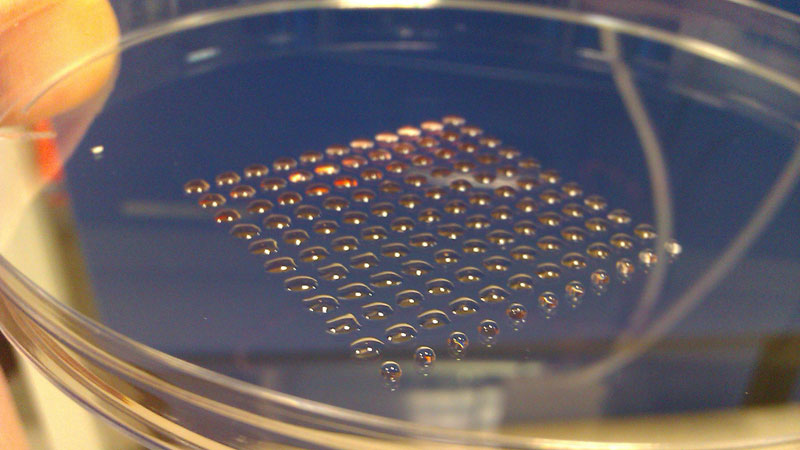
3D printing with embryonic stem cells (credit: Alan Faulkner-Jones et al./Heriot-Watt University)
A new 3D printing process using human stem cells could pave the way to custom replacement organs for patients, eliminating the need for organ donation and immune suppression, and solving the problem of transplant rejection.
The process, developed at Edinburgh-based Heriot-Watt University, in partnership with Roslin Cellab, could also speed up and improve the process of reliable, animal-free drug testing by growing three-dimensional human tissues and structures for pharmaceuticals to be tested on.
Background: printing embryonic cell cultures
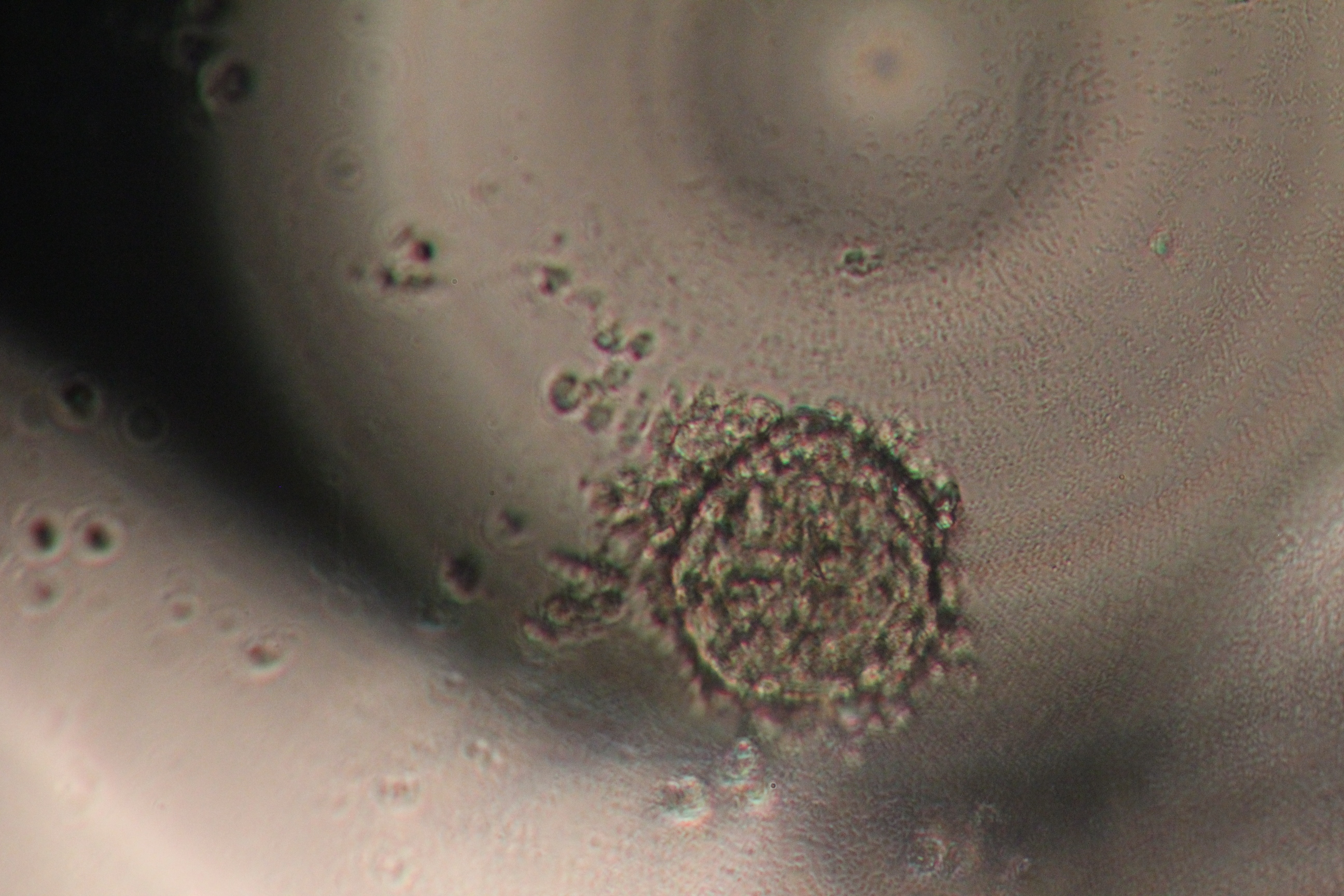
A range of stem cell cultures based on human mesenchymal stem cells (hMSCs) can already be grown in laboratory conditions.
But to preserve cell and tissue viability and functions, a key challenge has been the development of printing processes that are both controllable and less harmful, and that could also work with human embryonic stem cells (hESCs).
hESCs have a greater pluripotency (potential to generate a wide variety of differentiated cell types) than hMSCs and tissues generated would be expected to yield better models of human biology than those using mESCs as precursors.
A kinder, gentler printer
The new techniques developed by Dr. Will Shu and his colleagues at Heriot-Watt’s Biomedical Microengineering group are the first to print the more delicate hESCs. Using a controllable valve system, the printers can create programmable patterns from two different bio-inks with independent control of the volume of each droplet.
The researchers say the process is gentle enough to maintain stem cell viability and accurate enough to produce spheroids of uniform size (the natural spheroid process yields microtissues that are more similar to native tissue structures). The printed cells also better maintain their pluripotency. Tests showed that 80-90% of the embryonic stem cells stayed viable.
“To the best of our knowledge, this is the first time that these [embryonic] cells have been 3D-printed,” said Shu. “The technique will allow us to create more accurate human tissue models, which are essential to in vitro (lab) drug development and toxicity-testing.
“In the longer term, we envisage the technology being further developed to create viable 3D organs for medical implantation from a patient’s own cells, eliminating the need for organ donation, immune suppression, and [solving] the problem of transplant rejection.”
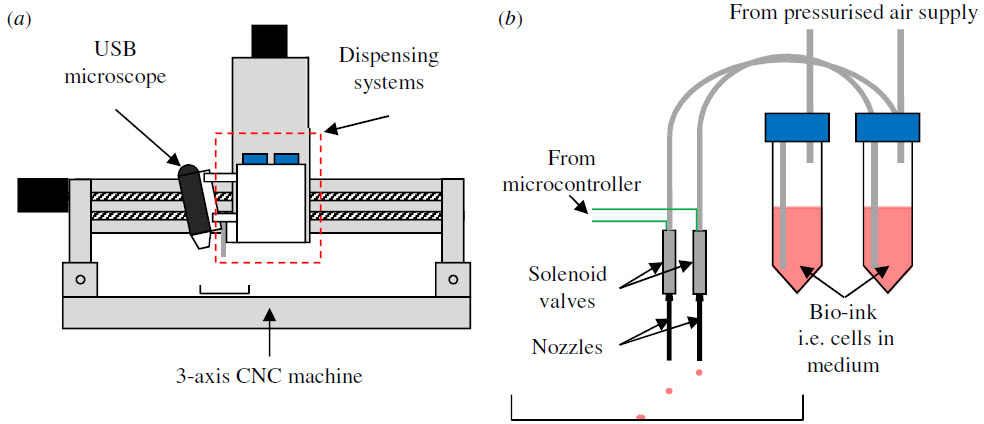
(a) Schematic drawing of the cell printer system. (b) Detailed schematic of the two valve-based dispensing systems. (credit: Alan Faulkner-Jones et al./Heriot-Watt University)

Comments (13)
by Edward
Does this mean that it will be easier to grow muscle cells to replace those lost, for instance, in muscular dystrophy?
by thomas
Mesenchymal stem cells can easily be harvested from a person and then grown into almost any tissue.
by Walter Baltzley
MUSING: I wonder if there will be elective surgeries for performance enhancement…imagine hyper-lungs that store enough extra oxygen that you could hold your breath for over an hour, or super-kidneys that allow you to go without a bathroom break for days…the possibilities are ENDLESS.
I wonder if these kinds of surgeries would become mandatory for certain professions? ALL PROFESSIONS? Would this create a form of enhancement apartheid? Could they become required by law…like vaccinations? What kind of “enhancements” might the government require?
by dbamford
Forget about a super-bladder, I just want a replacement for when mine wears out. How about a simple procedure to inject (or “seed”?) failing organs with stem cells or micro-structures that will integrate with and rejuvenate an existing organ?
by Vin
Enhancement apartheid can’t happen because adding more levels at the top increases niches exponentially providing more room at the top for people to ascend to and populate. The whole population is lifted bodily with increasing diversity of niches so tending towards ‘levelling out’ the whole population in niches appropriate to their individuality.
by Boristabby
No mention of organs with variable rigidity?
by Gorden Russell
Hey, does anybody here remember the movie, “The Fifth Element,” where Milla Jovovich as Leeloo (Leeloominaï Lekatariba Lamina-Tchaï Ekbat De Sebat) was copied out from her hand? That scene was just a little bit incredible when the film came out in 1997, but now it looks like something that will be done in the near future.
Just one more instance of the Law of Accelerating Returns.
by Oneironaut
Dear Editor,
Can you tell me, exactly how does this “eliminate the need for organ donation and immune suppression” and “solve the problem of transplant rejection” when the procedure requires embryonic stem cells (which most people don’t possess any vials of their own)?
by Singme
Clearly it says “In the longer term”
by David
You mean you did not keep your umbilical cord preserved? In the future they might be harvested from all baby’s umbilical cord blood just after birth.
by Oneironaut
No, didn’t occur to me.
by dbamford
Blood cells have already been regressed into pluripotent stem cells.
http://www.gizmag.com/embryonic-stem-cells-replaced-blood-derived-stem-cells/23914/
The new Johns Hopkins technique regresses blood cells into induced pluripotent stem cells (iPS) – able to make any type of bodily cell, but not able to form a new embryo (that would require forming totipotent stem cells, which are also capable of growing into the tissue of the placenta). This means there are no ethical problems involving human cloning in this procedure. In addition, as the iPS will be generated from your own blood cells, there should be no genetic mismatches that could lead to tissue rejection.
by Blaine
Awesome post, dbamford. Great points, especially on the “no genetic mismatches.” You’d probably really be interested in learning what the researcher Rongxiang Xu is doing in China. In situ stem cell treatments. Really interesting patents: http://bit.ly/12qxESa