3D solar-cell towers deliver up to 20 times more power per base area
March 28, 2012
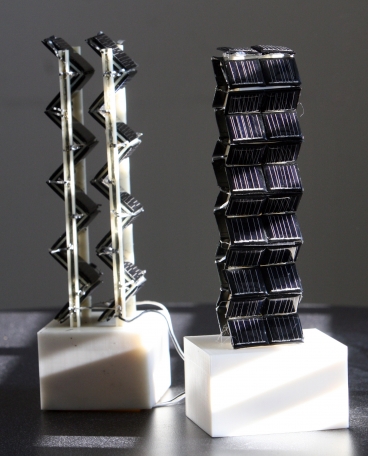
Two small-scale versions of three-dimensional photovoltaic arrays were among those tested by Jeffrey Grossman and his team on an MIT rooftop to measure their actual electrical output throughout the day (credit: Allegra Boverman)
http://web.mit.edu/newsoffice/2012/three-dimensional-solar-energy-0327.html
MIT researchers are building cubes or towers that extend solar cells upward in three-dimensional configurations and show power output ranging from double to more than 20 times that of fixed flat panels with the same base area.
The biggest boosts in power were seen in the situations where improvements are most needed: in locations far from the equator, in winter months and on cloudier days.
“I think this concept could become an important part of the future of photovoltaics,” says the paper’s senior author, Jeffrey Grossman, the Carl Richard Soderberg Career Development Associate Professor of Power Engineering at MIT.
While the cost of a given amount of energy generated by such 3-D modules exceeds that of ordinary flat panels, the expense is partially balanced by a much higher energy output for a given footprint, as well as much more uniform power output over the course of a day, over the seasons of the year, and in the face of blockage from clouds or shadows. These improvements make power output more predictable and uniform, which could make integration with the power grid easier than with conventional systems, the authors say.
The basic physical reason for the improvement in power output — and for the more uniform output over time — is that the 3D structures’ vertical surfaces can collect much more sunlight during mornings, evenings and winters, when the sun is closer to the horizon.
So far, the team has modeled individual 3-D modules. A next step is to study a collection of such towers, accounting for the shadows that one tower would cast on others at different times of day. In general, 3-D shapes could have a big advantage in any location where space is limited, such as flat-rooftop installations or in urban environments, they say. Such shapes could also be used in larger-scale applications, such as solar farms, once shading effects between towers are carefully minimized.
Ref.: Marco Bernardi, et al., Solar energy generation in three dimensions, Energy and Environmental Science, 2012; [DOI:10.1039/C2EE21170J]