A better brain implant: listening to single neurons
November 12, 2012
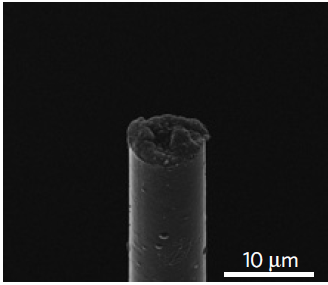
SEM image of a fully assembled, functional microthread electrode (credit: Takashi Kozai)
A thin, flexible electrode developed at the University of Michigan is 10 times smaller than the nearest competition and could make long-term measurements of neural activity practical.
This kind of technology could also be used eventually to send brain-computer-interface (BCI) signals to prosthetic limbs, overcoming inflammation caused by larger electrodes, resulting in damage to both the brain and the electrodes.
Existing electrodes are stiff and enormous compared to neurons. They are also attacked by the immune system, inflaming brain tissue and blocking communication between the electrode and the cells.
The new electrode is unobtrusive. It is a thread of highly conductive carbon fiber, coated in plastic to block out signals from other neurons. The conductive gel pad at the end is compatible with soft cell membranes, and that close connection means the signals from brain cells come in much clearer.
“It’s a huge step forward,” said Nicholas Kotov, the Joseph B. and Florence V. Cejka Professor of Engineering. ”This electrode is about seven microns in diameter, or 0.007 millimeters, and its closest competitor is about 25 to 100 microns.”
Listening to single neurons
Artist’s rendering of individual neurons (credit: Takashi Kozai)
To demonstrate how well the electrode listens in on real neurons, the team, headed by Daryl Kipke, professor of biomedical engineering, implanted it into the brains of rats. The electrode’s narrow profile allows it to focus on just one neuron, and the team saw this in the sharp electrical signals coming through the fiber. They weren’t getting a muddle of multiple neurons in conversation.
Listening to single neurons could also help with neuroscience research in general.
“How neurons are communicating with each other? What are the pathways for information processing in the brain? These are the questions that can be answered in the future with this kind of technique,” Kotov said.
“Because these devices are so small, we can combine them with emerging optical techniques to visually observe what the cells are doing in the brain while listening to their electrical signals,” said Takashi Kozai, who led the project as a student in Kipke’s lab and has since earned his Ph.D. “This will unlock new understanding of how the brain works on the cellular and network level.”
The electrode that the team tested is not a clinical trial-ready device, but the results strongly suggest that creating feasible electrode arrays at these small dimensions is a viable path forward for making longer-lasting devices,” he said.
Minimizing immune response and inflammation
In order to listen to a neuron for long, or help people control a prosthetic as they do a natural limb, the electrodes need to be able to survive for years in the brain without doing significant damage. With only six weeks of testing, the team couldn’t say for sure how the electrode would fare in the long term, but the results were promising.
“Typically, we saw a peak in immune response at two weeks, then by three weeks it subsided, and by six weeks it had already stabilized,” Kotov said. “That stabilization is the important observation.”
The rat’s neurons and immune system got used to the electrodes, suggesting that the electronic invaders might be able to stay for the long term.
Kipke is optimistic that prosthetic devices could start linking up with the brain in a decade or so. ”The surrounding work of developing very fine robotic control and clinical training protocols — that work is progressing along its own trajectory,” Kipke said.
Kipke is director of the Center for Neural Communication Technology. Kotov, the Joseph B. and Florence V. Cejka Professor of Engineering, is a professor of biomedical engineering, chemical engineering, biomaterials science and engineering, and macromolecular science and engineering. Joerg Lahann, director of the Biointerfaces Institute, is a professor of chemical engineering, materials science and engineering, biomedical engineering, and macromolecular science and engineering.
The work is funded by the National Institutes of Health and the Center for Neural Communication Technology, an NIH-funded biotechnology research center.
Comments (27)
by omran al-kandari
Now that gave me a brain orgasim !
by Dr.Pratt
When they can make probes the size of Microtubuels…that will be impressive, although this is a very good start.
by Marcos Marin
omg so stupid… coat the exogenous material with FREAKING NEURONS! You’ll simply get NO inflammation if you derive them from the patients own skin cells! If you can’t interface them in vitro how can you hope to in vivo?! gosh!
by alex n
I’m not sure that’s possible, and even if it was, there will still be a foreign, inanimate object in the tissue- you will still get inflammation. Also, coating something that is 7 microns wide in “FREAKING NEURONS” will double or triple its diameter, and drastically reduce the quality of recordings you can obtain with it- you would be recording from the FREAKING NEURONS you wanted to coat it with.
by lkhlkh
the real Future/Virtual Reality! i see hope!
by MikeB
Wow … I’ll bet you thought we were already able to listen to a single neuron. Certainly a lot of articles suggest that don’t they? Nope, we still listen to a ‘muddle of neurons in the conversation’ and make best guesses as to what individual neurons do. Of course, if you know differently, then the article is being disengenuous by suggesting that the technology is advancing current capabilities … frustrating article …
Also note that despite the purported advantages it will still be a decade (in the researcher’s opinion) before this technology could allow prosthetic-brain interfaces implying much longer for current tech … despite articles to the contrary.
by Giulio Prisco
@MikeB – better a decade than 2 decades.
by Marcos Marin
You can say this TO ANYTHING…
better 1 bird in hand than 2 flying…
better 1 billion dollars than 2… (sometimes even not in debt)
better 1 abortion than 2… yet,
better 1 kid than 2…
better 1 WTC than 2..
better 1 human extinction than 2…
better 1 better than 2…
better 1 idiot than 2…
better 1 etc than 2…
etc etc… <- doesnt help much.
by Giulio Prisco
You sure that 1 billion dollars is better than 2? Or 1 kid? In both cases 2 sounds better to me;-)
My point is that technology advances one step at a time. This is just one step, but, I think, an impressive step.
by Marcos Marin
1) I even added a parenthesis to help you out there.
2) Chinese government seems to disagree with you here too.
by Mr.X
2.China revised it’s policies. The new government thinks there is a need for more young people.
Anyway: China is not Giulio.That nation has more than 1.3 billion “children”, it may be not surprising that one birth would have been perceived by their government as favorable compared to two, if it is already so richly blessed:)
by Marcos Marin
You’re full of Ignoratio elenchi’s today Mr.X.
I never said it didn’t and I never said it was.
How could it disagree otherwise? Do you disagree with yourself often, Mr.X?
by Mr.X
@Marcos:
“Do you disagree with yourself often, Mr.X?”
Yes. Sometimes other parts try to take over.
“You’re full of Ignoratio elenchi’s today Mr.X.”
Only today?Maybe I should spend a penny and watch my diet more carefully.Thanks!
Ps:
G.”Or 1 kid? In both cases 2 sounds better to me;-)”
+
M.”2) Chinese government seems to disagree with you here too.”
+
X:”2.China revised it’s policies. The new government thinks there is a need for more young people.”
+
M:”I never said it didn’t and I never said it was.”
Yeah.
by Marcos Marin
You want me to explain or are you simply agreeing with me here?
by Mr.X
Your choice.Maybe I just didn’t understand all your clearly written out sentences.
If you want, please explain.Thanks in advance (I know you like to help others).
by Marcos Marin
“Maybe I just didn’t understand all your clearly written out sentences.”
– it would be easier to simply state that, human language is imperfect, no shame in that (except for being human in the first place)
“If you want, please explain.Thanks in advance (I know you like to help others).”
– Not really but.. can’t help it… lol, no pun intended =P
“2.China revised”
+M:”I never said it didn’t
“Anyway: China is not ”
+ “and I never said it was.”
Was this “helpful”? I mean.. if you did get this the first time, I dont get your reiteration of everything, but.. the conversation MAY have ended. lol
by Mr.X
“Anyway: China is not ”
+ “and I never said it was.”
Clearly.I know where the problem lies.You said China disagrees with Giulio, but China actually agrees with him.
That’s all I said.Next time I will not say revise, but be more specific.Maybe not everything is Ignoratio elenchi ;)
by Gorden Russell
Let us all hope that Kipke was just making a conservative projection so that he would not be called over-optimistic later if a prediction didn’t come through. We have so many warfighters who need prosthetic limbs, these new electrodes need to be developed as soon as humanly possible. It would be such a great improvement in life for so many people.
This reminds me of an earlier article here at the Kurzweil Newsletter about a company named Boston Dynamics who were developing a robot named “Big Dog” for DARPA. This is another thing that needs to be hurried along. We need robots with electronic sniffers to chemically detect the explosives of IEDs. Better to have robots getting blown up then our people. There was a story on the news yesterday about a family who lost their son to such a bomb. God how they suffered and cried. We must stop this as soon as we can.
Of course, after robots can fight a war, they can also take jobs away from workers. The Congress has to start making robots pay the Unemployment Insurance taxes and Social Security taxes of the people they throw out of work.
by Mr.X
“We have so many warfighters who need prosthetic limbs, these new electrodes need to be developed as soon as humanly possible.”
You mean soldiers.They are paid (sold) and wage war in some way.
“There was a story on the news yesterday about a family who lost their son to such a bomb. God how they suffered and cried. We must stop this as soon as we can.”
I too, think you should call your troops back home.
“The Congress has to start making robots pay the Unemployment Insurance taxes and Social Security taxes of the people they throw out of work.”
Depending on the robot, it would make more sense to have the owner pay the taxes.
Or today’s economies need complete restructuring.
by MatthewQ
Sailors, airmen and marines (and also clandestine intelligence forces like from Special Activities Division/Special Operations Group) are not soldiers. But they still wage war. Warfighter is a useful term.
by Mr.X
“Sailors, airmen and marines (and also clandestine intelligence forces like from Special Activities Division/Special Operations Group) are not soldiers. ”
Why?Why aren’t they soldiers?
by Marcos Marin
“Of course, after robots can fight a war, they can also take jobs away from workers.”
For a moment I feared you were going to ask drones to pay veterans taxes…
” The Congress has to start making robots pay the Unemployment Insurance taxes and Social Security taxes of the people they throw out of work.”
NOOOOOOoooooooo….
by alex n
Er. We definitely can record from a single neuron with cell-attached or whole cell patch clamp. You can also separate data from a ‘muddle of neurons’ into individual ones using spike sorting/PCA.
by A4i
They should investigate the possibility of building NFMIC nano particles , that can penetrate synapses and stay there. That nano particles should be capable of reading and writing signals on every individual synapse on a single neuron in totally non intrusive manner .
by Gorden Russell
Are talking about Near Field Magnetic Induction Communication? This is the first I’ve heard about it and had to search it out. It’s very interesting and sounds very promising.
by asiwel
Well, I don’t know about “near-field” magnetic induction – but I certainly appreciate magnetic induction in general and have used my Touchstone to charge my Palm Pre cell phone everyday since I bought it (too bad HP bought it too!) … and I sure wish the iPhone and others used the same technique!
by A4i
Yep! A practical device and proven technology. That is basically glorified NFC tag, but build on nano scale.