A computerized house that generates as much energy as it uses
September 18, 2012
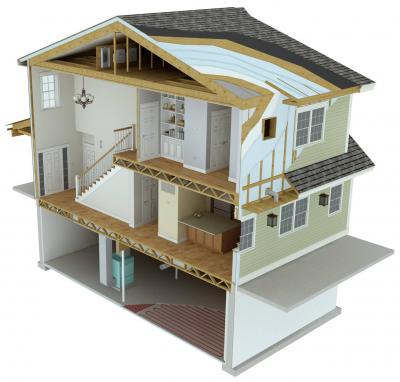
Model of NIST’s newest laboratory, the Net Zero Energy Residential Test Facility (NZERTF) (credit: NIST)
The U.S. Commerce Department’s National Institute of Standards and Technology (NIST) has unveiled a laboratory in the form of a typical suburban home, designed to demonstrate that a family of four can generate as much energy as it uses in a year.
The two-story, four-bedroom, three-bath “Net-Zero Energy Residential Test Facility“ was built to U.S. Green Building Council LEED Platinum standards — the highest standard for sustainable structures.
It incorporates energy-efficient construction and appliances, as well as energy-generating technologies such as solar water heating and solar photovoltaic systems.
A solar photovoltaic system will generate electricity to power lights and appliances when weather permits, and excess energy will be sent back to the local utility grid by means of a smart electric meter.
The house will draw energy from the grid on days it cannot generate enough on its own, but over the course of a year it will produce enough to make up for that purchased energy, for a net-zero energy usage.
New design guidelines and standards
The facility will be used to improve test methods for energy-efficient technologies and develop cost-effective design standards for energy-efficient homes that could reduce overall energy consumption and harmful pollution, and save families money on their monthly utility bills.
“Results from this lab will show if net-zero home design and technologies are ready for a neighborhood near you,” said Under Secretary of Commerce for Standards and Technology and NIST Director Patrick Gallagher. “It will also allow development of new design standards and test methods for emerging energy-efficient technologies and, we hope, speed their adoption.”
For the first year of its operation, the lab will be used to demonstrate net-zero energy usage. NIST researchers will use computer software and mechanical controls to simulate the activities of a family of four living in an energy-efficient home. No actual humans will be allowed to enter the house during this time so that researchers can monitor how the house performs, but lights will turn on and off at specified times, hot water and appliances will run — and small devices will emit heat and humidity just as people would.
NIST researchers plan to make data from the net-zero experiment available online so that researchers and the public can follow its progress.
Comments (15)
by Katherine MacLean (old science fiction writer and research fan
R & D on solar power panels will bring the cost down. Don’t accept a cost estimate on consumer use of new tech, look how fast price comes down on last years’ cell phone!. The high prices on the latest technology is paying for the novelty value and for the research. The hot weather is almost over..R&D in insulation will include new panes in windows that let in low angled sunlight and collect solor power from the light as it enters.the house.
by Bri
Not to mention that oil is going to keep on increasing in price. Very soon solar will take off, being applied to almost every surface.
by Roger F. Gay
Absolutely love it. This is what happens when engineers get funded research. I want one.
by Bob Vasquez
What would it take to get utility companies to cooperate with storing energy on the grid for later use or selling excess energy to the utility company? Yes, there have been attempts at this but, have you tried it lately? I like the idea, however, it implies construction of new towns. A house such as the one shown would cost $900,000 plus in my neighborhood. Also, that house design wouldn’t fit on most existing neighborhoods, given existing lot dimensions of 5,000 and 6,000 square. feet. Albeit that a smaller house could be designed, however, that means demolition of one’s existing house or a substantial remodel (removing the skin, rewiring, etc., etc. I still like the idea but, we will have to go from the theoretical to the practical at some point.
by daveb
This article is simultaneously encouraging and disheartening. Why build a net-zero McMansion? There are too many of them already. A better project would be to retrofit wasteful designs to make then net-zero. Or better yet build with passive solar designs instead of slapping PV panels on a big ugly box?
by Khannea Suntzu
Lets see how quickly known sources of energy fall away, due to depletion, squared against global population growth, and the resources cost to build or even maintain a house like this, and my estimate is we don’t even come close to 1% of what is needed to literally save the human species by the middle of this century. Buildings like these will be used, for sure, by very rich investors. In other words – so far this will be a cosmetic solution to a problem that’s several orders of magnitude too big too solve.
by Steve Humphries
I have been building up to a completely energy self sustaining home since 1999. Upgrading and adding new componets as they have become available. I have mastered all the things to be grid free except the cooling with air conditioning. I have been unable to find any type of cool technology that doesn’t use 1500-4500 watts of continious power to operate. That is just not feasible without a massive amount of solar panels. Why is there no systems that can do the same cooling effect without such power requirements? Also some type of thermal electric technology would be a great asset to combine with heating the home in winter. This could charge the battery bank when the grey skies do not let out enough sunshine to store.
by Editor
Nocera’s state-of-the-art tech might be of interest:
http://www.kurzweilai.net/personalized-energy-systems-for-heating-cooling-and-powering-cars
by daveb
Steve:
There are lots of cooling technologies apart from electric air-conditioning. People used fans and evaporative cooling for thousands of years before electric AC was invented. How is your property shaded? Planting trees and having an irrigated lawn (not sure of your climate and available water) will significantly lower the solar gain. Ceiling fans do wonders, and if you are not averse to some remodeling, you could investigate “solar chimneys” or cooling towers. Roof or window-mounted evaporative coolers (swamp coolers) require far less electricity than A/C. I have a roof-mounted, and it keeps my 1600 sq ft. home comfortable in the summertime. Also I have opaque blinds on many of my large windows to block solar gain. I would try a combination of techniques before resorting to electric AC.
Of course, you could just adapt to the heat. My great grandparents lived in Florida (!) and never outfitted their house with AC. Consider that the reason you are finding it difficult to find a source for thousands of watts worth of power might indicate that you have too much of a heat load to overcome and need to address the areas I mentioned above.
by bob
Evaporated coloring doesn’t work in humid areas, like in the southeast US
by GatorALLin
Why not move a real family in for 1 year to really prove the real usage tests? I am not a fan of “hey our engineering said that on paper this is how it really works in real life”. There is NO better way to prove it than actually have a real family move in and test it for real. You don’t know what you don’t know…. there are just too many small incidental things that can add up that you can’t simulate by turning on a switch that says we used the same power total by running that fake load of laundry. I hope they run the numbers for 1 year simulated and then move a real family in and run the same exact test to compare them (I would bet my last dollar that the numbers don’t match within 15% unless they corrupt the experiment by teaching them exactly how they have to live differently in this house, but even then I think it is off by more than 10%). When I say a real family, not the engineers that built it trying to prove the numbers…. a real/regular family. Just saying…
ps… I LOVE they are working on Net-Zero designs and hope they can cut the costs both up front and long term for these improved designs. I am a huge fan and in no way wanted my comments above to come off negative. I just get frustrated with simulations that claim to be the same thing as real life.
by Keegan
During R&D of any kind of facility you need to run tightly controlled simulation first before moving to an actual production facility (in this case a lived in house). This sort of development the more data the better and control of the data generation is key. After this test they will introduce a family unit into a test facility (house), but you want this data before you add the instability of little Johnny hitting a softball into the solar panels.
by Satan
How much more does it cost than a regular home?
by Hoss
This isn’t something that should be tested endlessly for five or ten years like food and medications. If the concept is proven after a year of real-world testing, it should be fast-tracked with low interest loans and other incentives, including upgrades as the technology matures. The potential is exciting!
by GatorALLin
…I agree with you… maybe they can test for 6 months with simulation and then 6 months with real family. I would guess that every single component can and will get better and or cheaper as volume goes up and as they make them they find better ways to improve them. I would think they need a way to keep updating this house to bring total cost down vs. focus on long term savings that can help with long term ROI. I hope they make this open source, so builders can put this new info to use in the real world…that is the best way to test these paper theories.