A cure for type 1 diabetes
February 14, 2013
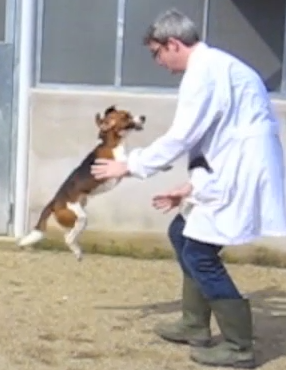
Diabetic dog cured from the disease (credit: UAB)
Researchers at the Universitat Autònoma de Barcelona (UAB) have succeeded in completely curing type 1 diabetes in dogs with a single session of gene therapy by introducing a “glucose sensor” into muscle.
This is the first time the disease has been cured in large animals, a fundamental step towards applying the therapy in humans. The dogs recovered their health and no longer show symptoms of the disease. In some cases, monitoring continued for over four years, with no recurrence of symptoms.
The therapy is minimally invasive. It consists of a single session of various injections in the animal’s rear legs using simple needles that are commonly used in cosmetic treatments.
These injections introduce gene therapy vectors, with a dual objective: to express the insulin gene and glucokinase genes. Glucokinase is an enzyme that regulates the uptake of glucose from the blood.
When both genes act simultaneously, they function as a “glucose sensor,” which automatically regulates the uptake of glucose from the blood, thus reducing diabetic hyperglycemia (the excess of blood sugar associated with the disease).
The study provides ample data showing the safety of gene therapy mediated by adeno-associated vectors (AAV) in diabetic dogs. It is based on the transfer of two genes to the muscle of adult animals using a new generation of very safe vectors known as adeno-associated vectors. These vectors, derived from non-pathogenic viruses, are widely used in gene therapy and have been successful in treating several diseases.
Long-term control of the disease
Dogs treated with a single administration of gene therapy showed good glucose control at all times, both when fasting and when fed, improving on that of dogs given daily insulin injections, and with no episodes of hypoglycemia, even after exercise. Furthermore, the dogs treated with adeno-associated vectors improved their body weight and had not developed secondary complications four years after the treatment.
There have been multiple clinical trials in which AAV vectors have been introduced into skeletal muscle, so the strategy reported in this study is feasible for clinical translation, the researchers say.
The study was led by the head of the UAB’s Centre for Animal Biotechnology and Gene Therapy (CBATEG) Fàtima Bosch, and involved the Department of Biochemistry and Molecular Biology of the UAB, the Department of Medicine and Animal Surgery of the UAB, the Faculty of Veterinary Science of the UAB, the Department of Animal Health and Anatomy of the UAB, the Spanish Biomedical Research Centre in Diabetes and Associated Metabolic Disorders (CIBERDEM), the Children’s Hospital of Philadelphia (USA) and the Howard Hughes Medical Institute of Philadelphia (USA).
Diabetes mellitus
Diabetes mellitus is the most common metabolic disease, and a large number of patients need insulin treatment to survive. In spite of the use of insulin injections to control the disease, these patients often develop serious secondary complications like blindness, kidney damage or amputation of limbs. Moreover, in order to achieve good blood glucose control, insulin has to be injected two or three times a day, which brings a risk of hypoglycemia episodes (lowering of blood sugar): an additional problem that comes on top of the other hardships of the treatment.

Comments (39)
by milkseed3@verizon.net
I was 9 when my family received a complementary newspaper. The cure for diabetes was the big story. My Mom and I cried as she read the story.. That was 1955. I can’t remember how many times since I have read about ‘the cure’.
by Teresa
I have had type 1 almost all my life and suffer almost all the complications including amputation, kidney disease, digestive issues, and eye and heart problems how would I sign up if they decided to try it on humans they can experament on me anytime, I am only 50 yrs old and things arent looking to good about making it to 60
by victor
Hi Teresa. My father died of type 1 diabetes 15 years ago, when he was only 45 (yes, at the end he had the whole bunch of troubles, including blindness and kidney failure).
I sympathize with you and I wish you all the best luck at the trials, for this one, or maybe with those with artificial pancreas. (You have probably read about that one too, on this website).
by victor
Try to reach the original authors of the paper, by email or phone, whatever!
by Tina
WOW! This news actually brought tears to my eyes…a cure for Type 1 diabetes! I have had Type 1 diabetes for 59 years, since I was 2 yrs. old…I am now 61 and my dream was to see a cure before I die! Who knows…my dream may come true yet!!!
by victor
… and your message brought tears to my eyes…
by Angel
I hope ,God may bless you for your dream will come true in one day .
I will really pray for that.
by Jeff
The damn Government dont want the cure for Cancer, HIV, Type 1 and 2 diabetes. The Pharmacy companies and Doctors and hospitols and insurance companies then wont be able to line there pockets
by Wes Bertrand
Unfortunately, this is no cure for type 1 diabetic humans, not by a long shot. In order for a cure to happen, the autoimmune attack on beta cells by T-cells needs to be addressed, which this study did not do. The reason why these researchers achieved success in these canines with this treatment is because their type 1 was induced deliberately (chemically) by the researchers; the dogs had normal functioning immune systems, so the newly viable insulin-producing cells in their muscle tissue were not attacked. This article is informative about this:
http://www.medicinenet.com/script/main/art.asp?articlekey=167821
My bet at this point is on the “re-education” of my T-cells via cord blood stem cells (I’ve been TD1 since ’95), as done in the following Chinese study. (Whether the people calling themselves the “FDA” will oppose or impede it is the coercive factor to consider.)
Reversal of type 1 diabetes via islet β cell regeneration following immune modulation by cord blood-derived multipotent stem cells
http://www.biomedcentral.com/1741-7015/10/3/abstract
by Carley Moore
Actually they have found that a Pancreas transplant surgery has cured
by Luke
Side effects of drugs to make a pancreas transplant work lead to cancer and other concequences. It’s detailed on the mayo clinics website. It’s not a viable option for diabetics.
by Concerned Citizen
What about those who have T1D, but as a result of a trauma instead of an autoimmune response? This may provide a cure for that group of people.
by lorna
I have type 1 and they never know why but do come up with all different ideas. i have never heard of it from trauma? What type of trauma? Wonder if I am ibn that group? Thank you
by Chris
I have a rat terrier who has canine diabetes mellitus and would love him to have the same treatment. Where in the USA are they having these studies and these experimental treatments done. I am there! So tired of having to give him 2 insulin injections a day and I think he is also. He is a young dog and still has a very long life ahead of him, hopefully, with this treatment they are talking about.
by Editor
The researchers do not mention studies in the U.S., but they do thank M. Watford (Rutgers University, NJ) for technical assistance. The corresponding author for the paper is Fatima Bosch, fatima.bosch@uab.es. She may have some suggestions.
by Concerned Citizen
This is the key. If they can cure a dog which has T1D naturally (as opposed to induced), then there may be hope for the millions alive today, and the billions who will follow in the future.
That should be the next test.
by Daphne
My God! I’m so tired of living with Type 1 Diabetes, and all the misery, and effects of long term survival with this disease. For 37 years it’s been a rock in my shoe, to understate it. I hope, and pray that my mother’s prayers are FINALLY coming true, that she will live to see the day I, and others like me, am set free from this condition.
by Joshua Cintron
I am elated, just as you are a cure for humans is right around the corner. My dad has type II diabetes, so I wonder how or if that may be curable as well.
by V.
It always says “This works on animals, dogs”
But when are the medicine coming to humans?
by Concerned Citizen
Lots of red tape when animal trials move to humans, as the governement does not want to be responsible for the death of 1 human in a clinical trial (though they gladly kill people in war all the time), even though many humans would volunteer to take on the risk. It is said that insulin would not make it to human trials if it was discovered today.
by Gabriel
Fantastic news! This should be headline news everywhere I go….that they were successful in treating this disease means that, what comes next, will be translation of the results into human therapies.
by Vin
So exciting. So muscle becomes a surrogate pancreas after just one treatment? Amazing. These AAV’s and that recent nanoshell protien complex delivery seem like 2 quite recent advances for gene therapy and who knows what else. Guess it’ll soon be 4.
by Erik
I thought the problem with gene therapy was that it needs to be administered repeatadly and there is an increased risk of cancer.
The article implies thas is not true anymore, at least not for dogs. Does it mean we may be able to cure other genetic diseases using the same method?
That would be awesome.
by Bri
I was thinking similar thoughts. It looks like we are coming into the era of human gene therapy that’s been promised for so long.
by gaoptimize
Potentially the biggest billion dollar implication story of the year. Oh, and I’m happy for the little dog in the picture.
by infinitos
so will this also cure type 2 also ??
by craig
This is for type 1
Type II can often be managed by not eating so darned much carbohydrates and calories in total. They often have high insulin but their body is stocked full of as much sugar and fat as the cells want so they won’t accenpt anymore
by Irena
Please understand that there are lean type 2′s-not everyone with type 2 diabetes is overweight. There has been a lot in the literature about lean type 2 diabetics-very important to know this information and to refrain from making generalizations. Overweight/obesity is very complex and much more than not pushing away from the table soon enough.
by Rob
I wonder if they will study Glucokinase in the treatment of Tye II diabetes. It may help with the insulin resistance that is the hallmark of the disease. It’s a simpler solution than waiting around for personalized organs like eyes and kidneys. Plus no surgery.
by Richard
American Diabetes Association
Innovative Immune Cell Re-education Technique Holds Promise for Type 1 Diabetes
http://www.diabetes.org/news-research/research/research-discoveries/recent-advances/innovative-immune-cell.html
by Joe
This study involves Type I diabetes. Type II is far more common. Type I involves loss of insulin-producing cells in the pancreas. Type II diabetics can make insulin but they have insulin resistance, i.e., the insulin receptor in the cells doesn’t accept the insulin. Thus curing Type II requires a different mechanism.
by Gorden Russell
Even if it is the least common of the two types of diabetes, there are still a lot of sufferers who will be helped if this cure works. This also means that there will be more people who will live to see the Singularity. That’s why we all keep visiting this site, isn’t it? Don’t you want to make it to the time when exponential progress will be so great that the exponent has an exponent? That’s the time that Ray Kurzweil projects that the lines on the graphs all go off-chart up and to the right. Just check out his book again and look at all his graphs. His projections have been coming true since the ’90s.
by Ian Clarke
Gorden, I keep visiting this site to maintain my optimism about the future. If I only watched the ordinary news, it would be easy to assume that technology & innovation were pretty much stagnant (or at least moving slowly). Not all the stories published here have the ‘wow factor’ but they’re enough to assure me that very clever folk are working hard to move us into a brighter future. It’s only in the last few years that I’ve started to believe I’m living in the future I dreamed of as a kid. Unfortunately, after reading Ray’s ‘The Singularity Is Near’, my expectations have risen considerably. :-)
by Gorden Russell
Always glad to hear from you, Ian.
by Ian Clarke
Likewise, Gorden.
I think it wise for us all to stay as healthy as we can, both physically and mentally. I hope I’m here for the Singularity, but I think that the path to it will be amazing and I just want to see as much of it as I possibly can.
by jp
Just because tech is moving very fast does not mean it will be a nice place to live.
by TomInWales
Err, and human trials begin when?
by dan
Type 1 diabetics produce little to no insulin due to autoimmune destruction of the beta cells in the pancreas.
Type 2 diabetics also inject insulin sometimes.
Is this a cure for type 2 or type 1?
by Luc Dufrane
buh-bye diabetes – rest in peace, we won’t regret you :-)