A display that makes interactive 3D seem mind-bogglingly real
December 19, 2012
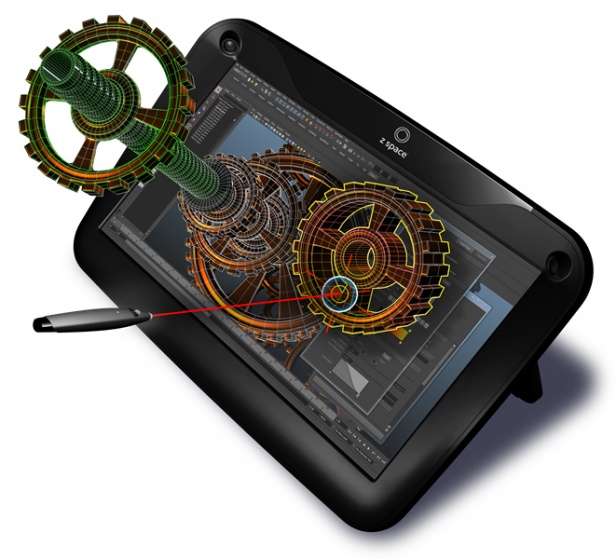
(Credit: Infinite Z)
The “Z Space” display, developed by Californian company Infinite Z, tracks a user’s eye and hand movements and adjusts the 3-D image that he or she sees in real-time, MIT Technology Review reports.
The resulting effect is stunning. Unlike the 3-D video seen in a movie theater or on a 3-D TV, you can move your head around an object — to look it from the side or from below, for instance — and the Z Space display will adapt and show you the correct perspective.
You still need to wear a special pair of glasses in order to see the 3-D images generated by the display. But the glasses have an additional purpose. As well as showing different images for each eye (to create the illusion of depth perception), they have markers that reflect infrared light.
This enables cameras embedded in the display to track the movement of your head (and thus your eyes) as you change your point of view.
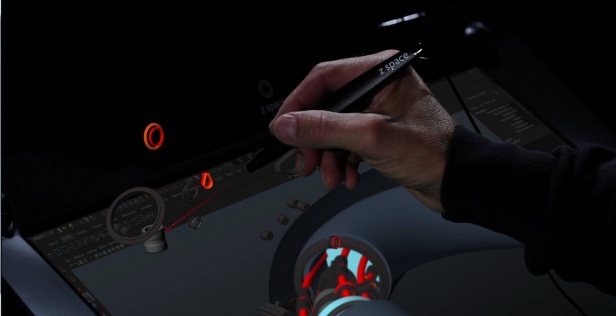
(Credit: Infinite Z)
The technique, which the company calls “Virtual Holographic 3-D,” also lets you manipulate virtual objects as if they really were floating just inches in front of you.
A special stylus connected to the display also contains sensors that allow its movement to be tracked in three dimensions. You can use the stylus to “grab” parts of the virtual image in front of you and move them around in 3-D space.
Comments (31)
by Luke
They should credit Johnny Chung Lee if they already haven’t. Quite a while back I watched his WII remote youtube videos and then his appearance on TED.
by Larry
They cheat in their image and video demo (the objects cannot be moved or positioned beyond the edge of the screen and they should give credit to Johnny Lee who demonstrated the same thing 5 years ago with a Wiimote and $5 worth of drug store hardware.
by Superxcm
http://www.youtube.com/watch?v=Jd3-eiid-Uw
looks like idea comes from this.:P
by Nate B
Can you explain how this is different from what CAVE environments have been doing for 20 years? Tracker on the head, tracker on the stick, parallax and all that jazz, yup. Boggle-check: Nope.
by Eric Anderson
I can see a range of users from a docor ho performs surgey to a Mc Donalds worker in India controling a rbot in the USA or anyon anywhere being a maid ir cook via a robot located where the ervice is needed and paid for.
by GAUSS
I’ve worked with these. They’re AWESOME.
by melajara
Let’s play virtual skeleton with this.
You are given the 206 bones of a human being. Your job is to name them and position them in space to ultimately reconstruct a full skeleton .
For geeks, we have a version with 300+ bones, and no its not for a cat but to build up a human baby!
by GatorALLin
can we get this as a $10 phone app? (please)
by Jerry
There’s a huge latency issue you have to deal with for AR on mobile phones. I did a test AR project earlier this year on an iPhone 4S and ended up either having to put up with the latency or create a smoothing algorithm. Not sure how well others have managed, I’m not the greatest programmer.
by aus
How many years until full-out interactive holodecks?
by Simon
Three.
by JC
Looks like it could facilitate custom assembly by a skilled human controlling several robotic arms. The factory floor could be human free while the human assemblers in a separate room control powerful robot arms. Perhaps to build with dangerous alloys.
by Jeroen
Reminds me of a modified Ninteno WII (sensor bar on your head) to track head movement and display accordingly. Only this one incorporates stereoscopy as well. Maybe not all new, but cool nevertheless
by ChrisF
Exactly … I played around with a version of that tech using the “TrackIR” head tracker recently. It was fun for a while but the novelty quickly wears off. The basic problem is that the 3d effect only works within the boundaries of the monitor (obviously) – once the object clips the border, the effect is immediately broken. I really don’t see much to get excited about here – i’ll hang on for the Oculus Rift I think…
by Jerry
3 more months until the Rift… Gives me time to finish my current game at least.
by Maxdepondt
Cool but usefull?
The demo is pretty basic and the pen doesn’t seem very handy. I am a fan of AR usually, but I think this is one just one more wow effect.
Wating for much more from Zspace. they should partner with Leap motion to develop a real modeling interface… but Oh, too bad, Leap Motion is already developing that by themselves….
I have to admit I appreciate the way they advertize to Maya users in their demo, but being one myself I can tell you that with my traditional USB mouth, I work much faster than the guy in the TVC (apparently) and I don’t objects to pop up from th screen (even though I am not against it)
I need powerfull tools that speed up my workflow.
Nice work, but still so much to do!!!
by snake0
One step at a time, combining this (or a full VR headset for the more hardcore of us) with a haptic interface such as gloves would allow you to ‘feel’ the objects on screen and speed up operation even more. Making CAD models will soon be as simple as a child playing with toy bricks.
by trakk
which reminds me, could anybody tell me what has happened to that leap motion device, it was supposed to be out by now,wasnt it?
by cglaze
One really cool application for this is audio mixing.
You could move tracks around and adjust attributes of the sound.
Up/Down = adjust frequency
Right/Left = panning
Front back = amplitude
Tweak your mixes visually and then get spaced out watching it all automated when you are done.
by melajara
Right, and becoming an audio sculptor.
More generally this is the beginning of a crop of synestetic (or cross-sensory) user interfaces.
Synestetic interfaces is also an interesting approach for boosting learning abilities or, literally, grasping difficult subjects.
by melajara
synesthetic, sorry for typo. @Editor, I feel sorry to have been the involuntary cause of the edit function removal some months ago. We really miss that feature (sigh).
by graham caldwell
I thought ,mitibushi was working on a tv that didnt use glasses.
by Rob B
Isn’t this just head-tracked stereoscopic display? Something thats been around, Im guessing at least 20 years?
Confused as the the innovation implied here.
by Another Rob B
I was about to say the same thing, it would be even better it it could track the eyes focal point and adapt the image.
by ChrisF
Right.. and it only works so long as you’re looking in the general direction of your monitor. Turn your head or lean too far to the side, and the effect is immediately broken. I’m holding out for true HMD-based immersion…
by Someone
“Beyond what you thought was possible”, starts the clip. Stopped it at that point, since that’s for sure beyond what I think is polite — which might in turn, I guess, be beyond what the makers of the clip themselves thought possible.
by Kristof77
Reminds me of Ironmans desing program, find a way to drop the glasess and pen and well have some really cool virtual reality…. even with the glasses and the pen really cool vr possibilites here
by Jerry
The glasses will replace all this using AR, the pen and tablet disappear instead!
by Corey
Wow. Imagine the applications with music mixing and production? Move an object up or down to adjust frequency range….left or right = panning…. Forward or backwards = amplitude… Watch the mix before your eyes….bravo!
by TomInWales
Drool.
by Thomas Jensen
Now THAT is cool!