A graphene/nanotube hybrid
November 29, 2012
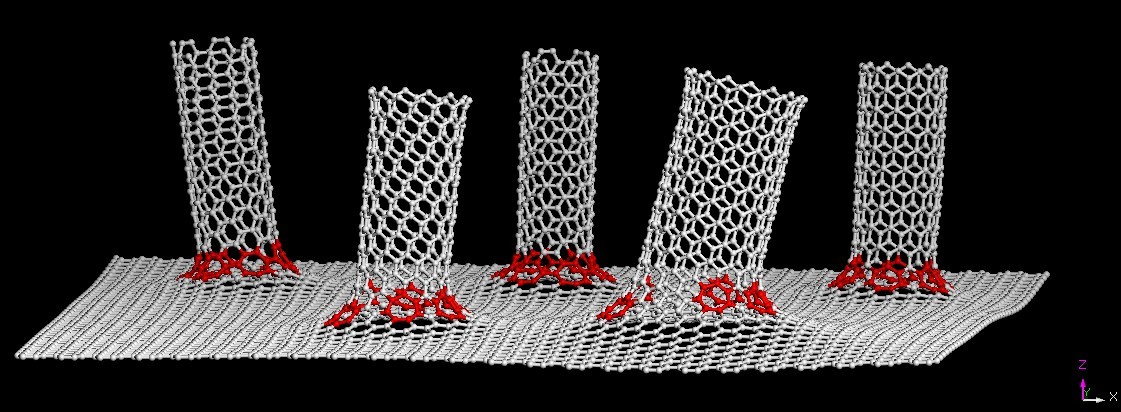
Seven-atom rings (in red) at the transition from graphene to nanotube make a new hybrid material from Rice University a seamless conductor. (Credit: Tour Group/Rice University)
A seamless graphene/nanotube hybrid created at Rice University may be the best electrode interface material possible for many energy storage and electronics applications.
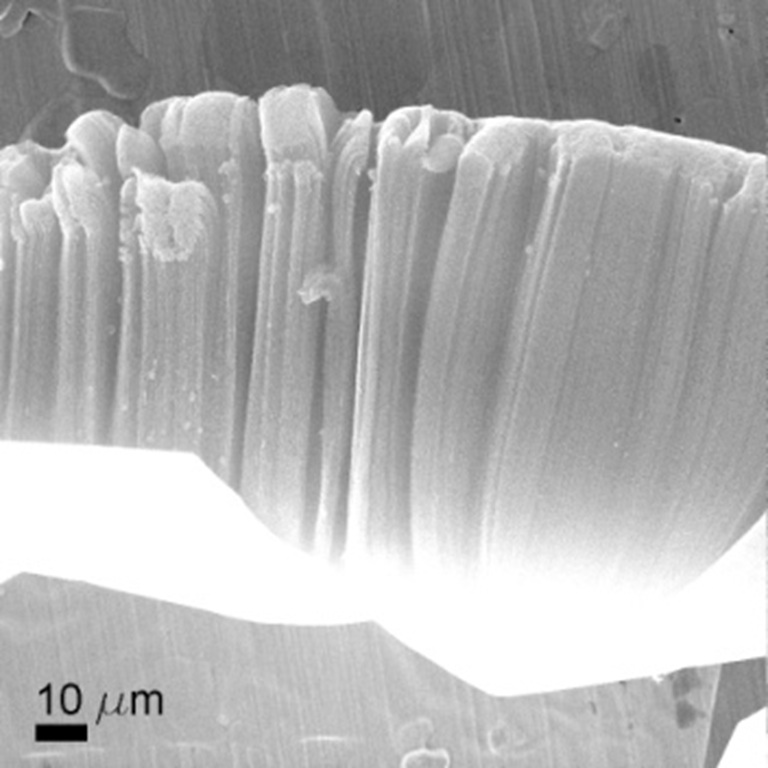
A forest of nanotubes, each just a few nanometers wide, grows from a graphene sheet on copper. The hybrid material created at Rice University has a surface area of more than 2,000 square meters per gram. (Credit: Tour Group/Rice University)
Led by Rice chemist James Tour, researchers have successfully grown forests of carbon nanotubes that rise quickly from sheets of graphene to astounding lengths of up to 120 microns. A house on an average plot with the same aspect ratio would rise into space.
That translates into a massive amount of surface area, the key factor in making things like energy-storing supercapacitors.
The Rice hybrid combines two-dimensional graphene, which is a sheet of carbon one atom thick, and nanotubes into a seamless three-dimensional structure. The bonds between them are covalent, which means adjacent carbon atoms share electrons in a highly stable configuration. The nanotubes aren’t merely sitting on the graphene sheet; they become a part of it.
“Many people have tried to attach nanotubes to a metal electrode and it’s never gone very well because they get a little electronic barrier right at the interface,” Tour said. “By growing graphene on metal (in this case copper) and then growing nanotubes from the graphene, the electrical contact between the nanotubes and the metal electrode is ohmic. That means electrons see no difference, because it’s all one seamless material.
“This gives us, effectively, a very high surface area of more than 2,000 square meters per gram of material. It’s a huge number,” said Tour, Rice’s T.T. and W.F. Chao Chair in Chemistry as well as a professor of mechanical engineering and materials science and of computer science and a co-author with former postdoctoral researcher and lead author Yu Zhu, now an assistant professor at the University of Akron.
Tour said proof of the material’s hybrid nature lies in the seven-membered rings at the transition from graphene to nanotube, a structure predicted by theory for such a material and now confirmed through electron microscope images with subnanometer resolution.
Carbon has no peer as a conductive material in such a thin and robust form, especially in the form of graphene or certain types of nanotubes. Combining the two appears to offer great potential for electronic components like fast supercapacitors that, because of the massive surface area, may hold a great deal of energy in a tiny package.
The research was supported by the Air Force Office of Scientific Research (AFOSR), the Lockheed Martin Corp. through the LANCER IV program, the Office of Naval Research Multidisciplinary University Research Initiative (MURI) program and the AFOSR MURI program.