A high-performance solar-thermoelectric generating device
May 4, 2011
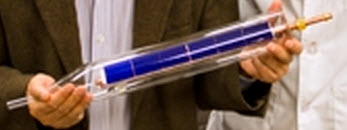
Prototype of a flat-panel solar-thermoelectric generating device (credit: Melanie Gonick)
Researchers at MIT and their collaborators have developed a high-performance and possibly less expensive way to convert solar heat into electricity, using flat-panel solar power combined with hot water systems.
Their system produces power with an efficiency roughly eight times higher than ever previously reported for a solar thermoelectric device that produces electricity from solar heat. It does so by generating and harnessing a temperature difference of about 200 degrees Celsius between the interior of the device and the ambient air.
While solar thermal electricity systems aren’t a new idea, they typically involve vast arrays of movable mirrors that track the sun and focus its rays on a small area. The new approach uses flat, stationary panels similar to traditional solar panels, eliminating the need for tracking systems.
The system is a solid-state device with no moving parts. A thermoelectric generator, placed inside a vacuum chamber made of glass, is covered with a black plate of copper that absorbs sunlight but does not re-radiate it as heat. The other side of the generator is in contact with ambient temperatures. Placed in the sun, the entire unit heats up quickly, even without facing the sun directly.
The device requires much less material than conventional photovoltaic panels, so it could be much less expensive to produce. It can also be integrated into solar hot-water systems, allowing the expenses of the structure and installation to serve two functions at once.
Li Shi, associate professor of mechanical engineering at the University of Texas at Austin, says this approach to solar power is “very novel, simple, and easy for low-cost implementation. The efficiency level they have demonstrated so far, at 4.6 percent, is already quite impressive.
“With the use of other or new thermoelectric materials that can operate at a higher temperature, the efficiency may be improved further to be competitive with that for state-of-the-art amorphous silicon solar cells,” says Shi. “This can potentially provide a different approach to realizing the $1-per-watt goal for solar-electricity conversion.”
Ref: Zhifeng Ren & Gang Chen, et al., High-performance flat-panel solar thermoelectric generators with high thermal concentration, Nature Materials (2011) doi:10.1038/nmat3013