A major step toward an Alzheimer’s treatment and vaccine
January 17, 2013
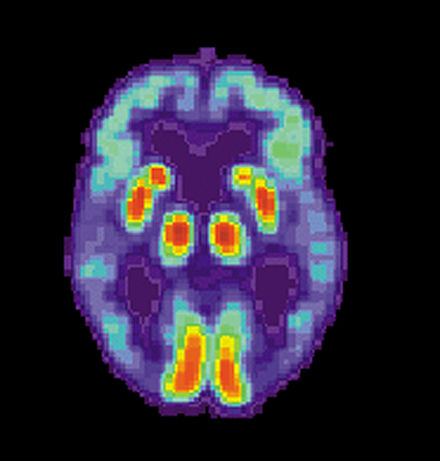
PET scan of the brain of a person with Alzheimer’s disease, showing a loss of function in the temporal lobe (credit: Wikimedia Commons)
A way to stimulate the brain’s natural defense mechanisms in people with Alzheimer’s disease has been discovered by researchers at Université Laval, CHU de Québec and pharmaceutical firm GlaxoSmithKline (GSK): a molecule known as MPL (monophosphoryl lipid A) that stimulates the activity of the brain’s immune cells.
The breakthrough opens the door to developing a treatment for Alzheimer’s disease and a vaccine to prevent the illness.
80% of senile plaques eliminated
One of the main characteristics of Alzheimer’s disease is the production in the brain of a toxic molecule known as amyloid beta. Microglial cells, the nervous system’s defenders, are unable to eliminate this substance, which forms deposits called senile plaques.
The researchers administered weekly injections of MPL over a twelve-week period to mice with Alzheimer’s symptoms. The treatment eliminated up to 80% of senile plaques. Tests measuring the mice’s ability to learn new tasks also showed significant improvement in cognitive function over the same period.
The molecule has been used extensively as a vaccine adjuvant by GlaxoSmithKline for many years, and its safety is well established.
Uses for MPL: treatment and vaccine
The researchers see two potential uses for MPL. It could be administered by intramuscular injection to people with Alzheimer’s disease to slow the progression of the illness. It could also be incorporated into a vaccine designed to stimulate the production of antibodies against amyloid beta as a preventive measure for people with risk factors for Alzheimer’s disease.
“When our team started working on Alzheimer’s disease a decade ago, our goal was to develop better treatment for Alzheimer’s patients,” explained research team leader Dr. Serge Rivest, professor at Université Laval’s Faculty of Medicine and researcher at the CHU de Québec research center. “With the discovery announced today, I think we’re close to our objective.”
Alzheimer’s disease (AD) is the most common cause of dementia worldwide. There is no current cure for the disease, which worsens as it progresses, and eventually leads to death.