A million-year hard disk
July 13, 2012 | Source: Science Now
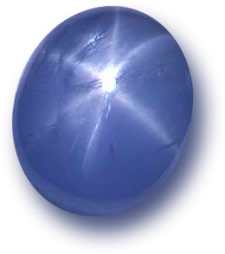
Star saphire (credit: Mitchell Gore/Wikipedia)
Patrick Charton of the French nuclear waste management agency ANDRA has presented one possible solution for long-term preservation of data: a sapphire disk inside which information is engraved using platinum.
The prototype shown costs €25,000 to make, but Charton says it will survive for a million years. The aim, Charton told the Euroscience Open Forum here, is to provide “information for future archaeologists.”
In 2010, ANDRA began a project to address these issues, says Charton. It brings together specialists from as wide a selection of fields as possible, including materials scientists, archivists, archaeologists, anthropologists, linguists, and even artists — “to see if they have some answers to our questions.”
The initial goal is to identify all the approaches possible; in 2014 or 2015, the group hopes to narrow down the possibilities.
The sapphire disk is one product of that effort. It’s made from two thin disks, about 20 centimeters across, of industrial sapphire. On one side, text or images are etched in platinum — Charton says a single disk can store 40,000 miniaturized pages—and then the two disks are molecularly fused together. All a future archaeologist would need to read them is a microscope. The disks have been immersed in acid to test their durability and to simulate ageing. Charton says they hope to demonstrate a lifetime of 10 million years.
Comments (3)
by Patricia Napolitano
Future scientists would also need a knowledge of the language in which the disk was written
by William Kramer
The caveat is: “All a future archaeologist would need to read them is a microscope.” Better than a microscope, how about a Geiger counter? If people or some other entity were to start digging though all that concrete or rubble, seems that the first question would be “why?” If they were primitives, why would they invest all that work into digging though reinforced rubble when there would be much more lucrative and fascinating things to be found in the remains of cities with much easier access? If they were advanced enough to have a microscope the chances are pretty good that they (1) will have knowledge of radiation, its effects and how to detect it or (2) whether advanced or not they will start to notice that they are dying when they go into that area, which is usually a great lesson to stay away. People long ago learned that walking into smoking calderas caused them to die from asphyxiation, so they stayed away. It was no great feat of reasoning. The whole “how do we keep future people away from nuclear dumps” seems overblown. It also seems rather nearsighted to think that within a few hundred years we won’t have the tech fix to excavate the dumps with robotics and recycle the radioactive wastes or send them to the sun or the Earth’s core for disposal.
by Dayhawk
I look forward to see where this goes. of course this is not a new Idea cause people long time ago came with Idea to storing info on a stone.