A new way to create ‘building blocks’ for drugs
October 3, 2012
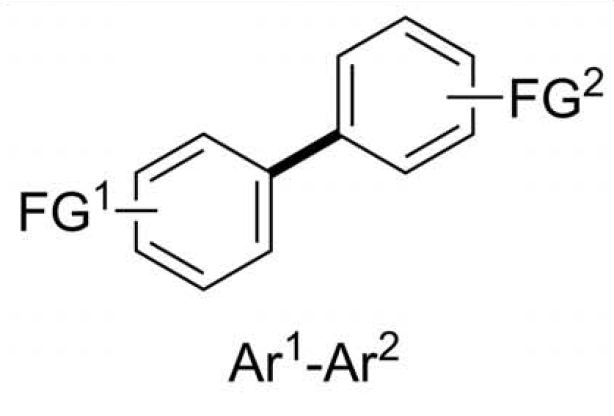
Synthetically useful biaryls (credit: Liam T. Ball, Guy C. Lloyd-Jones, Christopher A. Russell/Science)
A new way to prepare biaryls — compounds that are essential building blocks in the creation of drugs and many modern materials such as LEDs — using gold as a catalyst is described by University of Bristol researchers in Science.
Gold catalysis is easier, cheaper and more environmentally friendly than current methods that use palladium as a catalyst.
Biaryls, compounds containing two directly connected benzene rings, frequently feature in pharmaceuticals and agrochemicals as well as forming the core of many functional materials (for example LEDs, liquid crystals, conducting polymers).
Over the last two decades, methods for preparing biaryls have relied predominantly on cross-coupling — a method in which two differentially pre-functionalized benzene rings are connected together in the presence of a catalyst, most often based on the precious metal palladium. The power of this method was recognized in the 2010 Nobel Prize in Chemistry.
However, concerns regarding the environmental impact of such processes, arising from use of toxic metals and the requirement for pre-functionalisation of the coupling partners, have led to a search for more benign alternatives.
So much recent interest has focused on replacing one of the pre-functionalized benzene rings with the desired benzene ring itself, a process known as direct coupling. Despite major advances in this area, most direct couplings still only operate under undesirable conditions, for example strongly acidic solvents, high temperatures, high concentrations of toxic metal catalysts, large excess of one reactant, and so on.
In their report to Science, Professor Guy Lloyd-Jones, Dr Chris Russell, and PhD student Liam Ball from the University of Bristol’s Chemical Synthesis Doctoral Training Centre, describe a new method for performing direct couplings.
The reaction employs a low concentration of a gold catalyst to couple a simple aromatic ring with a non-toxic silicon-based partner, to generate biaryls at room temperature and under exceptionally mild conditions.
These conditions then allow many of the structural features required in drug-like molecules to be tolerated; indeed, the group illustrated the applicability of their chemistry through the concise synthesis of diflunisal (Merck & Co.), a non-opiod, non-steroidal anti-inflammatory drug used for the treatment of chronic arthritis, and for the relief of acute pain following oral surgery.
The appeal of the new direct coupling process is increased still further by the ease with which it can be performed. Unlike more traditional procedures, the chemistry is insensitive to the presence of air or moisture, allowing reactions to be assembled on the bench-top without prior purification of reactants and solvents. The gold catalyst is also cheaper than palladium catalysts, and any gold residues in the product are considered relatively benign.