New book by Peter Diamandis and Steven Kotler — Abundance: The Future Is Better Than You Think
January 20, 2012
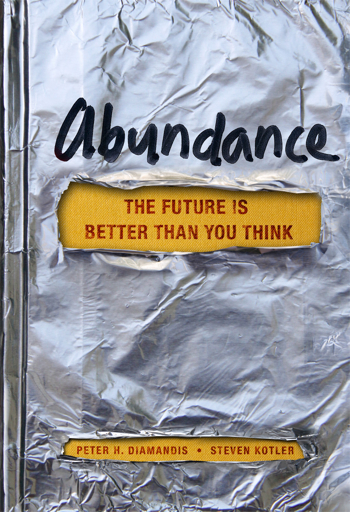
In the forthcoming book Abundance: The Future Is Better Than You Think, Peter H. Diamandis (chairman and CEO of the X-Prize Foundation and cofounder and chairman of Singularity University) and award-winning science writer Steven Kotler give us an extensive tour of the latest in exponentially growing technologies and explore how four emerging forces — exponential technologies, the DIY innovator, the Technophilanthropist, and the Rising Billion — are conspiring to solve humanity’s biggest problems.
“This brilliant must-read book provides the key to the coming era of abundance, replacing eons of scarcity,” says Ray Kurzweil, inventor and author of The Singularity is Near.
Matt Ridley, author of the Rational Optimist, agrees: “This vital book … gives us a blinding glimpse of the innovations that are coming our way. …” Stewart Brand, editor of the Whole Earth Catalog, describes the book as “comprehensively sampl[ing] … the profound innovations going on to improve the human condition.”
The authors make a compelling case for optimism. We are introduced to dozens of innovators and industry captains making tremendous strides in healthcare, agriculture, energy, and other fields: Dean Kamen’s “Slingshot,” a technology that can transform polluted water, salt water, or even raw sewage into incredibly high-quality drinking water for less than one cent a liter; the Qualcomm Tricorder X-Prize, which promises a low-cost, handheld medical device that allows anyone to diagnose themself better than a board-certified doctor; and Dickson Despommier’s “vertical farms,” which replace traditional agriculture with a system that uses 80 percent less land, 90 percent less water, and 100 percent fewer pesticides, with zero transportation costs.
As a bonus, the authors provide a detailed reference section filled with 90 graphs, charts, and graphics offering much of the source data underpinning their conclusions.
Comments (10)
by nscpani
diamandis -reference-web-site- summary of his book.
comments- in developing countries,, as industrialisation progresses ,
importance of teachers -particularly in primary stages has
steadily declined. just limping. in contrast college level
syllabus is ambitious.
if teachers at primary levels are inspired ,wonders can happen.
great scientists had something to search for at young age and
decades later it took shape.
inspiring them , will have real domino effect exponentially.
from nscpani
by ce
Exponential technological innovation, yes, but simultaneously also wonder about the pressure on ecosystems. The normal background rate of species extinction is about 10 to 20 species a year, we’re doing about 200 a day. There’s climate change and the acidification of the oceans, etc.
Wondering about “critical-state universality.” See Mark Buchanan’s book: Ubiquity.
From the book: “The basic idea goes by the name critical-state universality, and it represents one of the most profound discoveries in theoretical physics in the twentieth century.”
“As we have seen, great earthquakes, forest fires and mass extinctions are all merely the expected large fluctuations that arise universally in nonequilibrium systems. To avoid them, one would have to alter the laws of nature.” The same goes for large stock market crashes, wars, crop losses, etc.
“ . . . the way people aggregate into cities doesn’t depend at all on the fact that they are people. It may be somewhat insulting to say this, but similar patterns can show up for similar reasons in mindless colonies of aggregating bacteria or clusters of smoke particles deposited on a ceiling.”
Don’t know that the future is reliably predictable per “critical-state universality.” The patterns of innovation are real, but may not last?
by tschaefer
I’ve seen the Left (including the authors of this book no doubt) go through counter-cyclical phases on abundance. In boom times, they make environmental and other “peak” sustainability arguments that growth and abundance (1972 Club of Rome “The Limits to Growth” ), because in truth, leftist don’t like it when capitalism is working. In bust times, we have books like this, where the problem (which their policies create) is actually distribution, and there is or will shortly be abundance, it’s just a matter of “spreading the wealth around” properly – re-distribution.
Take tedhowardnz’s comment above: He wants to short-circuit the information mechanism for directing resources (money) so an all-wise and compssionate construct can take over and do a better job.
While I am a true believer in technological progress leading to the singularity, but it will not solve any of the problems the Left is hell bent on imposing on and seeing in society, and I for one will not be reading this book until I can buy it used for what it is worth – $.02.
by Bryan
Peter is a Libertarian, and this book very much talks about how to use economics to solve problems, and in fact one of its central arguments is the removal or stepping back of government regulations to allow innovation to flourish. So you assumed he was a lefty, and closed yourself off to a new way of thinking about problems. This is why lefties don’t like people who don’t like lefties.
by Logic
@tedhowardnz, you’re creating phantom arguments to drive people to your site to solve non-issues. Your argument makes no sense.
“Money does not value abundance” is a nonsensical statement. Money is an exchange value; it’s a label. It doesn’t value anything. *We* value things by giving it a monetary value.
“…as soon as supply exceeds demand monetary value drops to zero.” You’re describing abundance. An item in abundance will not have great monetary value, naturally. You’re correct. But while the item is still scarce, it may have *enormous* monetary value. And that value can be used to incentivize the *creation* of abundance. As an example, the high cost of medical care leads upstarts to imagine cheaper ways to achieve the same (or better) results. This leads to innovation which brings down those costs and puts the technology in the hands of more people, at a lower price. The financial incentive is a perfectly legitimate way to drive that innovation. Abundance is the eventual result.
To imagine that money is somehow “enslaving” anyone is hopelessly naive. You are vilifying a nonentity. It’s like saying your chair is “forcing you” to sit with bad posture.
I applaud Diamandis and Kotler for bringing this book to market, and I eagerly await the delivery of my pre-ordered copy. The future is indeed better than you think.
by tedhowardnz
Hi Logic
Quite the contrary.
Monetary value and human value are clearly two different things.
Certainly humans make monetary valuation choices.
One simple way to conceptualise it is to think of the distinction as money being human value multiplied by scarcity.
Oxygen provides a sort of limiting case (always useful to clarify a demonstration). Oxygen has great human value – if someone puts plastic-wrap over your face, or puts your head under water, that value becomes very obvious very quick. Yet oxygen is so abundant that there is no scarcity, and thus most people would be very reluctant to pay for the air they breath.
Thus there is no inbuilt economic incentive to maintain that abundance. We create laws against air pollution in an attempt to make up for that systemic failure.
Your logic about creation of abundance works only to a point.
Money incentivises people to produce so long as they can make a profit.
There is zero monetary incentive to make anything as abundant as oxygen.
So the distinction here appears to be about the various possible meanings of “abundance”.
Your definition seems to stop at the point that people can make a profit, whereas mine stops at the point that all human need is satisfied. The difference is significant if one is near the bottom of the income scale (though insignificant to those near the top).
The cost of medical care is something I have had some recent experience of. 4 years ago I had a melanoma on my temple. 2 years ago it metastasised, and although surgeons removed most of the left side of my neck and face, and all the lymph nodes they could find, it had spread deeper and more widely, and was in my liver, and in other tissue. At that point I was told by the medical establishment that there was nothing known to medical science that could alter the probability of my survival, which was given as 50% chance of living 5 months and a 2% chance of making 2 years.
I did a lot of research myself, and adopted a set of low cost strategies, mainly around diet, and am still here, and according to my last set of scans, tumour free. All my oncologist was allowed to say was “whatever you are doing, keep on doing it”.
If he recommends what I did to anyone else, he faces sanction and dismissal.
That is the system that the monetary incentive structure has created.
I am, by training and biochemist and ecologist, with a good grounding in mathematics (statistics and probability) and 40 years of developing computer software – so I have the skill base to do my own evaluation of published data. Few have that. Way over 90% of what is on the internet is factually incorrect – merely unsubstantiated opinion. So it takes a bit of sorting through.
I have published all of my medical history, and all of what I did, and why, on my blog-site for others to evaluate.
My chair makes few demands of me.
The facts of my biological origin make many demands of me – I need to have food, shelter, water. My enquiring mind demands access to communication and information and transportation.
These things are not yet free.
To get them I must currently engage in economic activity.
It is technically and conceptually possible to create systems that delivered those things in such abundance that they are free – yet there is no systemic incentive within our current political and economic system to do so (in fact there are substantial incentives to prevent it happening).
Understanding that does require making some clear distinctions – like the first distinction above – between economic value and human value.
When the logic of your argument failed – you attacked the man. That is a common strategy – continued by most politicians even today.
I am optimistic that the future may be at least as powerful and secure as I think possible – and I have quite a powerful ability to envisage possibilities.
by Logic
@tedhowardnz, your straw man arguments hinge upon the (false) assumption that capitalism requires scarcity for its profit motive, which is often true in isolated examples where supply is controllable, but which is demonstrably erroneous on aggregate over time. “Monetary value” and “human value” *are* two different things, but they’re not equivalents. One is a subset of the other. Money is a label, nothing more. When humans value something, they assign a monetary value to it, according to its relative abundance. There is no “systemic failure” (which system?) to keep oxygen pure. It’s abundant, so our resources are trained elsewhere. If it becomes scarce, we refocus on it to return it to abundance.
This is so much simpler than you’re (deliberately?) making it. When an item is scarce, there is financial incentive to make it more plentiful. As we push to make things more plentiful, there is a gradual trend toward abundance.
by tedhowardnz
@Logic
It is not as simple as you state.
If we were simply talking about money as a tool to empower the matching of goods and services, then your logic would be mostly accurate.
That is not our reality.
We now have systems that are designed purely around money – independent of any goods and services.
It is in these systems that we have systemic issues.
Now that people are able to pursue money, in and of itself, independent of any good or service, there is a massive incentive to optimise the production of money (in and of itself, as independent as possible from goods or services).
Thus we see the production of laws which may have rhetoric around them speaking of “public good” aspects, but when you look closely at there systemic effects, it is about providing barriers that protect profits.
This is a systemic issue.
It is easy to see how we have gotten into this situation.
Small and medium producers have seen that the regulations imposed by government are a barrier to them doing sensible business, so when politicians talk about removing regulation those voters identify the regulations that are a problem to them. What tends to happen in reality is that when regulations are removed, it is regulations that had inhibited the accumulation of money, and regulations that promote money (mostly on a short term horizon).
The financial incentive to make things more plentiful only extends to the limit of profitability.
Many people have little ability to make money, therefore little money to spend, therefore a great many unmet needs.
Life is easy for me – I make an hourly rate that is ten time the average for my town – so I am one of the fortunate few.
In this town there are many people who want to work, who cannot find paid employment. Most of the jobs that are here are very low paying (because of the excess of labour over jobs).
There is no financial incentive to meet the needs of most of these people, because most of them have little or no money – they are surviving, just.
The incentives for those who employ labour is to keep the pool of unemployed at a level that keeps wages low, thus seemingly reducing costs and increasing profit – except that if the trend takes off, then demand dies, and we enter recession.
There are a great many issues with money.
by tedhowardnz
I agree that we are developing the technical capacities to deliver abundance, but there are no systemic incentives to do so. Money is the major barrier to delivery.
Money does not value abundance.
Money is a function of both supply and demand parameters – as soon as supply exceeds demand monetary value drops to zero.
If you find that hard to think of, then consider oxygen – it is vital to each and every one of us, yet we all have what we want, and the monetary value of it is zero.
As long as we as a society remain enslaved by the myth of money, there will be a strong disincentive to ever deliver the post scarcity society which is undoubtedly possible, and undoubtedly desired by most in society – because there is no money to be made from it.
See my blogsite – http://www.tedhowardnz.wordpress.com/money for more on the topic.
by star0
I’m looking forward to reading this book. A friend of mine, who runs one of the largest science cafes in the U.S., is a big fan of Matt Ridley’s book “The Rational Optimist”; and I think Ridley’s comments about “Abundance” will be a good reason for him to buy the book.