Asteroid deflection mission seeks smashing ideas
January 16, 2013
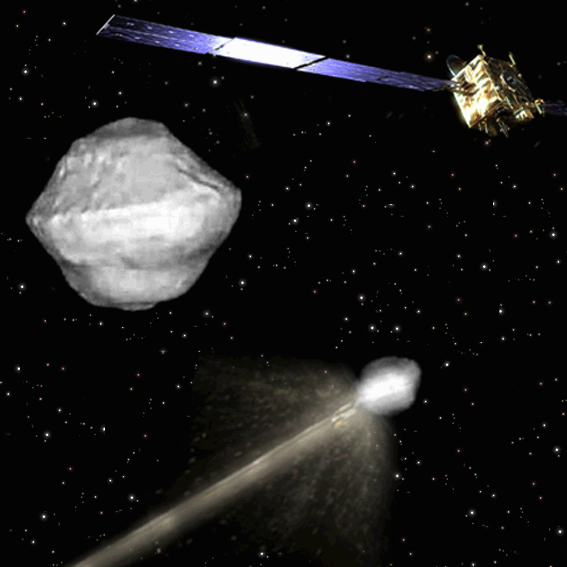
AIDA mission concept (credit: ESA)
A space rock several hundred meters across is heading towards our planet and the last-ditch attempt to avert a disaster — an untested mission to deflect it — fails.
This fictional scene of films and novels could well be a reality one day. So the European Space Agency (ESA) is appealing for research ideas to help guide the development of a U.S.-European asteroid deflection mission now under study.
They are seeking concepts for both ground- and space-based investigations, seeking improved understanding of the physics of very high-speed collisions involving both man-made and natural objects in space.
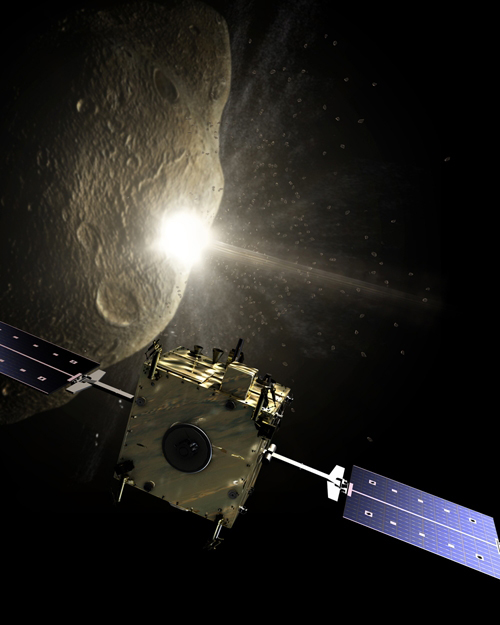
Measuring the impact on the asteroid (credit: ESA)
ESA’s call will help to guide future studies linked to the Asteroid Impact and Deflection mission (AIDA). This innovative but low-budget transatlantic partnership involves the joint operations of two small spacecraft sent to intercept a binary (dual) asteroid.
The first Double Asteroid Redirection Test (DART) spacecraft, designed by the Johns Hopkins Applied Physics Laboratory, will collide with the smaller of the two asteroids.
Meanwhile, ESA’s Asteroid Impact Monitor (AIM) craft will survey these bodies in detail, before and after the collision.
The impact should change the pace at which the objects spin around each other, observable from Earth. But AIM’s close-up view will ‘ground-truth’ such observations.
“The advantage is that the spacecraft are simple and independent,” says Andy Cheng of Johns Hopkins, leading the AIDA project on the US side. “They can both complete their primary investigation without the other one.”
But by working in tandem, the quality and quantity of results will increase greatly, explains Andrés Gálvez, ESA AIDA study manager: “Both missions become better when put together — getting much more out of the overall investment.
“And the vast amounts of data coming from the joint mission should help to validate various theories, such as our impact modeling.”
Comments (20)
by Dan Robinson
If we’re sending one or more rockets, why take other equipment, unless maybe a nuclear bomb? Use the rockets to change the orbit, probably by both early high-speed impact and slow push. Let’s not dependi on anything too hi-tech, especially that we don’t even have yet.
If the asteroid is expected to hit the earth straight on, almost any direction it’s pushed, hard “enough”, reduces chances of collision, if only by changing the time of arrival at earth’s orbit. Probably first send whatever rockets are available as soon as possible, to impact at top speed, maybe on one side or the other. For pushing, assuming it’s spinning, the most likely place would be at one pole or the other. In any case, it would likely involve a rocket with adjustable legs on the nose. Maybe that’s something to be preparing and putting in space.
On the other hand, the way our various economies are going, by the time it happens we might be back to using bows and arrows.
by Robby777
Rocket thrusters seem to be the best idea. – to alter the course soon enough to miss the earth and moon. Carbon fiber or any cables for towing are a bad idea because the thrust of the rocket would be along the axis of the cable. Pushing is the way…
by human2ai
Istead of breaking up an asteroid, dump extra mass on it to increase its gravitational attraction to the sun. I realize that the extra mass would increase the centrifugal, outward direction force from the sun but it would also increase the gravitational attraction inproportion to:
“mass increase^2″. The centrifugal opposing force would be only proportional to:
“increase in mass”. The asteroid would tend to move into a closer orbit to the sun until the two forces balanced because of the principal of “angular velocity”=velocity/radius. That is the angualr velocity of the asteroid devided by radius of orbit would increase because of smaller radius. since “centrifugal force”=mass x Veolcity^2/radius. The angular velocity is just inserting the velocity component times x the velocity component already there, so you can see how it would balance the increase in gravity at a smaller orbit radius.
The energy involve would just be the transporting of the masses to the asteroid, mabe from the moon or crashing at low velocity the spacecraft themselves into it would overall less costly and less danger prone.
by human2ai
I just realized the mistake in my idea. It would not work. I wish there was some way to delete it.
I was assuming the attraction force to the sun would increase to the “increase in mass^2″. According to the formula for gravity it would only increase “increase in mass” but not squared, so centrifugal force and gravity would still be equal at the same orbit and the orbit would not change.
by Robby777
Adding mass seems like a good idea, but then there is the amount of mass needed to make a difference. It’s huge!
by Sno
How about pointing a high energy laser at it, so that a small area is being vaporized and pushes the asteroid the other way ?
by Robby777
This is a better idea, but the composition of the asteroids vary greatly. Calibration will have to be done on site!
by Bri
From what I understand, these things are loosely bound together rubble. As the singularity draws near we will be able to generate many small autonomous robotic mining vehicles. We could send up a swarm and they could just chop it up and carry it away, like a swarm of locust.
by Arch Hughes
Do they have to carry it away? If they chop it up into small enough pieces, won’t all those pieces burn up harmlessly in earth’s atmosphere?
by Bri
The mass would be the same and it would not have spread that much. They want to go all the way to the asteroid belt. So much nicer to have special delivery!
by Bruce Wright
An amusing image, but why is it any easier to send up a swarm of vehicles? They still need to accelerate the ore somewhere; nanotech doesn’t repeal Newton’s law. Clearly you need somewhat better rocket technology than we have now, but not necessarily nanotech.
by tim the realist
Another idea if the rock is small enough like 100 meters or so would be to encase it in a giant inflatable airbag. Make the airbag out of Kevlar and if it’s large enough then atmospheric resistance would slow it down significantly to reduce impact energy.
by Arch Hughes
Or tether a bunch of space-shuttle sized parachutes to it, land it in the Sahara, and use the ice it to turn the desert green.
by Bri
That’s the spirit! You probably have never seen the movie The Andromeda Strain. The general premise was that life started in space and so something hitches a ride on it.
by tim the realist
Our moon has been our baseball bat for a long time. We could send rockets there and stage deflection thrusters or load up on some handy moon mass to deflect an incoming threat. The deflectors would be stored there ready for remote launch to save us when needed.
by Robby777
Not good – we can’t do without our moon. Its influence on our very lives is tremendous!
by Joel Sapp
I’m surprised they just want ideas for smashing things into the asteroid. There may be other ways to deflect the asteroid away from the planet.
by Bri
I suggest a humongous baseball bat. The big problem is the mass and speed. If we detect it far enough away, we’ll have enoughtime to implement a strategy. It takes so long to fly to a rendezvous site. I would side with an array of space based mirrors. They could be practical for solar energy harvesting in the meantime. If an asteroid is detected they could be focused at it from very far away. Enough of them could cause the surface to vaporize and produce thrust. If it’s rotating too fast we would be out of luck. Next I would favor a tethering approach. Numerous rocket thruster attached to tethers would have to match the rotation, deploy their tethers then alter both the rotation and the trajectory.. The same system could be deployed for asteroid towing. That way we would be developing the thruster tether tech for asteroid mining and be able to have them at hand in an emergency. This approach would give us a lot of practice as we us it for mining purposes. We would have a much higher chance of knowing what could work. The tethers would have to be very strong. Definitely a job for carbon nano fiber based cables. I think explosives and impacts might cause more harm than good. Too much chance of turning it into numerous smaller lethal impacts.
by Bruce Wright
I certainly agree – if the object is beyond a certain size, breaking it up doesn’t do a whole lot of good. It might do some good if the object was small though, since each of the pieces might be small enough to (mostly) burn up in the atmosphere even if the whole asteroid wouldn’t.
You could wrap carbon fiber fabric around the asteroid, secured with carbon fiber cables (to prevent all the rubble from flying apart), and then attach small rocket engines that would slow down and stop any rotation; then it should be reasonably easy to use more normal rocket technology to drag it away from a collision course. If the axis of rotation wasn’t pointed in the wrong direction (highly likely) you could also just mount the engines along the “equator” and thrust along the axis without stopping the rotation – if it had been on a collision course, most likely any small change in the orbit would push it away from the Earth.
by Robby777
pushing is better – if towed, then the cables are along the same axis as the rocket thrust. The cables will burn through.