Asteroid early-detection telescope planned
June 29, 2012
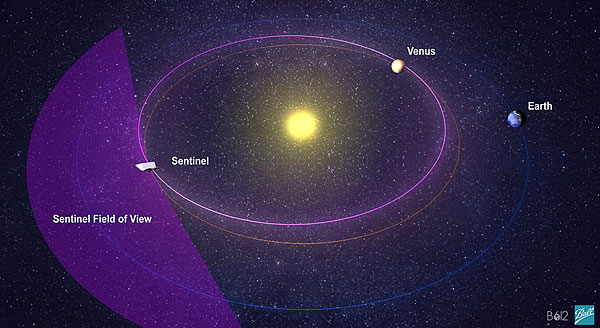
Sentinel space telescope (credit: B612 Foundation)
A new telescope, the Sentinel Space Telescope, promises to provide an early-detection system that could predict a devastating asteroid impact.
It will map the approximately half-million large asteroids that populate the inner solar system. The observations could be used to identify threats decades in advance of an impending collision.
A large asteroid colliding with Earth may seem like a science fiction scenario, but there’s reason to take it seriously. Hundreds of thousands of these bodies cross Earth’s orbit — and the consequences of a direct hit by even one could be devastating.
“We should be able to establish orbits well enough that we can predict where the asteroids will be in 50 to 100 years,” said Stanford Professor Scott Hubbard, an aeronautics and astronautics professor, who is overseeing development of the telescope.
The mission to launch the telescope was announced Thursday at the California Academy of Sciences by the nonprofit foundation, the B612 Foundation, whic is funding it. It was hailed as the first privately funded deep space mission.
With NASA support, the B612 Foundation will send the infrared telescope into orbit around the Sun, where it will map the swarms of large asteroids that populate the inner solar system. The telescope is expected to be ready for launch on the SpaceX Falcon 9 rocket in five to six years.
“The B612 Sentinel mission extends the emerging commercial spaceflight industry into deep space — a first that will pave the way for many other ventures,” said Hubbard, program architect for the mission.
Private space
In recent years, the private spaceflight movement has racked up a number of high-profile milestones, including the first private suborbital spaceflight in 2004 and the first private payload delivery to the International Space Station this year.
Stanford has been involved in the field since 2010, as a member of the Federal Aviation Administration’s Center of Excellence for Commercial Space Transportation.
“Fifty years ago, space was the exclusive province of governments,” said Hubbard. “Now we’re reaching a tipping point.”
But the announcement from the B612 Foundation — named for the asteroid home of French writer Antoine Saint-Exupéry’s Little Prince — goes beyond the low-orbit ambitions of other private-sector space missions.
Led by CEO Ed Lu, a Stanford alumnus, and Mission Director Harold Reitsema, the group aims instead to place its space telescope deep into space, near Venus’s orbit.
The device will range from 30 million to 170 million miles from Earth — hundreds of thousands of times farther than the Hubble Space Telescope, and in prime position to detect large objects before they come close to Earth. Ball Aerospace has submitted a proposal for Sentinel’s construction.
Exploring the neighborhood
Near-Earth asteroids are potential scientific gold mines, likely holding clues to conditions in the early solar system.
They may also pose a significant threat to life on this planet.
A recent National Research Council report concluded that although collisions with asteroids are rare, “one must also consider the extreme damage that could be inflicted by a single impact.”
An example often cited is the impact that devastated more than 2,000 square kilometers of Siberian forest in 1908. Scientists say it was likely due to an object a few dozen meters across.
More than half a million asteroids of that size or larger coexist with us in the inner solar system. Although NASA’s Spaceguard project has mapped the largest of these, hundreds of thousands of objects remain unmonitored.
During its projected five-and-a-half years of operation, Sentinel is meant to remedy that gap. The infrared telescope will scan the entire sky every 26 days with a 24 million-pixel array, sending information about asteroid locations and trajectories back to Earth via NASA’s Deep Space Network of antennas.
The telescope’s observations could be used to identify threats decades in advance of an impending collision.
Scientists said that with enough advance warning, a well-placed projectile, nuclear explosion, or “gravity tractor” — a massive spacecraft that would pull asteroids with its own gravitational field — could redirect a potentially devastating impact.
Data explosion
The data the mission is expected to produce will also be made freely available to the scientific and educational communities.
“I think there’s going to be a huge opportunity for student engagement,” said Hubbard.
The California Academy of Sciences and the Planetary Society, headed by Bill Nye, intend to partner with the foundation, and Hubbard hopes to involve students in analyzing Sentinel’s mapping data.
Asteroid locations and trajectories will, however, primarily serve as the basis of the near-Earth object protection system suggested by the National Research Council’s report on asteroid hazards.
“For millions of years, we have been a cosmic target, with occasionally devastating consequences,” said B612 Foundation co-founder and former astronaut Rusty Schweickart. “To say that we, as human beings, are going to put a stop to that is a very powerful statement.”