At last: a low-cost, professional-grade light-based 3D printer
September 27, 2012
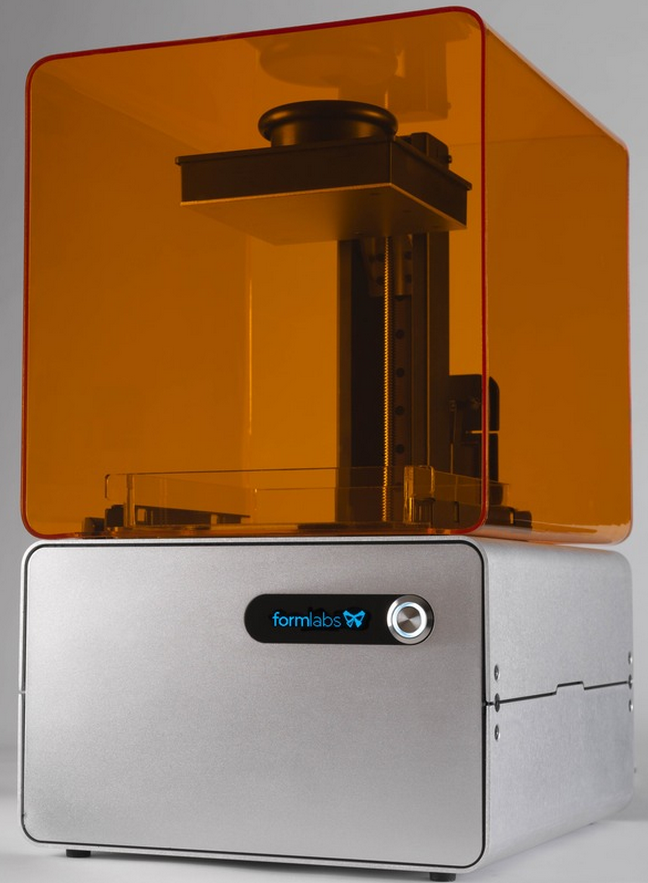
Formlabs’ new Form 1 3D printer could bring professional-grade 3-D prints to the home workshop.
Desktop 3-D printing has largely been the domain of extrusion-based machines like MakerBot’s Replicator and homebrew RepRap designs.
These lag behind the capabilities of pricier, professional stereolithography devices, where UV light cures incredibly thin layers of resin to create objects on par with manufactured goods.
Developing this type of printer at a consumer price point has been an elusive goal until now.
The Form 1 is a desktop-sized machine that creates professional-grade, light-cured 3-D prints, Wired reports.
Their prototype units are fully functional and Formlabs will finance manufacturing via a Kickstarter campaign that broke their $100,000 target in 2.5 hours.
Initial backers will be able to pre-order the Form 1 for $2,299 (only 25 will be available at this price); additional units are priced at $2499 and $2699, based on order of contribution. Actual market pricing has not yet been released.
How it works
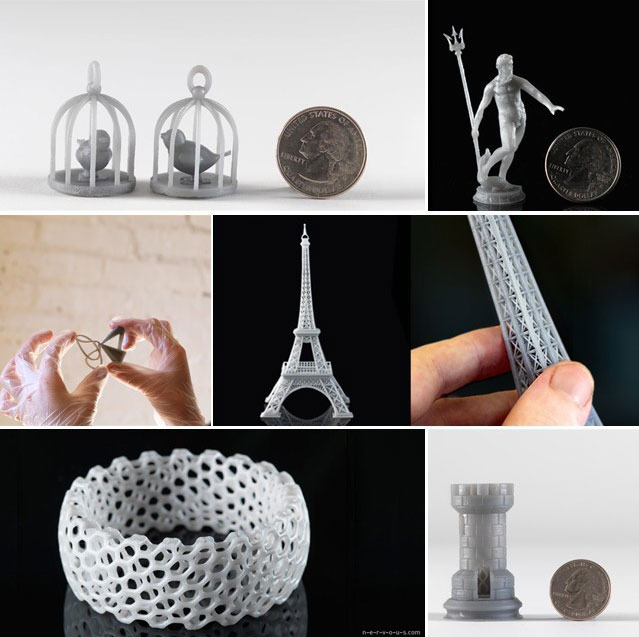
Plastic isn’t deposited on a build platform; instead, parts are extracted from a gooey pool of resin. In addition to its higher accuracy, this process also makes translucent parts and complex geometries possible. It can print objects 4.9 by 4.9 by 6.5 inches with layers that are just 25 microns (0.001 inches) thick.
To put this in perspective, the Form 1 resolution is four times higher than the new MakerBot Replicator 2 (100-micron layer thickness), and is on par with professional grade systems. With tolerances this tight, designers will be able to produce high quality presentation models suitable for painting, small runs of production parts, and models with enough detail to be used in jewelry casting.
The Form 1 may be the first low-cost 3-D printer that allows people to focus on developing their product, instead of fussing over the production process.


Comments (32)
by Fred Bosick
These things make plastic parts that are electrical insulators. It won’t mean anything until we can make metal and ceramics with embedded conductors.
by James
How about a 3D printer that prints a 3D printer?
by snake0
Exactly, the RepRap team have been throwing around this slogan for years but seem to be running around in circles with different designs and have yet to show any real steps towards a 100% self-replicating machine. There’s always the fine print of ‘well you have to buy some parts separately, like bolts, circuit boards, etc etc..’. Either it can build itself or it can’t. It’s about time some competition showed up to really shift this industry into gear.
by Chuck
Wait til people start printing untraceable firearms. Yikes.
by Giulio Prisco
Like this? http://www.kurzweilai.net/the-worlds-first-3d-printed-gun-is-a-terrifying-thing
by Mr.X
What can I build if I buy this printer?
by GatorALLin
this stuff… http://www.thingiverse.com/
by Kristof77
Phenominal!
I can see the next copy rights battles on the horizon. Soon a small community will start making blueprints of products available for download, small things like models of buildings, table top games, decroations, jewerly and no one will really care since its a small community at the items being printed aren’t all that valuable. Then future generations of the replicator will be able to print in multiple mediums (metal, plastics, glass) and evenutally be able to print curcuits as well. Once downloading the schematics for electronic devices, appliances, tools, and bigger better 3D printers becomes a possibility the copy rights infridgement law suits will make Napster look like a warm-up.
by Simon
Games Workshop already sued Thingiverse.
by russgilder
There are already issues. there are guys printing AR-15 lower receivers. this does not make the ATF happy.
by On the Balcony
you are 100% right. Which chips would you like to buy schematics for first?))
by Dan Robinson
Editor, maybe someone could print a time travel machine to transport the printer I’ll have in the future?
I didn’t see mention of prices here, or much elsewhere, including the software to support 3D printing. I suppose if I have to ask, it’s too much.
Is it possible to print parts separated by a soluble gel that could be rinsed away, leaving for instance at least a simulation of a bearing or workable bolt and nut?
by Editor
Prices are mentioned in the post. How about printing a time machine designed as a printer of time machines?
by Bri
This comment is for the 3D printed drugs article. The comments section is turned off. That article is more comprehensive, as to 3D printing tech advances. It appears to be exploding, including a printer that can print it’s self. No matter what they try to do to make a drug printer unhackable, it will be hacked. The police commissioner of NY has told Lady Gaga that he’s out to get her for any drug violations, because she is a role model. He said that his daughters idolize her and he can’t figure out why. Drug use is not fueled by celebrity. It’s been in society since before we formed organized settlements. This machine will be like rocket fuel on those behaviors, no matter how much prison time he gives Lady Gaga. People have to be responsible for their own behavior. All I can say in relation to that is, good luck.
by Editor
Comments now on for “3D printing: the desktop drugstore” (and I’ll check to see why they were off).
by Gabriel
Absolutely correct Bri — the more and more Abundance spreads, personal responsibility will increasingly be what keeps people out of trouble.
by Gorden Russell
I like the way you capitalize the word Abundance, Gabriel. I’ll have to start doing that. I thought we’d have to wait for self-assembling photovoltaic carbon nanocells to have Abundance, but now it looks like it might come early.
by asiwel
Abundance – the Future is Better Than You Think – is a great new book by Peter Diamandis (of X-Prize fame) and Steven Kotler, well worth reading. That probably is why it is being captialized here.
by GatorALLin
To be fair…this guy was earlier in his design and has already been shipping units. It will be interesting to watch how the competition heats up to offer higher resolution, larger build sizes, faster print times and still finds ways to keep the costs down (both up front cost of the unit and also cost of the models when printing 3d). http://www.kickstarter.com/projects/b9creations/b9creator-a-high-resolution-3d-printer?ref=live
by gatorallin
Love this link to help support another great kickstarter project. My only concern with this 3d printer is that the build size or build table seems very small. Also this does not appear to be open sourced, so how this 3d printer keeps up with cool changes may not occur as fast or as easily (or as inexpensive as open sourced 3d printers).
by Marcos Marin
Print a bigger one =) .. and then open source it ;-)
by Mr.X
I like the way you think ;)
by Dan Tanna
Still just baby steps toward nano-assemblers, but steps nonetheless.
by Kostas
There’s an open source version already developed:
http://b9creator.com/
by SpottedMarley
can somebody please print me out a 3D printer?
by Editor
No, but I can print the specs for one. The rest is up to you.
by Bri
Probably never. The extrusion devices are the only ones capable of possible multimaterial fabrication. This method slowly lowers the form into uncured resin.to get thin layers it dips it in the resin and then brings it back up to allow the viscous resin to drain away . Viscosity and surface tension wouldn’t allow the resin to seep into crevices of intricate multimaterial components
by Bri
This comment was supposed to be under Melejara. I must have hit the window.
by melajara
Biohackers will love that!
Now if you could embed printed electronics in the fabrication process that would be awesome. Any idea of when this combination will be possible?
by Dan Tanna
Looks like that would be up to you to pursue this idea.
by GatorALLin
I have heard a few working on that idea already… I can’t see any reason that the software side of things would allow you to pause a 3d printing and put in metal parts that would be at high wear places or help fuse a plastic and metal part. This could include metal screw holes or other things where 3d plastic printing was not enough. Love the hybrid thinking to combine different assembly steps, like building in electronics…… great thinking.
by GatorALLin
…error…should be “would not” vs. would.