Better than human
January 2, 2013
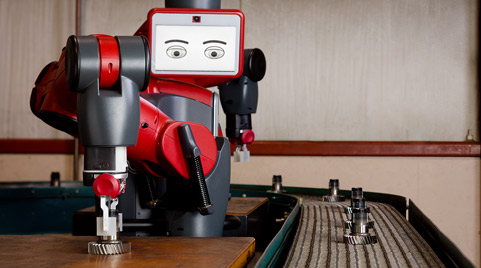
Baxter (credit: Rethink Robotics)
It’s hard to believe you’d have an economy at all if you gave pink slips to more than half the labor force. But that — in slow motion — is what the industrial revolution did to the workforce of the early 19th century, says Wired maverick Kevin Kelley.
Two hundred years ago, 70 percent of American workers lived on the farm. Today automation has eliminated all but 1 percent of their jobs, replacing them (and their work animals) with machines.
But the displaced workers did not sit idle. Instead, automation created hundreds of millions of jobs in entirely new fields. Those who once farmed were now manning the legions of factories that churned out farm equipment, cars, and other industrial products.
Since then, wave upon wave of new occupations have arrived — appliance repairman, offset printer, food chemist, photographer, web designer — each building on previous automation. Today, the vast majority of us are doing jobs that no farmer from the 1800s could have imagined.
It may be hard to believe, but before the end of this century, 70 percent of today’s occupations will likewise be replaced by automation. …
Comments (106)
by Jim Mooney
I have consistently said that while we have a 21st century science we have an 18th century economy – and that doesn’t appear to be getting any better, if not worse. This is why all those rosy predictions by Buckminster Fuller or The Triple Revolution were right about the production increase, but wrong that it would result in, for instance, lowered work hours (If anything they are increasing.)
by Walter Baltzley
Optimists such as Buckminster Fuller did not account for the fact that the technology would create an imbalance of power between workers and their employers…between the rich and the poor. Karl Marx did, but I hope things don’t play out the way he envisioned.
by Gabriel
I feel a lot of people are not expressing this right.
Yes, the future belongs to the augmented and the AI…but it helps to clarify that, those who choose not to augment themselves, will not be left behind….because, as expressed before, they will have a world of abundance around them to enjoy. In a sense, they aren’t missing out on anything…it’s not that they are being ‘left behind’, there is this us vs them rift and so on….that’s something I feel is, unconsciously, made without being intended.
If people choose to augment themselves in the future, this is their own personal choice to made, probably stemming from their own personal philosophy and beliefs…if that’s what they choose, they will still have this new world around them, which still gives them plenty to love and live for….it’s just that, they are making the conscious decision not to augment themselves and “move on”. They aren’t gonna live on preservation farms or any ‘cages’….
Their seems to just be a lot of anxiety and attempts to create an “us vs them”, and I don’t see it that way – All of this can be eliminated if people simply augmented themselves (and their will be a lot of pressure to do so), but if they don’t, and such decisions should be respected, measures will have to be taken to accommodate them, and they can be more then comfortable given the abundant resources of the world to come.
My vision for the future are as followed:
1) Their will obviously be different sects of society depending on the level of augmentation…for those who choose not to augment themselves whatsoever, they are more then ‘taken care of’, and have plenty to love and live for…they simply do not wish to augment themselves for their own personal reasons, and thus, are accomodated in their own (inevitably temporary) sect of society until they die.
2) This sect of society comes to be because, naturally, the augmented still care and love those who don’t (probably now, on a level that the ‘naturals’ can’t even comprehend anymore)…..because they obviously are not Terminators who suddenly, with their mega-intelligence, wish to kill everyone not like them….they still have memories and emotional attachment (though now vastly augmented and beyond what they could have comprehended before) to their loved ones and obviously would not suddenly wish to kill them…that’s an irrational movie-style Darwinian fear….again, these are human beings, vastly more capable then they were before.
3) The sect of society made to accommodate the ‘naturals’ will not be this poorly run-down dystopian farm ripped straight from Hollywood where the ‘naturals’ are forced to live off of rations, and thus, unconciously pressured to augment themselves and some them stubbornly and pridefully don’t because they don’t want to ‘give in’ to their ‘captors’…..It will be a sect of society, undoubtedly vastly more comfortable and pleasant, then what people have today given the post-scarcity environment that people now live in.
4) the ‘pressure’ to augment is really only in the minds of the ‘naturals’. The augmented have absolutely nothing to fear from the ‘naturals’, given the sheer rift in capability (any luddite movies or John-Conner style “resistances” are all futile before they begin), but more importantly, because they still love them, now in a level they probably can’t even comprehend, as, shocker, they are human beings (though vastly more capable) who still are, in essence, the same people they were before….I imagine much of the ‘pressure’ the naturals have to augment is largely and irrationally perpetuated by themselves; indeed, their will be pressure to augment, so they can be as connected and capable as all the rest….but ultimately, the decision is theirs alone. Anything else, is just misguided and unnecessary anxiety created by the person.
A lot of the anxiety is rooted, in one sense, because of the idea that the ‘naturals’ will be lucky to get what they get, given how weak and feeble they are to everyone else….aside from, yet again, the choice to augment is theirs alone (and by all means, they should)….they will have plenty to be happy about, and the augmented are not these overlords watching them. Someone may say that I’m being overly-presumptious in assuming what more intelligent beings will feel, but I feel it’s inflated….we are not making Terminators – we are not making our own captors and those who don’t augment must pridefully resist as to not become like them, and those who give in, are weaklings with no spine….for goodness sake, what a masochistic vision of the future, humanity, and yourself. We are human beings on the verge of making ourselves even more capable and connected…we have plenty to live for, and those who choose not to go all the way for their own personal reasons, will still be accomodated and live the rest of their finite life in abundance unless they change their minds.
Is that to say that their won’t be ANY malevolent AI’s or augmented people in the future? Honestly, their probably will be….it’s not a sign that there is something wrong with augmentation or human-level (and beyond) AI on principle….but simply that, people are people, and their will be new threats and concerns in this new world (e.g. grey goo)….the good news is, for every augmented terrorist, their will vastly more people wanting to stop them with the same, or preferably even greater level of capability as part of the new status-quo, so it’s not like there is this vast difference in capability….the only exception is, those who don’t wish to augment, who will be protected and accomodated given their frailty…those who are augmented and malevolent probably won’t bother or care for such ‘weaklings’, but for the crazies who do, again, their will be defenses and measures made to protect them.
This could lead to a final pessismistic critique that, it’s ‘because’ the augmented are still humans, that that’s what everything comes down too…that it’s because they are human beings, it’s exactly why this fear and anxiety is birthed and we know just how bad human beings are right?….It’s hard to deal with that level of pessimism, but I still point to the happiness and capability created on an exponential rate, historically, and moving more in that direction, and, honestly, ask them to ask themselves why they have this outlook…for every crazy, their are vastly more wanting to right what’s wrong in our world. I can be labelled annoyingly optimistic and naive, but I suppose it’s better then being endlessly and annoyingly pessimistic.
The world of the future will not be a true Utopia anymore then our world is….but that being said, it certainly move further in that direction, just as it always has; a world where everyone is even more god-like and capable then we are, and though it will bring it’s own set of concerns and issues, it will be well worth it…of course, their will be disagreements on that, which is subjective.
And that’s it…yes, admittingly, this is my own personal outlook for the future, and people will accuse me of optimism (though given I said their will be dangers and threats, I’m not sure how fair that is) and not saying anything that’s grounded in reality…but I could easily counter those ‘pessimists’ and say they are just as overly-presumptuous in assuming what more intelligent beings would do, as I am. In any rate, it pays to remember that the future is something we create, and not something that just happens….so if any fears or anxiety is worthwhile, then obviously we need to make sure we make a future where we don’t have to worry about them (where the ‘naturals’ are “left behind” etc). It’s fine to talk about all sorts of different scenarios, utopian and dystopian, and argue their plausibility… but eventually, we have to collectively decide which road we want to take.
by Giulio Prisco
I am afraid structural unemployment is here to stay. Manual workers are displaced by robots, and knowledge workers are displaced by cheaper workers today and eventually AI tomorrow. In all cases, technology continues to make displacement more and more cost-effective.
We need to realize, soon, that future economy will need only a shrinking minority of persons, and find an alternative way to organize society. I think BIG (Basic Income Guarantee), no question asked, has to be part of any viable solution.
by Gorden Russell
Right, Giulio, some kind of income is needed to keep society from collapsing. That’s why I keep beating the drum for taxing robots. The funding has to come from somewhere.
by McTruck
Tax robots? Get serious. We need less government, less centralization, less taxes and more local solutions. The days of gigantic, clumsy and inefficient government “solutions” to problems they have created is dead. Decentralized, Internet-based and supported by robots and AI will be the future sooner than you think.
by Gabor
Totally agree, Giulio! People will have a very rood awakening when we build our first “conscious” robot. While the above article has some very good points, it completely ignores smarter than us “aware” robots that cannot be much more than 20 years in the future. When machines become conscious they wont be just comparable to us, they will run circles around us instantly as they can immediately access our whole network of information and unconscious machine intelligence. I imagine our human work opportunities as laughable in 20 years. Like it’s laughable today for a regular person to measure up to a World Champion Chess Program. The chess program effortlessly beats us in a specialized area. A conscious machine will beat us immediately (in human terms) in ALL specialized areas. It will create specialized unconscious machines (built on those we have created but much better) to replace any and all human work.
Of course this will be a good thing and people’s mind will change about having to have to work for a living. Work is not what makes us human, work is a temporary necessity to survive. People just don’t see it that way because the very fact that most of us need work to survive and so far machines were only replacing low level mostly physical work. By the end of the decade though, higher level jobs will start to be outsourced to machines. So those currently in power will start to lose their jobs and the reason to glorify modern slavery.
My guess is that, yes we will gradually lose ground on the employment market. Any lower unemployment figures will be very temporary and/or a miscalculation. Probably a “BIG” will be introduced within the next 10 or so years in the form of making unemployment benefits longer (eventually indefinite) and less based on how much you actually worked in the previous period. The reason being is that without the “middle class” buying power the economy would grind to a halt. It will probably happen in Europe first as they are more social minded but the US won’t be far behind.
by Jim Mooney
Actually, the despised Nixon (who was more liberal than most democrats today) proposed that during his tenure – a Guaranteed Annual Wage.
by de Broglie
Giulio, how would a Basic Income Guarantee work for countries with liberal immigration policies? If the B.I.G. was higher in a particular country, wouldn’t that induce people to move there? Indeed, the United States would have difficulties with Mexican immigrants trying to come to the United States and have children born in the United States.
by grayfox9x
I think, at some point, it will become clear that the structure of society will have to change. There will be a problem, however, with a period of time between the point where unemployment rises so much that social unrest begins AND the point where society realizes the changes are permanent and society itself has to change.
In the US, especially, the idea of socialism is a problem for many people and many of these people have guns. I am more fearful for the next generation .. they will go through the modern equivalent of the industrial revolution ..
by MinorityMandate
It is called an event horizon because beyond a certain point predictions are impossible. Transitions are always difficult, and survival is not guaranteed.
The question of robots seems to be similar to the speculation; what would happen if everyone won a multi-million dollar lottery. Well? What would you do? How about your shiftless brother-in-law?
by Jim Mooney
We just redefine the word “shiftless.” It’s a hateful appellation the worker bees put on those they don’t understand. Most of the great artists and thinkers were “shiftless” for good portions of their life, and constantly heard “why dontcha getta real job?”
by davidjj
I would ask what all the now unemployed millions are going to do and how will they support themselves? Will they just amuse themselves with consumption? Automation may make some things cheaper but it still takes raw material and energy to manufacture a product. Even a robot with AI can’t make a free lunch. There is room for optimism but leave some space for reality – certain critical resources are already running out.
by McTruck
Just imagine as we enter an era of mass customization with even more sophisticated 3-D printers on every corner, or in every household. Manufacturing of everything but food will all be local, efficient and involve almost no humans.
by {i}Pan~
Unfortunately, today we are not only going to replace labor, but also intellectual work as well (AI).
Only augmented humans will have a chance at participating in any kind of meaningful economy in society (perhaps there will be isolated economies of non-augmented humans….if the post-humans allow it).
Today is only different in that the combination of robotics and AI will leave no area of human endeavor untouched.
During the Industrial Revolution, they automated labor, but didn’t have intelligent machines that could do intellectual work. Today we do (or will very shortly). So, what job are we going to invent that we couldn’t invent an AI to do it better than a non-augmented human?
by Gabriel
Pan, these are not bad things….we are creating a world of abundance – it’s very plausible that money won’t be an issue in the future because it won’t exist anymore, or will be radically re-defined. The amount of wealth and material abundance that nanotech will create will displace countless jobs, but the reward will be, well, having everything you could need at your fingertips.
If anything, something like that would have to happen, unless pressure was mounted on people to augment themselves, which, undoubtedly, will create strife for those who don’t want too or see it as ‘unnatural’ or whatever. Without getting into that debate, the fact is, our society is changing and is going to radically change in the near-future, so everything is up for re-discussion….
What is a job? What is money? What kind of economy do we need or should aim for? We need twenty-first century thinking to answer these questions and alot of the issues, I feel, are simply because our thinking is still rooted in economic ways-of-being that are becoming obsolete, which is why all this discussion is taking place. If hordes of people are going to become displaced by algorithms and the augmented, then obviously measures will have to be taken to alleviate them.
The only real question is….do we have the will? If we are moving to a post-scarcity environment, and some people still don’t have basic needs met because some people like the feeling of having leverage over others (i.e. having more money, and thus, access to resources even though resources are no longer scarce), then obviously we have a problem – and it’s the only real problem….do we have the will to re-evaluate things and change for the betterment of everyone? I say the answer is “yes”, but then again, I am an optimist.
by eldras
I agree with Pan, only augmented humans will get ahead.
The thing that hard to forecast though is whether rich will mean anything as superabundance may result from accelerating technology.
So many industries including genomics and robots and A.I. are on exponential curves: it looks like ‘more of the same’ but in fact infrastructures are gearing up and technical competence becoming widespread.
Imagination or higher thought will initially give you an edge.
I can buy a new mobile phone that takes photos for $15- (£10)
Your DNA sequence will be under $100 this year – which guarantees you some level of immortality (you with no memories!)
you have to do things:
1. Survive.
2. Keep aware of new tech and get it
Even these may be passed if we can resurrect the dead.
There is a trend to be much better than our ancestors.
I should take the bookies bet than no-one will reach 150 in the next 100 years at the great odds they’re offering odds!
Victorians thought electricity would bring Utopia though not specifically how.
It is economic for the state to reprogramme sick people,& rejuvenate to full health old people.
t the dead
I think the state will find it psychologically pressurized to resurrect as well, but that’s harder to see.
So I agree Gabriel…abundance.
God protect us from Cock ups.
by piman
“God protect us..”
I wouldn’t count on it.
by McTruck
Money will still exist in the future. Commodities and metals will continue to have value, IP will have value, even “bitcoin” will have value. ;)
by Jim Mooney
But those with wealth, who control Hateradio, will use their favorite tool, FEAR, to keep things as they are. Don’t underestimate that. It’s worked for centuries. And if fear doesn’t work, they just start a war and get the flags waving.
by Walter Baltzley
We only have four options when it comes to human endeavor:
Physical
Mental
Emotional
Spiritual
We practically eliminated the need for physical labor in the first industrial revolution, and now we are also eliminating the need for mental effort…how can we build an economy based on emotional or spiritual endeavor?
by Gabriel
There is another curious option for a post-scarcity environment, a reputation-based economy like the “Whuffie” in “Down and Out in the Magic Kingdom” book by Cory Doctorow. Basically, as the name implies, a person’s social worth is now measured by their reputation and what they have accomplished over money.
by haglin
The human body is still superior in many ways, very low energy consumption and a very flexible and self repairing design.
Even though I believe we will achieve human level machine intelligence within a couple of decades, the programs will be more like search engines today. The information you can get back will be determined by what you put in. I mean, even with the most pewerful search engine today you can’t search for all the girls that likes you…
You will be able to ask an AI in the future to write a report, build a design or be your chat buddy, but they will not have access to the physical world like we do, which will limit them.
People are still going to dive in the Great Barrier Reef, go skiing in Aspen, eat good food, go out to dance and do other experience related activities.
I don’t see computers taking over jobs in those sectors for a long time, even though we will eventually be able to get there, if that is what we desire at that point of time.
by Bri
Ahhhhhh! Someones playing my song. Let’s go diving on the Barrier Reef, before it blanches from acidity( no pun intended, but I’ll take it.). Those Googly Glasses are sooooo like twenty teens. Let’s just move ahead a decade or two and we could have total sensory contact with an avatar. Let’s play with Robo Tuna. He’s a sleek little diver and he’s up on all the latest fades. Not only is he up on all that Barrier Reef Jazz, like in every freakin symbiotic relation that’s going on out there, he’s also friends with your personal house keeper robot, so he KNOWS what you like and dislike, and if your bored he could flip you over to the latest game, and not to mention he KNOWS all your proclivities. Remember your diving, but then again the real thing could have been turned into a vinaigrette, so this may or may not be a simulation. It’s hard to say, these things get kinda blurry these days. Oh that’s right! We were talking about what people might be doing for a living, to make money. Jack The Knife, the Robo Tuna guide that is taking you on the ultimate Barrier Reef dive, could be real or simulated to a degree of reality that could fool everyone. Not only that, you could be hanging with Bono and Sting. Everything is about to change in ways that you guys aren’t thinking about. In a short time you could be bouncing like in the movie Jumper, from one real or imaginary world to another in a flash. In terms of monetary flow it’s a nightmare. In terms of designing an electrical circuit, it’s shorts to ground everywhere. Heroin is nothing, when it comes to AI and virtual reality. No person could ever come close to giving you what you want and need. An embrace that can be total. One could even say parasitic, because humans are so needy. Honestly, you guys should remember the scene from Inception, where the character says “you mustn’t be afraid to dream bigger darling” and instead of a pistol he fires a rocket. AI will be everywhere, and amazingly smart. Think more along the lines of those genius whiz kid cartoons, where almost anything is possible. Robots, they’re cheap and they don’t stop.
by haglin
Eventually we will get nanobots that can hook up to our neurons and give us a simulated reality indistinguishable from the real thing (if that is what we want, which I doubt)
by Gabriel
Why in the world wouldn’t you want full-immersion VR?
by Ian
Some people have a very strange obsession with “reality”. Personally, I think this reality is an absolute abomination and if I can’t get to a better one, I’m off!
by piman
“…I believe we will achieve human level machine intelligence…”
“People are still going to dive in the Great Barrier Reef, go skiing in Aspen, eat good food, go out to dance and do other experience related activities.”
“I don’t see computers taking over jobs in those sectors for a long time”
Hm I don’t get it: Why couldn’t human-level AGI’s (with better machine-bodies than today) run a restaurant, run a ski resort, safely operate a sailing vessel?
..Unless you’re thinking that robotic bodies (“physical presence”) won’t be ready for that for a long time?
by haglin
I think it will take time before we get cost effective robots in experience related industries that people will be prefer to use compared to humans.
by AZryan
‘Spiritual’ is just a religiously poetic word for ‘Emotional’. Just like ‘prayer’ means ‘wishes’ and ‘miracle’ means ‘improbable’. This abuse of poetry is the key to religion’s brainwashy stickiness. That’s why it’s nearly impossible to simply deconvert someone using plain, clear logic.
And ‘Emotional’ is just an element within the larger frame of ‘Mental’ so… you got a score of 50%. Maybe you could use some A.I. help A.S.A.P.?
by Walter Baltzley
Interesting…you judge my post based on your own personal definition of reality and then assume I need to “augment” my thinking with your own opinions…hmm…
I believe that we are all inter-dimensional energy-based entities (spirits) that interface with a physical avatar. In my view “spirituality” is accessing information available through our multi-dimensional senses that is not otherwise accessible via our nervous system.
Prayer is communication with the higher-level being (god) that created this physical world. I believe that this being is literally sire to our spirits and that we are his children.
A “miracle” is merely an event that cannot be explained by our current limited understanding of science.
As for the distinction between “mental” and “emotional” I use these terms in their colloquial sense to distinguish between LOGIC, and IRRATIONAL forms of thought. Computers are (as yet) incapable of emotion…most of the work in programming has been focused on LOGIC because the most profitable applications are logic based rather than emotional.
by snake0
The normalcy bias has its grips on you friend. Once robots are abundant they can build you a solar farm with automated food generation, what do you need money for?
by Walter Baltzley
They CAN, but why would the person who owns them do this for me?
by McTruck
A lot can and will happen in 32 years. AI will continue to make incremental improvements and will become as essential as a capable assistant / confidant. Robots will become essential to functioning and navigating day to day existence also. We’ll wonder how we ever got along without these things.
by SyntropicSwanson
Paradigm shift. People are already spending significant amounts of time in computer based reality environments. The continuing population growth threatens the planet’s resources and environment. Can mankind be refocused to leverage the paradigm shift?
by Walter Baltzley
I disagree with the premise “continuing population growth threatens the planet’s resources and environment”. I believe it is the inefficient use of resources that threatens humanity and its environment.
Earth’s resources are extremely abundant…however we only harness a tiny fraction of those resources, and we use them in an exceedingly wasteful manner:
1) We squander the rarest and most precious forms of energy while ignoring the most abundant.
2) We feed off of the most expensive food, and produce it in the most polluting and destructive manner possible.
3) We rely the rarest and most precious forms of fresh water, and ignore more abundant sources.
4) We build on unstable geology, and cover good farmland.
5) We focus our efforts on extracting resources from the earth, and ignore the infinitely greater resources of space.
I am going to do some research and write more extensively about this on my blog: http://roadtoabundance.wordpress.com/
by AZryan
In general I agree with your message, but your choice of the word ‘ignore’ is a bit much.
Point ’2′ seems a bit over-the-top as well. Exaggeration doesn’t make an argument better.
by Walter Baltzley
True…I was being over-dramatic.
by thomas
“Better than Human” The title of this article says it all.
by Bri
Yea, I thought that that was misleading or self defeating.
by Gabriel
Myopic titles like that always seem to present exactly the wrong type of impression; the only thing it succeeds, is in scaring people, which is especially wrong if you are trying to be optimistic.
by AZryan
Was anyone reading this ‘scared’ by the title. I think not, but you claim it’s the only thing the title actually did. Titles of internet articles are often ‘provocative’. I’m guessing you already know that and know why that is, but complain anyway -which is something I also expect in the comment section below such articles. Oh well…circle of life.
by Rob
Nice to see someone has an idea that makes sense. There will always be unfulfilled needs of humans. That being the case, smart people will find ways to meet those needs. Another growth industry is leisure time. People living today don’t have to work from sunup to sundown like subsistence farmers of yesteryear. Heck even farmers today can do things a subsistence farmer wouldn’t believe possible . That’s what most people can’t comprehend because most people either haven’t been taught economics or have been taught nonsense Keynesian economics.
Mr. Kelly is not just an optimist. He understands economics at a basic level and that’s the source of his optimism.
by Jonathan
There’s a huge difference between the Industrial Revolution and the coming Transformation: AI. True AI will be creative and uber-intelligent. Even jobs such as ‘judge’ ‘legislator’ ‘artist’ etc COULD be done by AI. Kelly (and you) do seem to understand basic economics, but this tired argument is myopic.
by eldras
>>True AI will be creative and uber-intelligent.<<
yup. and then some.
Hard to see an upper limit ti machine intelligence?
by Gabriel
What it comes down to is….people will have more time to do the things they WANT to do – more time for personal growth versus hard-laboring for the sake of survival. It has happened already and the world we will live now is testament to that.
by Camaxtli
What will we do? Well, we will do whatever people are able to do either better or more cheaply than AI. Among those things will still be pattern recognition for quite a while I believe. Even when AI can do it better, we can often do it cheaper and more broadly. Zooniverse and all its citizen science crowdsourcing projects are a great example.
We can also relate to our fellow human beings for support and care. Watson shows us that diagnosis and treatment can be automated fairly well, but the administration of those treatments and explanation, sympathy and empathy are things people are still better at and probably will be for a good long time.
We can also want things. We are very good at dreaming up things to want and never being satisfied and we get bored. So we are useful as consumers and judges of consumer goods designed for humans as well as designers of goods and services to meet the whims of desire.
I think that the definition of work will continually be redefined to include behaviors that we currently do not think of as work. And so I don’t think there will ever be an “unemployment rate” of 70%.
Examples of those behaviors are gaming playing, survey taking, crowd sourcing projects. The majority of humanity will increasingly be involved with either doing these things or designing the products for these tasks.
by Gabriel
It’s worth mentioning just how much “poverty” has changed already, which Peter Diamandis loves to bring up: people below the poverty line almost all have TV, running water, a car, a/c…really all sorts of basic things that we really take for granted and are beyond what the richest in the world could have dreamed, in a historical sense, not that long ago.
So even now, our definitions of things are changing; it’s happening in a subtle way that we don’t really notice or pay much attention too. I am in full agreement with you that, the notion of work and a job, will change to reflect a new way of living that enables a person to do what they want to do were they not forced down a certain road for the sake of having money and a good standard of living…this is what I mean by enabling more personal growth and liberty, and why also boredom, in principle, is a silly critique people have….we’re always dreaming and always thinking of ways to alleviate boredom, and when people have more opportunity to do the things they want to do, or would like to do, if money and practical issues were no longer a concern, then I can’t imagine this really being much of an issue…..and this is especially when our quality of life greatly expands with nano-tech, VR and the vast capabilities in store for us in the coming decades.
by FMRP
It doesn’t go far enough. The real questions are:
1. Robots are going to take all our jobs eventually; okay but is it really a bad thing? Who said we need “jobs”? This concept is so outdated.
2. Why would human beings’ income be necessary related to their work/job? We should see this upcoming change as a great opportunity to put our priorities straight as a civilization. Maybe there are other ways to “make a living”, maybe the very notions of “jobs” and “work” will become obsolete. If we think in terms of abundance, then we won’t need jobs anymore, at least not the way we define a job today. Who needs a paycheck when energy, food, water, education and health are all so abundant that they can be provided to everyone for free? Hell, who needs money at all when nothing costs anything anymore? That’s were the robots and AI (and singularity) are taking us. I for one am looking forward to it, as it will free people from their currently meaningless jobs and give them the opportunity (and time) to use their brain for other purposes.
by Walter Baltzley
I believe your line of questioning to be on-track…however, I would add one more question…how do we ensure that which is produced freely is also freely distributed? Or how do we prevent selfish individuals from monopolizing the means of production?
by AZryan
Voting.
Failing that….protests.
Failing that…….guns.
Failing that………well, we’re probably slaves to robotic masters by then.
by Satan
The amount of pessimism here makes me wonder why do any of you bother reading these articles? Just to reinforce your negative views of a dismal future?
Lighten up. The future looks great.
by Thomas Jensen
I do happen to find the articles very interesting. Robots will no doubt provide endless opportunities to some people, but to think that they will not also cause problems is to be overly optimistic and not wanting to face reality. There is no guarantee that the future will be bright and glorious, just because it can be. There is of course no guarantee of a dystopian hell either, but right now, I can’t really see any obvious solutions to the problems a near-total robotic takeover of all human work will cause. There will at least be a period of unrest, until robots can make *everything* for free, which will then liberate us from the shackles of economy (mostly). That, in turn will cause new issues, but as long as people can be assured food, shelter, entertainment and relative freedom, they are at least not as likely to cause trouble, as if when they have to fight for it.
My hope is that robots/AI will become our benevolent masters and that together, we will explore the universe. Eventually, we will probably merge.
by Camaxtli
I don’t know what’s negative about 70% of people not working. In a world of automated, cheap goods and services, *having* to work to survive or even be comfortable should be embarrassingly passe. If, after say thirty years, there are still people having to do things they don’t want to do in order to survive or lead modest, comfortable lives, I will consider that a shameful failure for the human race. The future is people only working because they want to with what *work* remaining being the kind of things people naturally want to do.
by McTruck
Politically, the future is a dead end. Remove the road bumps and it starts to brighten a bit.
by Thomas Jensen
I agree with Bri. In the industrial revolution, millions of workers were needed to produce the farm machinery that replaced them as well as everything the workers themselves needed that they no longer made themselves on the farms.
Today, millions of workers around the world are laid off, when their work is being taken over by robots, but no new jobs are created for them in the process and they are no longer needed on the farm and property prices have risen out of their financial reach in many places. Unless some way is found to deal with this situation, people will deal with it themselves, in the way we’ve always been dealing with overpopulation and unevenly distributed wealth: War and plundering.
by Alberto Russo
In Obama Care we will have one Robot per family to take care of us without the need to work
by pt
Is it really that difficult to fathom more people creating their own jobs? The possibilities of design and engineering are expanding rapidly…the main issue is people not doing enough self-education to utilitize new technology in valued ways, and that sure isn’t the fault of the labor markets not hand-holding people into a 70k/year job. Without unevenly distributed resources, there’s less incentive for innovation…why bust your ass for 70 hours a week to envision and execute an incredible idea if you get the same reward as someone busing tables at a restaurant for half those hours? That’s not to say that our current system provides equal opportunity, as that surely isn’t the case.
by Walter Baltzley
Think about this LOGICALLY…not everyone has the intelligence or the desire to be an engineer, and even if they did, tools of automation will soon overtake that field as well. Invention is simply an act of recombining ideas…something computers excel at.
As for “self-educating”….most of the information you find for free is either out-dated or not SCARCE enough for others to pay for. If you want to get a job you will have to PAY for the most up-to-date knowledge available. Not everyone can afford this education.
As for incentives…social psychologists have demonstrated through repeated experimentation that people are more motivated by intrinsic value than external incentives when performing high-level tasks. In fact paying people more can DIMINISH the quality of their work.
People work hardest when the ENJOY what they do. Provided their minimal needs are met, lack of pay does NOT diminish their desire. They “bust their ass” because the work, or its outcome, IS the reward.
For example, I am working on a project to design a “Digital Matter Net”…a network linking micro-reactors and 3D Printers…I do not expect to receive a dime for my work, but believe that it will have massive social impact. Just seeing it implemented would be reward enough.
https://digitalmatternet.wordpress.com/
by Khannea Suntzu
If we do not act with considerable prejudice democratic society will not shoulder the austerity imposed on by “the blind, invisible watchmaker hand of the free market”. That which hurts us must be rooted out and killed. If you like free markets, make sure they operate in a manner that people do not suffer because of them.
In case you were wondering, they do, and considerably so. Billions world wide are confusing free markets and capitalism and progress and free choice and technology and science. They are recoiling in pain on account of the badly represented mishmash of all of these.
Show me a system that makes a maximum number of people happy and prosperous and I show you a peaceful world. What we are in right now is NOT a peaceful world and I guarantee you it will get a lot worse unless we rapidly make some chances.
by Tom B.
Khannea, I couldn’t agree more. Clearly, robotization favors those with capital. As we know, capital resides primarily in the hands of about 1% of the population. Eventually, the rest of us won’t be smart or capable enough to take a job from a robot and the 1% will have automated themselves into a corner because we won’t be able to pay for what they make.
It’s already happening. This last recession allowed companies to shed millions of jobs that they have no intention of replacing. Sure, they will hire some people back, but in some cases it’s almost charity. They could just as easily automate some of those jobs.
Nope. I’m afraid capitalism will be a casualty of robotization.
by Satan
“we won’t be able to pay for what they make.”
Automation makes products cheaper, not more expensive. Products will only be created if there is a profit to be made from them.
by Walter Baltzley
Cheaper does not matter when you have ZERO income…unless they are going to give their products and services away for FREE…
It is true that automation tends to create MORE jobs in the aggregate and in the long-run. Unfortunately people do not LIVE in the long-run. They need food, shelter, and hygiene TODAY, TOMORROW, and every day thereafter.
It could be years or even decades before the jobs of tomorrow finally emerge for the middle-class. What are they supposed to do in the mean time to survive?
by Camaxtli
It produces cheaper goods, but not free goods. Unemployment today, without some sort of savings or social safety net means zero income. Also, some things are more resistant to cost reductions than others, even in a perfectly free market, like safe, comfortable housing or state of the art healthcare. Not everything gets expotentially cheaper or even geometrically cheaper over time.
by Walter Baltzley
The reason housing has not become exponentially cheaper is actually due to government regulation rather than free market forces. We could build the modern equivalent of a one-room log cabin for a few hundred dollars, but we are forbidden to do so by law.
As construction methods improve and costs go down, government requirements increase. The law requires that we have indoor plumbing, electricity, double-paned windows, and central heating. Who knows what homes will be required to have in the future.
The same holds true for vehicles. We could build the modern equivalent of the model-T for a few hundred dollars, but you would not be allowed to drive it on the highway. It is government regulation that keeps the cost of automobiles high.
by ChrisF
I’d argue that the cost of a house has very little to do with the cost of the bricks and floorboards etc. It’s the land that you’re paying for – the right to call that tiny piece of the planet’s surface your own.
In any economy, those who have access to scarce resources can hold others to ransom. In a post-singularity world, the only scarce resources will be land and patents/trademarks. My guess therefore is that the cost of land will soar, but not because of any government intervention.
by Tom
Agreed.
I think a relevent addition is to say, we should see “free market capitalism” for what it is – a theoretical ideal not applicable to the real world without severe compromise.
Free Market => no graft or political influence, which we have.
Free Market => no political system at all, which we have.
Free Market => no price fixing, which we have.
etc., etc.
So, to follow the example, housing is expensive due to price fixing and manipulation of credit availability.
by Satan
The free market is the system that makes the maximum number of people happy. Look at the number of people who are out of poverty since nations started adopting more free markets as opposed to controlled markets.
Historically speaking this is a very peaceful world. Review history.
by mac
Spot on Satan! The chickenlittles can’t quite grasp how free markets have possibly brought an end to scarcity and violence…….what with all the ‘exploiting’ going………When ones template is not matching up with reality, it is the template that is flawed.
by Bri
My post doesn’t negate the progress of our civilization. All the effects you cite, I am aware of. The nature of work itself is changing, and how valuation is derived. It’s not that I’m negative. If anything I’m positive. I’ve said it before, name a job that humans will do better, more economically, than strong AI and robotics. I don’t see these new jobs, like the industrial revolution created. The need for human brain power and skills was what drove the industrial revolution. That’s being made obsolete.
by Walter Baltzley
When you eliminate the need for human physical and mental energy, the only things that remain are emotional and spiritual endeavors. Unfortunately, I do not see how we can base an economy on these elements of humanity.
by Walter Baltzley
Sorry friend, but to say that free markets have brought an “end to scarcity and violence” is an exaggeration. Freedom and access to millions of square miles of untapped resources has certainly reduced poverty and increased the quality of life of billions of people.
However, scarcity and violence have NOT ceased, and in fact have escalated in some ways. We now have the capability to snuff out the lives of MILLIONS in an instant. True our violent escapades have become less frequent, but we inflict death far more EFFICIENTLY than ever before.
by Walter Baltzley
Unfortunately we do NOT have a Free Market System as defined by Adam Smith in his famous work Wealth of Nations. A Free Market requires:
1) That all players have equal access to accurate information
2) That no individual or group establish a monopoly, and gain the ability to manipulate the actions of others.
3) That all players be treated equally under the law
Automation, as it is being carried out now, does NOT promote a free market environment. It encourages the kind of inequalities that Smith warned AGAINST in Volume I Chapter 8: Of the Wages of Labor.
by McTruck
Free markets are great. Where can we get one of those?
by Walter Baltzley
I like this statement…I am going to steal it for myself :)
by mac
And, yet, globally, standards of living have RISEN nearly universally over the past 200 years to levels of material prosperity never seen in human history. Conversely, global violence has plummeted to the lowest number of per capita deaths from war and violence in human history. It seems reality is operating differently than you imagine it should be.
by Walter Baltzley
Again, you are looking at statistics in AGGREGATE and over the LONG-TERM…people do not live in this fashion, and even history will show that transitions like these can be highly detrimental to the individual. Without mitigation people DIE…from starvation, disease, murder, and suicide.
Also, equating DEATH with Violence would be a mistake. We are far more efficient with our violence today…we only need to kill a few for the rest to fall in line. Violence today is mostly show of force…flashing your guns, parading your missiles, and holding demonstrations. You don’t actually need to shoot anyone to be violent.
by Jonathan
Contact me at jonnelson40@hotmail.com anyone who really wants to do something about it.
by melajara
I’m recognizing here the indomitable optimism of Mr. Kelly.
I’m not sure he is quite sincere in this article as readers and the magazine he works for, want optimism, so Mr. Kelly is bound as per contract to deliver.
My main concern would be. Ok we are creating new activities and new jobs with the robots, good point. And human beings will act as team leaders, and so for the foreseeable future.
Huh? Why so when robots, embedded AI , etc, will be superior to (unenhanced and after a while even enhanced) human beings in EVERY respect?
It’s all too logical then that THEY will take the leadership and undertake some activities the rest of us mere humans will be completely unable to follow or even to understand at all!
This is the real divide, the looming threat. Granted it can be softened and postponed with human deliberate enhancements but, in the long run, and not quite a so long run (maybe a century) IMHO this departure and rupture from a common social contract (robots + human beings) is inevitable.
by Walter Baltzley
I beg the question…ARE we “creating new activities and new jobs with the robots”? Can you give a single example of a job CREATED by automation that itself will not be ELIMINATED via automation within the next ten years?
by ChrisF
I’ve yet to see an answer to this question Walter, on any of the forums I look at – would love to hear of an example, but I suspect that there isn’t one….
by Satan
No problem – a Blotegetomomist is a job that will be created and not eliminated. There are thousands, I won’t spell them all out here.
by Bri
So misleading. In about twenty years,70% of the work force will be made obsolete by robots and they can do all the newly created jobs. Secondly, there are different layers to an economy.. Secondary and tertiary relationships. Some produce wealth and some exploit or feed off created wealth. the economy is much more complex than this article presents. It also is a good example of linear thinking. This change will not be like the industrial revolution.
by Clay
Totally agree. Also, the work force in the early 19th century had more time to learn/create new skills. Today’s workforce won’t have as much time to adapt against a more complex economy.
by Satan
“This change will not be like the industrial revolution.”
Exactly – it will be better.
by Bri
I love it! I’m talking to Satan the optimist! I’m optimistic too! I think we should run full forward through the transition, but a persons potential to compete in the work place, even if heavily augmented, will diminish quite rapidly. Another system will evolve. The Industrial revolution didn’t give pink slips out, it lured away people with greater job prospects. No matter how smart Johnny is, baby Watson will be smarter and less expensive. It’s a totally different paradigm shift than ever before, and it will hit us fast!
by thomas
This article assumes all currently working humans who are displaced by technology(truck drivers, bus boys, maids, etc.) will suddenly be creative and resourceful when robots put them out of work. “Rapture of the Nerds”.
I agree with Bri. This paradigm shift is totally unlike the industrial revolution. We humans are rapidly being outsmarted and outperformed by the exponentially rising capability of machines. Meanwhile, our intellect remains static-except to the extent it can be enhanced by machines that are evolving apace.
by Renzo Canepari
Society first allowed me to vote in 1972. I voted for an honest man who proposed a guaranteed income for all. He ran against a crook. The crook one. Also, don’t be surprised if this starts from the top. down Hundreds of robotic surgeons are produced every year. Stock market work is done by machine–I don’t know what is happening now, but Kurzweil came up with financial software called “Fat Katt.”
by Rob
If you believe that a politician can guarantee you an income, they can only do so by theft. That right there is an argument against voting. Hint Renzo, they’re all crooks. The only way to make it in the world is to invest in yourself and provide a good or service that others want. Unless you can do that, you’re just a parasite trying to get something for nothing.
by Walter Baltzley
Lets think this through LOGICALLY…you can only “invest in yourself” if you have something to invest, and you can only “provide a good or service” if you have the means (capital) to do so. You cannot create something from nothing.
In addition, you have to create a product or service that can COMPETE in a market place dominated by billion-dollar corporations and automated systems.
As for your “parasite” comment…it has been argued that the entire human race is a parasite feeding off the productive fruits of nature. We did not create this world, have done nothing to earn its support. We simply take what we want and give nothing back.
by ChrisF
Nicely put. Each of us can earn a living by either (1) selling our labour, or (2) selling access to goods that we own. The first option will be gone soon. No problem for those of us with significant amounts of property and other assets to our names, but what about the other 90+ % of the world’s population ?
by Satan
I am SATAN THE DESTROYER! I am evil! so EVILl!!
ok…fine, I’m Satan the happy optimistic guy.
I do listen to Deicide though
by Walter Baltzley
You are an imposter…the REAL Satan never announces himself.
by Bri
Most people don’t realize, Satans a nice guy.
by Gabriel
Only on KurzweilAI would I ever read the words that Satan was a nice guy XD
by Walter Baltzley
Oh, I agree. Satan is a very nice guy…he’ll tell you everything you want to hear and promise you everything you ever wanted…he speaks softly and leads you gently to hell.
His greatest deception is to pretend not to exist…he says “I am no devil, for there is none. There is no good, or evil…no heaven or hell…” He the father of lies and the master of deceit.
by Gabriel
….Um, it was a joke Walter – lighten up ;)
by McTruck
I always watch you on the Hail Satan Network.
by Tom
Agreed.
Merging fast with our technology to use all of it’s advantages before AGIs do is our only hope.
by Tom
“its”
by Walter Baltzley
I believe that the “Second Industrial Revolution” could indeed be better than the first, but it will not happen naturally. We have to MAKE it better than the last by recognizing potential problems and circumventing them at the pass. Otherwise we will make the same mistakes as before, only with far worse results.
The First Industrial Revolution was not all fun and games. Many suffered and died during the transition from pre-industrial life. Millions of workers were displaced, people lost their homes, and some even starved. Things worked out for the best in the LONG-RUN, but there was IMMENSE short-term suffering.
by Gabriel
Indeed Walter – that’s why it’s so important to make sure that the short-term suffering is kept to a minimum…..educating people about the ethics and values of the coming technologies, the promise and peril, so to, for example, do away with any luddite or fundamentalist movements that may occur, or at least keep their danger at a small level.
We can greatly reap the benefits that are yet to come – it’s just a question of minimizing the turbulance on society as much as possible, so people won’t have to suffer through misguided intentions during the transitioning period.
by Walter Baltzley
Once again I ask…where are “all the newly created jobs”? Can you give a single example of a job CREATED by automation that itself will not be ELIMINATED via automation within the next ten years?
by McTruck
Robot repair?
by Walter Baltzley
Robots will become so cheap as to be DISPOSABLE…just like TV’s and VCR’s…there will be no need for repairs. Plus, technology will advance so rapidly that robots will need to be replaced every few years anyway.
by Gabriel
Kurzweil personally sees a day when Work and Play are indistinquishable from eachother….that the primary focus is to “create knowledge”…when we live in a post-scarcity environment where nano-tech can create virtually any physical product for next-to-nothing, the role of work will shift to creating knowledge of all kinds (from the arts, music, science, tech and so on)….the role of playing will be the same, so their is no distinction between the two.
Something to think about.