Bioteeth generated from your own cells
March 12, 2013
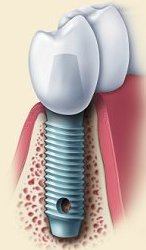
Current design of a dental implant (credit: American Association of Oral and Maxillofacial Surgeons)
Researchers are developing a method to replace missing teeth with new bioengineered teeth generated from a person’s own gum cells.
Current implant-based methods of whole tooth replacement fail to reproduce a natural root structure and as a consequence of the friction from eating and other jaw movement, loss of jaw bone can occur around the implant.
Research towards producing bioengineered teeth (bioteeth) has largely focused on generating immature teeth (teeth primordia) that mimic those in the embryo that can be transplanted as small cell pellets into the adult jaw to develop into functional teeth, the researchers say.
Remarkably, despite the very different environments, embryonic teeth primordia can develop normally in the adult mouth. Embryonic tooth primordia cells can readily form immature teeth following dissociation into single cell populations and subsequent recombination, but such cell sources are impractical to use in a general therapy.
“What is required is the identification of adult sources of human epithelial and mesenchymal [stem] cells that can be obtained in sufficient numbers to make biotooth formation a viable alternative to dental implants,” Professor Paul Sharpe, an expert in craniofacial development and stem cell biology at King’s College London’s Dental Institute, who has led the research.
The researchers isolated adult human gum (gingival) tissue from patients at the Dental Institute at King’s College London, grew more of it in the lab, and then combined it with the cells of mice that form teeth (mesenchyme cells). By transplanting this combination of cells into mice, the researchers were able to grow hybrid human/mouse teeth containing dentine and enamel, as well as viable roots.
“Epithelial cells derived from adult human gum tissue are capable of responding to tooth inducing signals from embryonic tooth mesenchyme in an appropriate way to contribute to tooth crown and root formation and give rise to relevant differentiated cell types, following in vitro culture,” said Sharpe.
“These easily accessible epithelial cells are thus a realistic source for consideration in human biotooth formation. The next major challenge is to identify a way to culture adult human mesenchymal cells to be tooth-inducing, as at the moment we can only make embryonic mesenchymal cells do this.”
The research was funded by the National Institute for Health Research (NIHR) Biomedical Research Centre at Guy’s and St Thomas’ NHS Foundation Trust and King’s College.
Comments (14)
by John
Maybe I should start a biotech company and lead the charge on regenerative dentistry. I’ve got a degree in molecular bio and a desire to utilize this technology for my own health improvement. I want to have my toxic mercury fillings removed, but the replacement filling materials available all seem to have their own toxicity issues. It would be much healthier to simply replace my teeth, or sections of my teeth, with my own teeth. I’m sure I could generate plenty of funding because people want this, so then it’s just a matter of brain power and effort and time and dedication, and assembling a team of talented people to make this happen. Only problem is I don’t want any animal experimentation to be involved, so I’d have to get around that somehow.
by alvaro
we need in this field of research people like jobs, wozniack , Gates ,page ,Zuckerberg ,etc . and maybe will not be necessary wait for 10 years
by tim the realist
No one has ever tried to cure tooth decay. This is just a new way of treating the disease Instead of curing it. This one sounds like it will be just as expensive an painful as current treatments.
Dentists, toothbrush manfacturers, and toothpaste manufacturers do not want to be out of business. If anyone really cared, there would be at least a couple of articles detailing research towards a cure.
by alvaro
There is a new technology based on hydrogels called Curodont .
http://www.credentis.com/
by tim the realist
This link is for another treatment, not a cure. It does not prevent the decay mechanism, it repairs the damage caused by decay. I want a vaccine, one shot and never get a cavity again.
by Renzo Canepari
There is an entity called Oragenics that has been working on a vaccine to prevent decay. The stock trades on the American Exchange, but I believer that they are having financial problems
by Carl
There is also this, nicknamed Keep 32 – as in keep your 32 teeth:
http://en.wikipedia.org/wiki/Keep_32
by Cara
People lose teeth through accidents and injuries as well. This could also help people who have fluorosis.
by alvaro
That’s great! . But i believe that in a near future the bioteeth will be also produced combining 3d printers , bioreactors and nanobiomaterials
by melajara
This is just the beginning of the story.
The ultimate goal is to recreate the natural process occurring when toddlers are losing their first set of teeth for the definitive ones.
This would be one more achievement in (re)programmed rejuvenation.
Note that the method emphasized in this article was already presented in 2004 with possible first trials in humans for 2007.
See http://www.telegraph.co.uk/science/science-news/3319385/Dental-advance-will-let-adults-grow-new-teeth.html
No acceleration in transitioning lab results to healthcare, to say the least :(
by alvaro
it’s true…
by Paul Denton
This is partially true. The method in 2004 was just using embryonic stem cells to implant teeth from a mouse to a mouse. The latest development utilises human tissue in combination with a mouse. A bit of an advance, but yes this is slow progress for 10 years. I guess in another 10 years, they might have the technique experimentally tested in humans, and then another 10 years to clinical practice.
by David
Ah, but would you as an adult really want to go through “teething” again? Better we adjust our diet and dental care, avoiding the need to replace them. Many young people today are growing up cavity-free.
by Tom
true, but as an adult with a mouth full of filled teeth and a chocolate addiction teething doesn’t seem so bad as more fillings.
And there are billions like me.