Blind mole rats may hold key to cancer
November 6, 2012
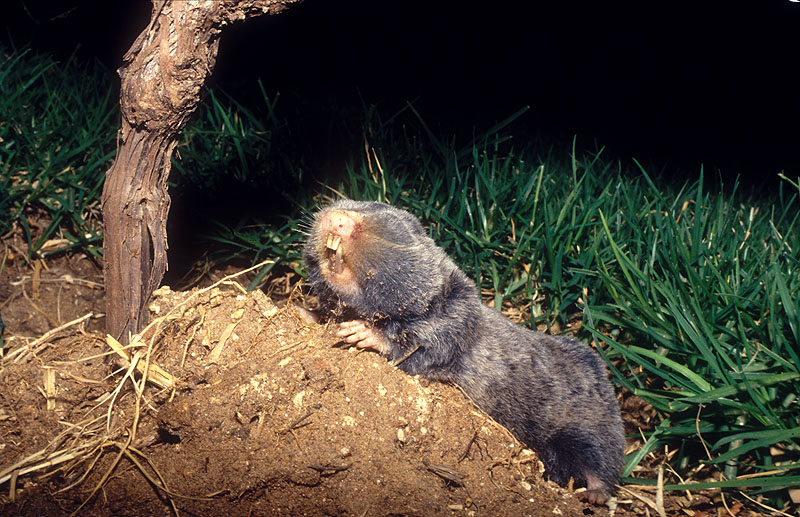
Blind mole rat (credit: Bassem18/Wikimedia Commons)
Some 23% of humans die of cancer, but blind mole rats — which can live for 21 years, an impressive age among rodents — seem to be immune to the disease.
Cell cultures from two species of blind mole rat, Spalax judaei and Spalax golani, behave in ways that render them impervious to the growth of tumors, according to work by Vera Gorbunova at the University of Rochester, Nature News reports.
“These animals are subject to terrific stresses underground: darkness, scarcity of food, immense numbers of pathogens and low oxygen levels. So they have evolved a range of mechanisms to cope with these difficulties,” explains co-author Eviatar Nevo at the University of Haifa in Israel, who has published papers on the creatures since 1961. “I truly believe work with these animals will bring a dramatic revolution in medicine.”
No biologist has yet worked out how to keep the cells of blind mole rats alive long-term in culture. But the rodents’ cells commit mass suicide when overcrowded, preventing uncontrollable proliferation, which may make the animals so long-lived: it could be a natural mechanism their bodies use to clear precancerous cells, stopping tumors in their tracks.
Comments (10)
by NakedApe
I understand that sharks and alligators have superb immune systems that make them impervious to disease. We should take some clues from them as well. Our own genetic makeup apparently makes us vulnerable to disease, particularly cancer.
by Christian Gehman
Sunlight kills?
We originated on a dark planet?
by scientist
this paper was published because one of the coauthor is a member of the national academy of science of USA and pratically can put in any paper he wishes in PNAS. Especially if he is, as Nevo is, an unrestrained, ego-maniac with no moral and ethics. He will send papers that he coauthored and has no expertise in the subject of the study so he has his name on yet another paper, to a dozen reviewers from his friends, and send to pnas editorial the two positives and get a free ride into the journal with no screening.
AS to the results: the paper is full of contradictions,there is no direct conection to cancer. There is no control to the experiment of interferone accumulation, like adding externally interferone and see if it is indeed the causative agent, and not just a result of contamination in the cell culture as known to every beginner that just got his 1st lesson in working with cell culture.
by tim the realist
Genome was sequenced last year.
http://www.nature.com/nature/journal/v479/n7372/full/nature10533.html
by tedhowardnz
Thanks Tim
Great link.
One more step on the journey to indefinite life ;)
by tedhowardnz
Ditto that.
That is a Kickstarter project I would happily contribute to.
by GatorALLin
Love to participate as well in a DNA sequencing of the mole rat to help find things that could help humans fight diseases….. but I think science funded type products would be more likely to end up on http://www.petridish.org/
by JC
I hope they are full DNA sequencing the blind mole rat as we speak!
by AZryan
I thought this has been known about these creatures for a long time now? And from what this article says, nothing new had been learned -including from a guy who has been studying them since the 60′s. But he thinks it will lead to a revolution in medicine someday. Um…ok. I guess it might, but does that deserve an article on the vague speculation?
Just seems like filler. Maybe there should be a ‘factoid’ section to note things like ‘Naked mole rats don’t get cancer -maybe that’ll help us one day?’
by Bri
I must admit that I agree. It’s very speculative that this will be applicable to humans. It’s not that I would discourage the research, and it is intrigueing that they have evolved such properties, but it is far from being relevant to human cancer. With all the advances in human cancer research, it seems like it will be cured any day now.