Carbon nanotubes to replace silicon: IBM
October 29, 2012
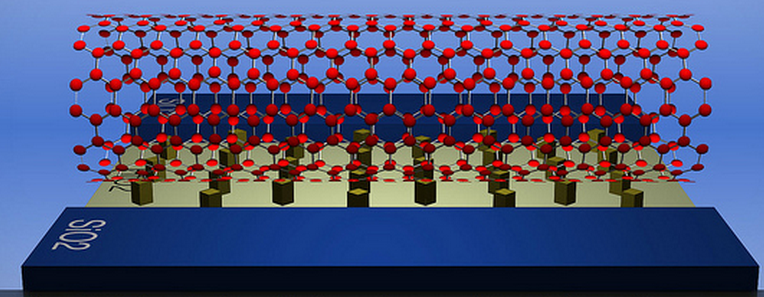
IBM carbon nanotube: The substrate gets dipped in the carbon nanotube solution and the nanotubes attach via a chemical bond to the coating in the HfO2 trenches (credit: IBM)
IBM scientists have precisely placed and tested more than 10,000 carbon nanotube devices in a single chip, using standard semiconductor manufacturing processes — paving the way for carbon technology to replace silicon in future computing and allowing further miniaturization of computing components. The development promises to lead the way for future microelectronics, with controlled placement of individual nanotubes at a density of about a billion per square centimeter.
Silicon transistors are approaching a point of physical limitation. Their increasingly small dimensions, now reaching the nanoscale, will prohibit any gains in performance due to the nature of silicon and the laws of physics. Within a few more generations, classical scaling and shrinkage will no longer yield the sizable benefits of lower power, lower cost and higher speed processors that the industry has become accustomed to.
Carbon nanotubes represent a new class of semiconductor materials whose electrical properties are more attractive than silicon, particularly for building nanoscale transistor devices that are a few tens of atoms across. Electrons in carbon transistors can move easier than in silicon-based devices allowing for quicker transport of data. The nanotubes are also ideally shaped for transistors at the atomic scale, an advantage over silicon. These qualities are among the reasons to replace the traditional silicon transistor with carbon — and coupled with new chip design architectures — will allow computing innovation on a miniature scale for the future.
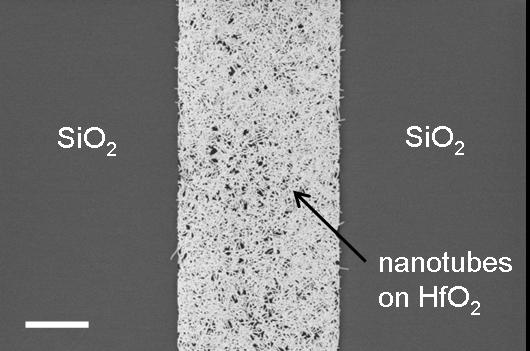
IBM SEM image of carbon nanotubes deposited on a trench coated in hafnium oxide (HfO2) showing extremely high density and excellent selectivity (scale bar: 2 μm). (credit: IBM)
The Road to Carbon
Carbon nanotubes are single atomic sheets of carbon rolled up into a tube. The carbon nanotube forms the core of a transistor device that will work in a fashion similar to the current silicon transistor, but will be better performing. They could be used to replace the transistors in chips that power our data-crunching servers, high performing computers and ultra fast smart phones.
Earlier this year, IBM researchers demonstrated carbon nanotube transistors can operate as excellent switches at molecular dimensions of less than ten nanometers — less than half the size of the leading silicon technology. Comprehensive modeling of the electronic circuits suggests that about a five to ten times improvement in performance compared to silicon circuits is possible.
Sorting out the semiconductors
There are practical challenges for carbon nanotubes to become a commercial technology notably, as mentioned earlier, due to the purity and placement of the devices. Carbon nanotubes naturally come as a mix of metallic and semiconducting species and need to be placed perfectly on the wafer surface to make electronic circuits.
For device operation, only the semiconducting kind of tubes is useful which requires essentially complete removal of the metallic ones to prevent errors in circuits. Also, for large scale integration to happen, it is critical to be able to control the alignment and the location of carbon nanotube devices on a substrate.
To overcome these barriers, IBM researchers developed a novel method based on ion-exchange chemistry that allows precise and controlled placement of aligned carbon nanotubes on a substrate at a high density — two orders of magnitude greater than previous experiments, enabling the controlled placement of individual nanotubes with a density of about a billion per square centimeter.
The process starts with carbon nanotubes mixed with a surfactant, a kind of soap that makes them soluble in water. A substrate is comprised of two oxides with trenches made of chemically-modified hafnium oxide (HfO2) and the rest of silicon oxide (SiO2). The substrate gets immersed in the carbon nanotube solution and the nanotubes attach via a chemical bond to the HfO2 regions while the rest of the surface remains clean.
By combining chemistry, processing and engineering expertise, IBM researchers are able to fabricate more than 10,000 transistors on a single chip.
Furthermore, rapid testing of thousands of devices is possible using high volume characterization tools due to compatibility to standard commercial processes.
As this new placement technique can be readily implemented, involving common chemicals and existing semiconductor fabrication, it will allow the industry to work with carbon nanotubes at a greater scale and deliver further innovation for carbon electronics.
Comments (31)
by Robi5
Maybe there should have been a few words in the article about the fact that the trace is huuge, almost 5 micrometers, and the goal is to make it 1/1000th the width and less. It’s an interim step of course and improvements will happen, but you can see in the image that the trace’s edges are fuzzy and carbon nanotubes overhang it to the extent of about 100nm. So the article could have said a few words about if and why scientists believe that selectivity/specificity can be improved by about two orders of magnitude.
by GAUSS
Because that’s how you get funding: BS your way to the top, promise results, and so on.
by grettir76
I wonder if michio kaku will be forced to make another video about moores law and will probably phrased it in something like this “We scientists/physicist solved the problem that promised to halt moores law, yada yada”
This might well be one of the more important advances in this decade if they can workout most of the problems associated with this tech. Personally im very excited by these news.
by omran al-kandari
I respect prof.kaku but i always disagreed with him hardly on AI , quantum computer and moores law , The law will keep going but on another scale .
by Gabriel
Indeed Omran, Moore’s Law’s has broadened, and once a new paradigm replaces an old one, the process starts all over again and we may continue to say this is Moore’s Law in action.
by Brian Roberts
Don’t we still have spintronics and memristor tech as well? Plus by the time those and carbon nanotubes hit the Moore’s wall quantum computing will most likely be chugging along.
by Haute Technologie
Ed,
You could start prepending your articles with a ‘Summary: New technology solves all first world problems like too many salad dressings to choose from.’ like ZDNET does, see http://goo.gl/OcOcH
So… tl;dr – in other words:
How much faster?
When? (!?!?!?!?) 8-D
by JC
All your carbon nanotubes are belong to IBM Research!
by Ravenrose
It’s never the last word, Silly Rabbit!
Tricks are for Paradigm Shifts.
by GAUSS
Interesting article, but unfortunately it’ll be a long time before we see commercially available versions. Memristor technology will have its say in this market as well.
by someday69
SOo IBM,has Test’ed,,,one’nano’tube,,,,project’,,in ah’lab’somewhere….You know we’ve been hearing about this kind of Chemistry,now,,for ,,ah’long’time,,nano’tube’this,,nano’tube’that…At least there’testing’ Something,,,,finally…/probably have computer’s run’in these chips”-Up in some 47th floor,,air’cool’d complex”hex…..or not…
by Ralph Dratman
Now children, can’t you stop squabbling? We were talking about nanotube electronics.
IBM’s nanotube array sounds like a good step forward, but I think in the end we will have to grow the carbon structures in situ. Working hard to attach them to trenches is valiant, but I doubt it will be the last word.
by Giulio Prisco
Ralph – of course the technology should and will improve, but this is a very interesting milestone that points to a roadmap for much higher computing performances. It seems that Moore will not give up so easily as the naysayers think.
by Razor
Feasible mass fabrication is the key factor here. IBM also got first to demonstrate methods to mass fab silicon/optic chips. Sure there’s any number of exotic experiments you can do in a lab that could lead somewhere, but ultimately for it to be of value it’s going to come down to how easy your method will scale up to commercial and industrial viability.
by FinisMorte
So we’re really done with Moore’s Law for silicon?
by melajara
10’000 transistors per chip is back to Z80!
They need to increase yield by 1 million for really becoming competitive with Silicon based fabs.
But they have still 8 years for doing so as nanotubes for pervasive computing is not expected in this decade.
This news fits with planned schedule.
by Daniel
This is fantastic and what it really needs are billion dollar loans from the government with their experts picking the winners so we don’t waste valuable resources. I think we should enlist the aid of those giant intellects, Paul Krugman and Timothy Geithner to tell us who will win and who will lose. Add in whatever energy czar the magnificent Obama chooses to guide us in our daily pursuit of Social Justice and we will face a brighter carbon future.
by de Broglie
“If you’ve got a business—you didn’t build that. Somebody else made that happen.”
IBM didn’t build that!
by AZryan
He was specifically talking about the infrastructure that individual businesses ‘didn’t build which is a statement of pure fact’…but feel free to be stupid and lie and post under completely unrelated topics like the crazy person you are.
by Marcos Marin
I agree with you, AZryan, BUT there is a hidden truth under his statement, IBM didn’t build that, Hitler did! =)
by Roma
You brought in the Nazis. You loose.
by AZryan
Can’t tell if you’re joking or not -which means you failed at humor if that was the goal. You also failed to spell the word ‘lose’ correctly -which does make your post look more like a joke, intentional or not.
Anyone looking at IBM can read its history with the nazis, so I hope you weren’t thinking you were being clever and calling ‘Godwin’s Law’ on Marcos’ post -’cuz you failed at that, too.
by AZryan
Your comments have nothing to do with this article, pointing out that you’re a brain-addled nutjob. For the record, few of the companies ‘Obama picked’ were losers. Meanwhile, Romney’s Bain had ~22% of the companies go under or get liquidated. But Bain always made out because the game was rigged so they couldn’t lose and didn’t use much of their own money either. Romeny was screwing people to get rich, Obama was trying to stave off an economic collapse chain-reacting with the entire system. You could argue the details (if you weren’t insane), but your ‘big picture’ B&W view is massively distorted.
by Bri
You nailed that right on the head. It’s a shame that few people see that. If Romney was so pro America, why does he have his parasitic gains in a Swiss bank account? The one percent made 1.7 trillion dollars during this economic down turn, and yet they didn’t invest in creating new jobs. Anyone who believes that giving them tax breaks is going to make them invest in America, has drunken thief koolaid!
by Bri
We have the stone age, the copper age, and the iron age. Maybe this age should be called the carbon age. LOL. At times it’s seems that everything will be built out of carbon!
by Gorden Russell
Yes, Bri, our rooftops and then our siding and foundations. Then our automobiles and robots…all carbon, all the way down.
by Marcos Marin
You guys are so annoying…
by Bri
And your ot?
by Marcos Marin
Leave my out ot of this!
by Tom Mazanec
Maybe call it the Diamond Age?
by Renzo Canepari
Bri, Glas to see I might be wrong re: the last response I sent to you, but we will see where the money comes from. If I could dictate, the federal government would finance–or give low cost loans to advance all this stuff. We have a horrible trade deficit.