Cellphones that can see through walls and detect cancer
April 23, 2012 by Amara D. Angelica
University of Texas at Dallas researchers have designed an imager chip that could one day turn mobile phones into devices that can see through walls, wood, plastics, paper and other objects.
The UT Dallas imager chip technology being explored by UT Dallas researchers is designed for imaging in the terahertz frequency range, specifically from 280 GHz (.28 THz) to about 1 THz. The terahertz frequency range is 1000 times higher than GHz (microwaves) and lower than near-infrared (which is just below visible light).
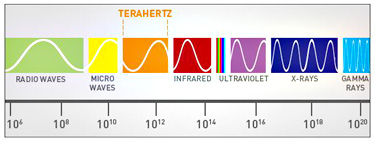
The Terahertz gap (credit: UT Dallas)
What makes this design a breakthrough is that it miniaturizes the imager, eliminating the need for a bulky, expensive lens system.
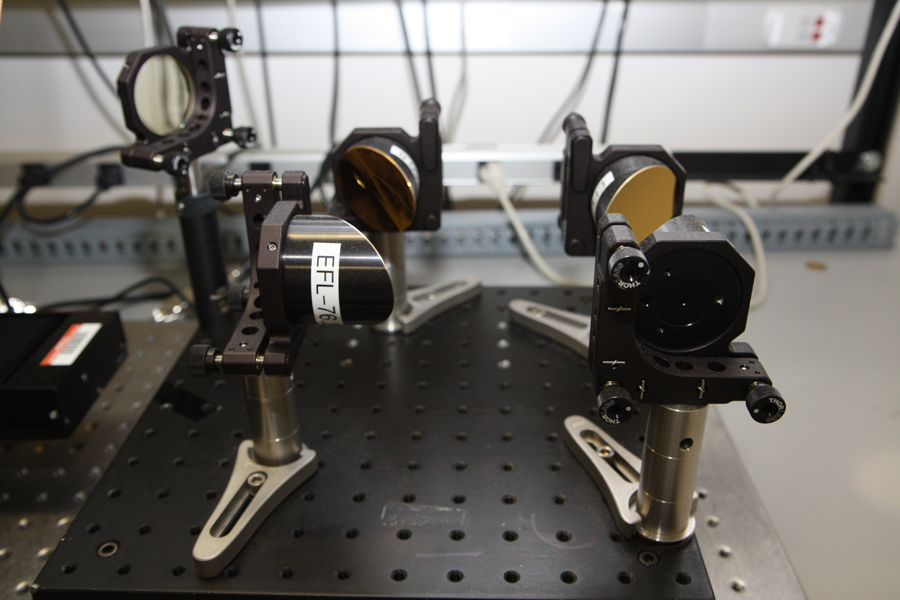
An example of the bulky lens system that would be replaced by the terahertz imager chip (credit: University of Dallas)
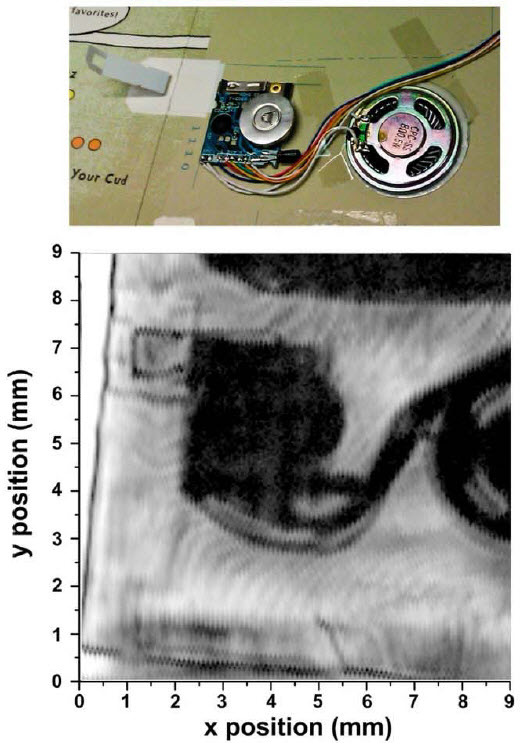
Image taken with UT Dallas terahertz imager
Instead, it uses a tiny, low-cost 65-nm or 130-nm CMOS chip with an array of sensors. (CMOS chips are used in many consumer electronic devices, such as computers and smart phones.)
According to Dr. Kenneth O, professor of electrical engineering at UT Dallas and director of the Texas Analog Center of Excellence (TxACE), “The combination of CMOS and terahertz means you could put a chip on the back of a cellphone along with a transmitter” to “illuminate” a scene, turning your phone into a device carried in your pocket that can image through walls and other non-conductive materials, or for detecting a metallic stud in a wall, for example.
One defense would be to use metallic paint on a house (and metalized glass), or your own cell-phone chip to know when someone was “painting” you (in the language of military radar).
Dr. O said the initial applications, once the chip is further developed, would be detecting imperfections in important documents or counterfeit currency, and for inspecting devices in manufacturing. It could also be used for detecting cancer tumors, diagnosing disease through breath analysis, and monitoring air toxicity, he said.
How it works
According to a technical paper by Dr. O’s team (including researchers at the University of Florida and Cornell University) published in the 2012 International Solid State Circuits Conference Proceedings in February, the proof-of-concept unit the team developed uses a 4×4 pixel array (for 16 pixels).
They created two designs, using Schottky-Barrier diodes, operating at 280 GHz and 860 GHz. This device has a limited range (about four inches).
In an email interview, Dr. O explained several interesting technical aspects of the system to me. “We are currently targeting applications between 200 GHz and 1 THz,” he said. For those frequencies, the wavelengths are ~1.5 mm to ~0.3 mm, so “the resolution will be on that order.”
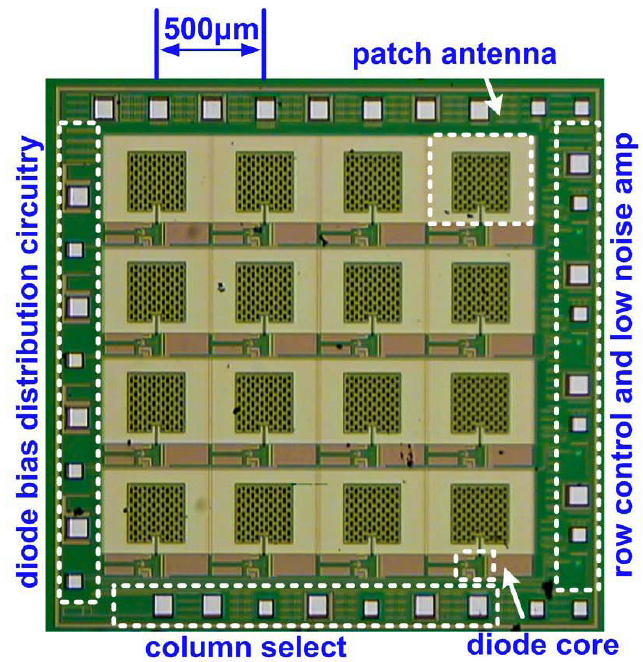
Terahertz sensor array
Future developments

Tricorder concept (credit: Qualcomm)
The .3 mm resolution is especially interesting because that’s better than can be achieved with most MRI systems. In the future, one could conceivably develop such an imager to replace a huge, expensive MRI system for imaging cancer for example — avoiding the radiation risks with X-rays.
A sensor array with 10,000 sensors would greatly increase the resolution and range, he said. “A 1000 array design at 280-GHz and 10,000 array design at 860-GHz will not be a huge engineering challenge and cost can be in the range for the consumer market.”
This technology could perhaps also be incorporated in a “Tricorder” type medical diagnostic device (see “T-rays technology could help develop Star Trek-style hand-held medical scanners” for another terahertz-scanner design).
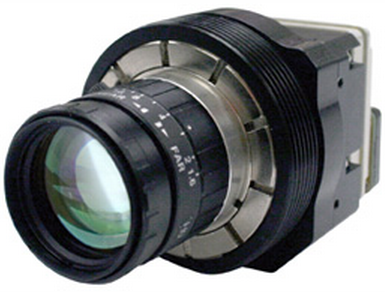
Current thermal imager technology (credit: FLIR)
So what is the ultimate upper frequency limit? “Responsivity of a given diode at a fixed operating condition drops by 10X as you increase operating frequency by a factor of 10,” said Dr. O.
For higher frequencies, such as 32 THz (the frequency at which humans, at 98.6 degrees F, radiate, or glow, as seen in thermal imagers), or 17 THz (the frequency at which objects at 68 degrees F, or room temperature radiate), his guess is that future lens-less imaging might be achievable, but at a limited range (less than a few centimeters).
ADDED 4/25/2012: Meanwhile, we’ll all be living in Faraday cages. On the plus side, we’ll be less vulnerable to EMPs.
I”m guessing the first chips will be incorporated by DIY hackers (Arduino One + Gameduino for VGA out or Arduino BT for wireless link for real-time laptop display or recording), with the pin-head-size imager hidden in clothing.
Next, the technology will be miniaturized into augmented-reality glasses with “X-ray vision” mode. That will lead to THz electronic countermeasures (jamming, deception, etc.) and sub-millimeter cloaking for privacy protection.
Law enforcement and TSA will inevitably also adopt this technology, replacing the TSA’s hazardous X-ray machines. Passengers will have to decide whether to dress “virtually naked” (no metallized outer garments), or be forced to remove their metallized outer garments for inspection — hopefully in private. ADDED 4/28/2012: GraphExeter, a new graphene-based material invention just announced, will allow for clothing covered with a transparent radio-frequency protection.
As the imager’s frequency response extends from ~1 Thz up toward 32 THz (human thermal radiation) in the future, it’s going to get even more interesting, since we are all illuminated bodies at night….
Also see: Graphene lenses for electrons