Chinese-made unmanned vehicle passes freeway test
January 24, 2013
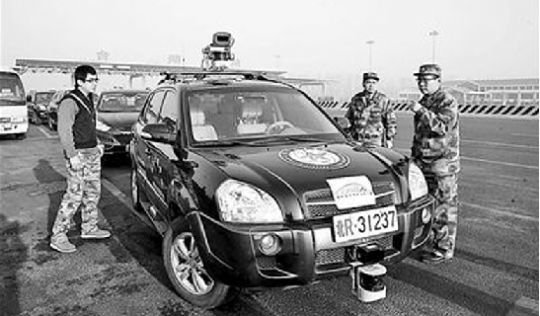
Unmanned military vehicle passes 114-km freeway test (credit: China.org)
An unmanned vehicle designed by Military Transportation University of the PLA (MTU) recently won top prize in the fourth Future Challenge, a contest for intelligent vehicles, China.org.cn reports.
The vehicle, a third-generation prototype named “Fierce Lion 3,” completed a 114-kilometer journey within 85 minutes, with a top speed of 105 kilometers per hour, making itself China’s first unmanned vehicle to pass a freeway test.
Third party certification agencies, including National Natural Science Foundation and Beijing Institute of Technology, deemed that the vehicle had successfully completed the journey with no human intervention, and that its technology had reached a “world-class” standard.
Fierce Lion 3 was directed to complete a wide range of maneuvers on the freeway, including cruising in one lane, following traffic, changing lanes, passing slower traffic, and responding to human instructions.
The vehicle is equipped with an override system to allow human intervention, to prevent the vehicle from causing damage to the passengers or other vehicles in case of emergency.
The in-car computer system controlled the entire journey, including acceleration, braking, passing, and pulling up. The researchers only set the vehicle’s destination coordinates.
During the trip, Fierce Lion 3 passed slower traffic 33 times. The autopilot system even once refrained from making a pass after the radar detected the rear traffic was coming in at too fast a speed to make the maneuver safe.
Observers said they saw the vehicle darting away, “as if an experienced driver was holding the wheel.”
The vehicle was equipped with radars, video cameras and a sat-nav device.
Three cameras monitored the front and side traffic, sending lane marks and buffer zone visuals to the computer. The radars detected the distance between the car bumper and the traffic in front, advising the computer either to accelerate or to slow down.
Three computers, including one for backup use, analyze all information and control the mechanical system similar to a passenger jet’s fly-by-wire avionics.
A professor from the MTU, Xu Youchun, said computer-controlled driving is safer, as maneuvers are more precise and road rage is eliminated. He said the computer strictly ensures a safe braking distance of 100 meters.
In total, MTU’s unmanned intelligent vehicles have registered over 10,000 kilometers of test drives. The cars’ performance has been stable on both urban streets and rural roads.
Regarding the future application of unmanned vehicles, automation expert Zheng Nanning, member of the Chinese Academy of Engineering, said such technology could save manpower in military logistics. A transport convoy would only require one driver to lead the group.
Also, in civilian use, Nanning said, an unmanned vehicle could take over the vehicle to reduce driver fatigue and allow the driver to doze off safely, and if connected to the Internet and the cloud, an in-car system could provide optimized directions.
Eventually, he said, unmanned city buses will be possible.
Comments (26)
by Infinitos
i do enjoy driving sometimes but lets get real , computers can drive better than us , they let other cars to pass by peacefully , and it doesn’t road rage , it also doesn’t text while driving , its perfect while your driving home or to work you can read the news / check your emails.
i will buy one for sure .
by Carol Hu
Dear Infinitos, I am a Chinese student. I am now working on my undergraduate dissertation, would you mind sparing a few seconds for my short interview about the future of work?
by Editor
Sure, go ahead and ask. I’m sure you’ll get a lot of good ideas here. Welcome to KurzweilAI, by the way!
by Carol Hu
Thank you for your email. I am going to study what will happen to the future work with the development of high tech. I am lost now, because I find there are so many different ideas about the dispute. To relate to the situation of work, could you please help me to identify where I should start?? Thank you very very much.
by Bri
@Carol Hu: Hi! Welcome to our blog. The future of work is an issue that I take special interest in. I feel it is inevitable that AI and robotics will out perform humans in any endeavor. This causes me concern in relation to how economics will function in the near future. Ray Kurzweils predictions postulate that in less than thity years AI will be many times more capable than humans are now. From what I understand he feels we will augment our mental capacities in order to maintain the current financial paradigm. I stand in opposition to this thought. I feel there are several dynamics which will preclude this. First, AI will be able to advance much more easily. A human will have to acquire the upgrades and integrate them into there minds. An AI would only have to be replaced by an employer. As an employer myself, I find AI and robotics very atractive. A robot will work 24 hours a day, seven days a week with no complaints. It will only cost the price of replacement. A human worker will be much more expensive because it must be paid wages. Humans need breaks and like to talk. A robot will not. It won’t need sick days. If a robot gets sick(breaks down) a replacement can be available almost instantly. That replacement can utilize any learned skills from the previous robot. A human would need job specific training. Robots can be designed for very specific tasks. Ones that humans would have difficulty performing. A group of robots can be synchronized to accomplish complex tasks very easily. Human on the other hand don’t sync up well. Our minds tend to wonder to things like friends and family. These and other issues lead me to believe that an employer will always favor robots with strong AI capabilities. If this turns out to be the case it will undermine the foundations of finance and capitalism.. We need the income from jobs in order to consume. If people are put out of work by robots, they will not have money to spend on cars, clothes, or anything. Without the flow of consumer dollars, businesses won’t have customers. I envision a system similiar to communism. If all businesses around the world deposit thier income into a central bank, then everyone would have access to the profits from business. We humans wouldn’t work. The robots woukd. We would consume. This type of system hasn’t worked before because of a number of reasons. Greed being one of the biggest ones. I feel the system could work if there was a strong AI directolibg how much finances flow to individuals. There are many issues to consider, but I think it could be achieved. One thing is certain. Many jobs will be lost to robotics and AI. It will have a very destabilizing effect on society. Government needs to study these issues and come up with solutions or otherwise many people will suffer. It is one of the most important issues that we face in the near future. It has the potential for serious social unrest and collapse. There is no way to stop the trend toward AI and robotics. We need to understand the dynamics of these issues and make plans in accordance to them. I hope that I have been helpful. These are my opinions. Not everyone shares my belief in this outcome. As I’ve said, I feel they are inevitable.
by Carol Hu
Thank you so much for your sharing. Do you believe that the combinatorial exposion of innovation can create more jobs in the future, rather than eat out all jobs ?
by Bri
Yes for more robots and AI. We will try to adapt by training for new jobs, but robots and AI will be created faster than we can adapt. It’s not like the invention of the light bulb. The industrial revolution opened up jobs that only humans could do. Those people who lost there jobs before could find higher paying jobs that they trained for. Now all the advantages that humans have will be quickly copied. When AI becomes as smart as humans we lose the advantage. I think of it quantitatively. List the new jobs that you think will be created and think if a human will be able to out compete a human level or better AI in a totally adaptable robot body. Even creative jobs will be lost. It’s not like any job transformation before. One of the fastest growing job areas is health care. In a short time Tony nano scale robots will keep us healthy and doctors will lose their jobs to tiny robots. The trick to understanding this issue is understanding what happened before and why. Then understanding what is happening in the future. The speed of technological change is happening at an accelerating rate. Soon it will be much faster than our ability to change occupations. That is my belief.
by Editor
Bri, you raise some important questions. I just spoke with Carol via Skype. She is writing a dissertation (for a B.A. (Hons) International Business Management) at the University of Nottingham Business School (China campus) on an exciting and important topic: the future of autonomous vehicles and their impacts on society and workers. I hope you and others can help with ideas and contacts.
by Bri
It’s important to explore these issues. Even if it is similiar to the light bulb analogy, it will have profound impacts on society. All the jobs in association to the automotive industry will be affected. A UPS delivery truck is one example. With a humanoid robot and an automated truck. There would be no need for a human job. With fewer accidents there will be fewer collision repairs. Less insurance adjusters. The net effect is fewer jobs. All those people will need to retrain for other occupations. This same effect will happen over every field of job opportunity. Take a high paying job like a surgeon. The DaVinci system costs over a million dollars now but it will be very inexpensive soon. It remembers all the physical actions that the surgeon performs. Soon expert systems like Watson will data mine all that information and a robot will have the experience of all the previous surgeons. There is no way for a human to acquire that information. Apply this mind experiment to every job. The outcome is the same. Even when it comes to being an Einstein and doing cutting edge research. Robots will be able to outperform humans in less than twenty years. In twenty years the rate of accelerated change will be many times faster than today, making this effect be even more dramatic. If we implement a socialized, communistic capitalism hybrid, everyone can have access to the abundance that is coming. If not, the very foundation of commerce will be undermined. We need to be aware of this force of change and refine the potentials of these three forms of human commerce. A complete and unbiased examination of what are the failing points of these systems can bring us to a new era of prosperity. Everyone can live like millionaires because that would stimulate commerce. The money spent woukd go back into the system. In my opinion it woukd have to be moderated by AI. Humans are prone to greed. When cell phones are the size of red blood cells we will be able to participate in this process in a much more connected way. Society has the potential to be more civil. The main issue is understanding the forces at play. That will happen soon. Watson type expert systems with above human intelligence will quickly ferret out the trends and advise us as to the outcomes.
by Dennis R.
Once driverless cars are ubiquitous can we please increase the speed limit? A top speed of 105 km / hour doesn’t seem that impressive…
by Paul in Vancouver
I’m pretty sure the 105km limit was self-imposed to comply with local speed limits during testing. Once the technology is perfected, I can forsee special lanes on U.S. highways with speeds well in excess of 100mph (160km)
by David
I hope we have driverless cars by the time I am old, so I won’t be stuck at home or in a nursing home.
by Paul in Vancouver
The first countries to have mainstream driverless cars will benefit from huge advances in productivity and safety. I’d give it another ten years.
by Mjr_Dzaster
Cool…let’s eliminate even MORE jobs! That’s EXACTLY what a planet with an out-of-control population needs…less jobs for human beings. lol!
by GatorALLin
…could it be this new technology will be eliminating crashes…. maybe this creates new opportunities vs. the fear of losing jobs
by Joseph
Yes, not just fewer drivers but fewer insurance agents and repair workers as well. I find that the world, in general, is either ignorant or in denial of the coming impact of automation. I often have dead end discussions with airline pilots who proclaim with absolute certainty that we will not even have single pilot airliners within 50 years… let alone autonomous airliners ever. And pilots are supposed to be “tech” savy!
by David
Google “Broken Window Fallacy”
by David
The cost of insurance will go down. Less repairs means more money in your pocket to spend on other things, like your child’s education, your own retirement, a new computer, a new TV, repairs for your house, new carpet, a boat, and many other ithems that will tend to indirectly create more jobs in tother sectors of the economy.
by Paul in Vancouver
The transition to a driverless car economy will be far less painful than the transition from horse and buggy to automobiles at the turn of the last century.
by David
Yeah, just like the time when the light bulb was invented and took away jobs from all of those people making kerosene lanterns. Or the time when the kerosene replaced whale fat and took away all of those jobs slaughtering whales.
People thought that automation would take away jobs, but there are now more jobs than ever. The number of jobs worldwide keeps going up year-after-year. Automation increases productivity making us all wealthier.
Since so many people will live, due to safer roads, when cars become completely automated, people who would have died will keep their jobs. I guess if they died, then that would open up a job for someone else.
by Elliott
Ding, ding, ding……Give David a hand for his spot on comments. Change is never easy, and, in may cases not welcomed. We either embrace it or fight it but it is inevitable. Let’s hope that our technological develops unfold faster than our ability to pollute or fry ourselves before we run out of time. Only further technological development will be able to find ways to improve our energy needs, produce sufficient food for our world population needs because medicine will continue to extend our lives. And it goes on and on.
by ChrisF
That’s not much comfort for millions of taxi, truck and bus drivers across the world who will lose their incomes because of this technology, many of whom will struggle to find replacement jobs. The world as a whole may become richer as a result, yes, but that says nothing how those gains will be distributed.
In the long term, I’m a techno-optimist – I look forward to a world in which nobody has to work in order to feed themselves and their loved ones, thanks to the existence of a basic guaranteed income or something of that nature. But I fear that the next decade or two are going to be very difficult for a great number of people. Automated cars are but the first step…
by Carol Hu
Hi David, what do you think will happen to the future job considering the impact of tehcnology? I am a Chinese student from University of Nottingham, Ningbo China. I am now working on my undergraduate dissertation about the future of work.
by brownt
Sorry to state the obvious but that is where we are heading… For the 1st time we are faced with a paradigm shift in human social structure. Driverless vehicles is only the beginning. We need to start having discussions on how human society adapt to these revolutionary technologies
by trakk
cheesy name for the vehicle…..but otherwise a significant achievment.
by GatorALLin
Next up…. get them to send a rover to Mars with self driving AI and some really good cameras….