Clothes will sew themselves in DARPA’s sweat-free sweatshops
June 11, 2012
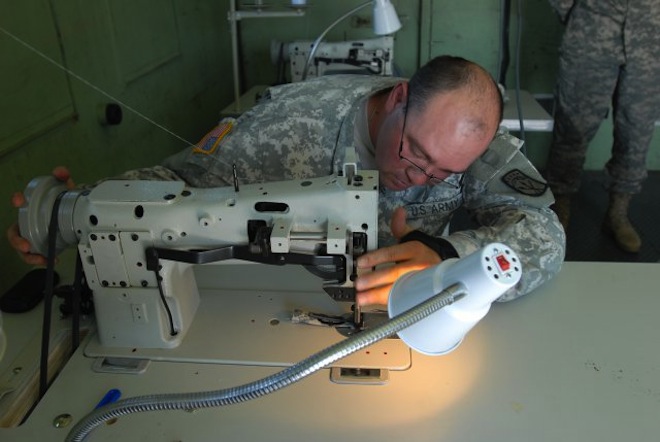
Soldiers might one day live in a world where sewing machines work without human effort (credit: U.S. Army)
DARPA has awarded $1.25 million to fully automate the sewing process, Wired Danger Room reports.
One 2010 estimate put the military’s annual clothing budget at $4 billion dollars.
SoftWear Automation Inc., has so far developed “a conceptual” version of the automated system. According to its website, it is a robotic system that relies on an extremely precise monitoring of a given fabric’s “thread count” to move it through a sewing machine in the proper direction and at the right pace.
Dr. Steve Dickerson, the company CEO and a robotics and engineering researcher, along with co-authors from Georgia Tech, elaborated on his robo-tailoring science in a 2010 paper, presented at a robotics conference in Tokyo.
First, an “overhead, pick-and-place robot” grabs the necessary pieces of fabric and places them at the head of a sewing machine. The appliance itself would be equipped with “machine vision” capabilities, specific enough to spot and track individual fabric threads to “provide fabric location information” to actuators that operate the sewing machine’s needle and thread, and “budgers” — motorized balls, underneath the sewing machine that latch onto the fabric via vacuum seal — that move the material to and fro.
According to the company, automated sewing “appears to allow cutting and sewing at costs less than in China.”
Not to mention far fewer allegations of human rights violations. An estimated 50,000 workers are employed by contractors producing military garb, many of them earning “[wages] below the poverty line [and] the median sewing wage in the industry,” according to a 2010 report from The American Prospect.
Of course, it could also mean the decimation of jobs worldwide, as well as dubiously constructed garments.
Comments (9)
by Jan Parker
It would be wonderful to stop the exploitation of garment workers, they have been mistreated for centuries. As a casual home sewer I know how difficult it is to sew, and to do it every day is pure torture. More robots the less humans that are catagorized into a lower status as inhuman in order to keep walmart prices lower. We have soon many more people to clothe very soon so this problem will definately come to a head.
by Guillermo
I think that it’s quite possible that this will actually help China’s disastrous workers exploiting to be ended, not worsen it. Of course, you can say that this may also mean the decimation of jobs worldwide, but I tell you that what many chinese workers had was worse than having no job. Also, if the chinese government doesn’t find a decent employment for these people, it will mean a crisis for China as you all say, as their clothes manufacturing bussiness will drastically decrease. However, my hope is that the result of this threat is the realization of the Chinese government, that their situation was unsustainable and unethical, and so, after an innevitable period of crisis needed for nearly any change, maybe something better will surge.
by Paul
This technology is in conceptual stages only, and atleast 10 years away from commercial viability. It will be a great advancement in manufacturing automation, and will free up workers to do less repetitive tasks.
by Editor
“10 years away”: source?
by Spikosauropod
I still think this would be a tragic thing to do to China. They are extremely dependent on U.S. sales:
http://www.forbes.com/sites/gordonchang/2012/01/22/china-is-175-6-dependent-on-the-u-s/
If we start building robots to do the work of Chinese employees, it could spell disaster—not just for them, but for everyone. I think it is plainly evident that the moment one of these things works properly they will be rolling off the assembly line. How long does it typically take for a high demand product that is essential to competitiveness to saturate the market?
Once they work properly and someone is manufacturing them, there will be no turning back. No one will be able to stop the wheels from rolling.
Part of me says that this is inevitable, but part of me says that we don’t have to push quite so hard. I mean, really, DARPA? Someone commented in one of the forum threads that business has become warfare. Are we back to mercantilism?
by Editor
Re “tragic thing to do to China”: yes, and indirectly, to the countries that China buys from and invests in (like the U.S.). I think it goes further. For example, a low-cost 3D scanner (let’s say, based on a Kinect, with recognition software) and a killer app could generate the data for low-cost, instant, numerically controlled machine-generated, custom-designed clothing for each person, eventually (quickly?) bypassing entire clothing and retail industries. Ditto for furniture and other consumer (and business) products. Where does this lead us?
by Saul Wilson
Also, if poor people who don’t work in the garment industry don’t need to spend as much of their income on clothing, they will have more options on what to do with their money. Choice causes stress so maybe we should protect the unpleasant jobs of some poor people so that other poor are not over stressed.
by Saul Wilson
My dream of having kids who can grow up to work in sweatshops has been dashed.
But this project will need to develop the ability to do more than simple seams since pockets and zippers and joining sleeves to shoulder are probably a bit more involved than the pick and place system can handle on it’s own.
by gaoptimize
This completes the worst fears of the Luddites. Though not arround to witness it, their intellectual spawn will no doubt decry this development.