Creating complex 3D metallic structures at nanoscale
October 21, 2012
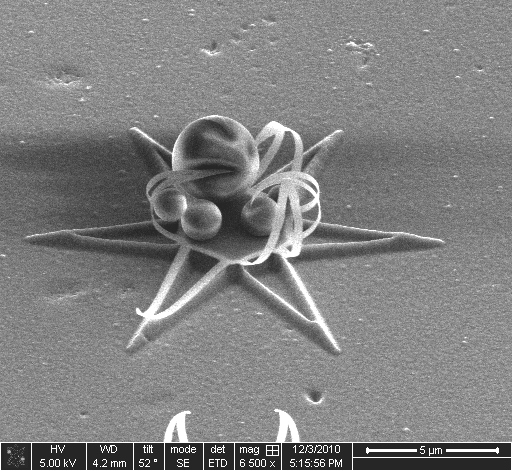
Microparticles of lactose are trapped in self-organized structures made from thin-film metal. (credit: Khattiya Chalapat, et al./Aalto University)
Scientists from Aalto University in Finland and the University of Washington have demonstrated how to create complex 3D structures at nanoscale by combining ion processing and nanolithography.
The fabrication of many objects, machines, and devices rely on the controlled deformation of metals by industrial processes such as bending, shearing, and stamping. Is this technology transferrable to nanoscale? Can we build similarly complex devices and machines with very small dimensions?
When dandelion flowers bloom, if you cut the flower stem into small strips and put them in water, the strips will fold with observable width-dependent curvatures due to differences in the water absorption between the inside and outside parts of the stem.
“Our idea was to find a way to adapt these natural processes to nanofabrication,” said Khattiya Chalapat of Aalto University. “This led us to an incidental finding that a focused ion beam can locally induce bending with nanoscale resolution.
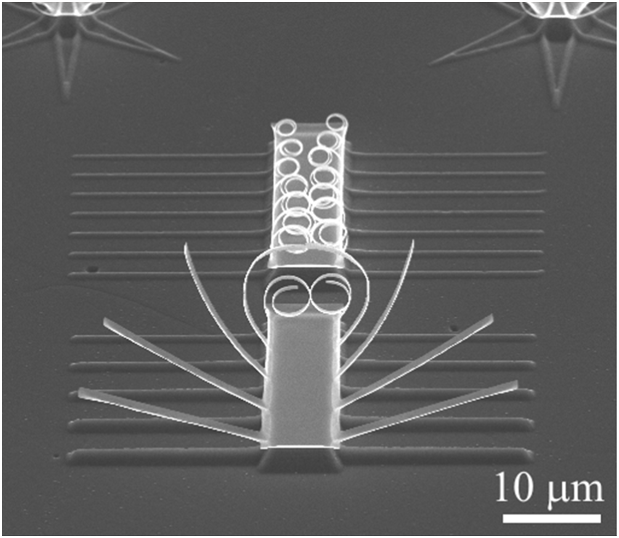
Folding of metal thin films by reactive ion etching (credit: Khattiya Chalapat, et al./Aalto University)
“The technology has applications in the fabrication of nanoscale devices. The structures are surprisingly resilient: the team found them to be quite sturdy and robust under a variety of adverse conditions, such as electrostatic discharge and heating.
Because the structures are so small, the coupling and the magnitude of typical nanoscale forces acting on them would be commensurately small.
“We have demonstrated so far that these structures can capture and retain particles with dimensions of the order of a micrometer,” said Sorin Paraoanu of Aalto University.
Comments (9)
by seeker
Would you like to breathe in air full of such nanoparticels ? this looks scary
by Chalapat
Thank you for your comment. I was thinking the same when I first saw the SEM images of all the nanoparticles (either natural or artifically-made).
But, after I talked to some chemists, I have realized that many people are developing these lactose particles for medical uses.
Some particles are used as powder for respiratory drug delivery:
http://www.sciencedirect.com/science/article/pii/S0939641106002906
by Chalapat
When considering respiratory problems, some people are actually more sensitive to natural microparticles.
For examples, pollen from flower,
http://en.wikipedia.org/wiki/Pollen
by Gorden Russell
The air already has nanoparticles in it. People with hay fever find pollen very scary. But they survive, and what doesn’t kill you makes you stronger.
by thepiper
read up on some of the chem-trail sites. It’s already in motion.
by Vin
Intel should probably look into this for 3d transistors.
by Gorden Russell
And once they do, Vin, there will be a 3D printer and robot that print out and assemble a focused ion beam unit to build these Intel 3D transistors. Then the robots can become von Neumann machines, replicating with the speed of bacteria.
Has anybody here ever taken a course in microbiology? In the lab you culture bacteria by plating them out on a medium of agar mixed with nutrients and poured into a Petri dish. You do this with a little glass rod with a nickel-chrome wire tired in a loop at one end. You sterilize the loop in the flame of a Bunsen burner then stick it in a test tube of nutrient broth that has already been inoculated with a single bacterium. Then you plate it out by rubbing the loop across the surface of the agar and put the lid on the plate.
As a student I would do plate out my samples in an afternoon lab, put them in the incubator, then forget about them until after breakfast the next morning. Checking on my samples before class I would find that each little germ would have grown to a large colony (just like in the movie, “The Andromeda Strain.”)
Now if you start with a single 3D printer, a single robot, and one focused ion beam unit (each printer capable of replicating itself and the robot and focused ion beam in a day), in 30 days of 24 hour operations you will have over a billion robots and printers and ion beamers.
This will drive down the cost of these things until they are sold for a few per cent over the cost of the feed stock and delivery. But they will be delivered by robot trucks that came out of printers, so delivery will be cheap. Even the fuel for the trucks can be synthesized out of air and water and sunlight once you have robots printing out solar arrays next to Hoover Dam.
Pundits at the New York Times will print out Op-Ed articles crying about the “Robot Plague.”
Just check it out with your calculator. Punch in “one times two” and hit the “equals” key 30 times.
by Vin
I quite like the video. Reminds me of ‘Andromeda Strain’. :D
by Bri
Great movie. ” helleva way to run a hospital!”. The music really helps.