‘Creative right brain’ myth debunked
March 7, 2012 by Amara D. Angelica
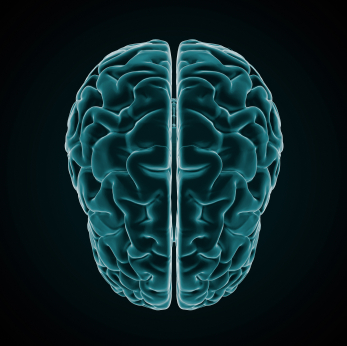
Yet another brain myth bites the dust, joining “we only use 10 percent of our brain,” and other pseudoscience nonsense that tries to cram people in nice neat boxes.
The left hemisphere of your brain, thought to be the logic and math portion, actually plays a critical role in creative thinking, University of Southern California (USC) researchers have found, at least for visual creative tasks (and musical, as previously found).
“We need both hemispheres for creative processing,” said.Lisa Aziz-Zadeh, assistant professor of neuroscience.
The research team used functional magnetic resonance imaging (fMRI) to scan the brains of architecture students, who tend to be visually creative.
While being scanned, the subjects were shown three shapes: a circle, a C and an 8. They then were asked to visualize images that could be made by rearranging those shapes — for example, a face (with the 8 on its side to become the eyes, the C on its side to become the smiling mouth and the circle in the center as the nose).
The students also were asked to simply try to piece three geometric shapes together with their minds and see if they formed a square or a rectangle — a task that requires similar spatial processing but not necessarily creativity.
Even though it mainly was handled by the right hemisphere, the creative task actually lit up the left hemisphere more than the non-creative task. The results indicated that the left brain potentially is a crucial supporter of creativity in the brain.
Aziz-Zadeh said she plans to explore more of how different types of creativity (painting, acting, singing) are created by the brain, what they have in common, and what makes them different.
Deconstructing the right-brain myth
The “creative right brain” myth apparently originated from misinterpretations of Roger Sperry’s split-brain experiments on epileptics in the 60s, which earned him a Nobel Prize in 1981. It has already been debunked.
See, for example, University of Washington neurobiologist Dr. William H. Calvin’s excellent 1983 book, Throwing Madonna:Essays on the Brain (the text of chapter 10, “Left Brain, Right Brain: Science or the New Phrenology?” is accessible here).
Despite that, there are still lots of suppliers of education and training materials based on this myth, and lots of bureaucratic teachers, self-help writers, financial charlatans, polarizing politicians, and quick-buck counselors eager to put people into programmed slots where they can be easily manipulated and controlled.
Ref.: Lisa Aziz-Zadeh, Sook-Lei Liew, and Francesco Dandekar, Exploring the Neural Correlates of Visual Creativity, Social Cognitive and Affective Neuroscience, 2012; [DOI: 10.1093/scan/nss021]

Comments (16)
by Matt Gaidica
I think “myth” and “debunked” are a bit strong for the findings in their paper. In fact, it supports hemisphericity, and so does most scientific literature. The confusion appears when we start to decode hemispheric interaction, whether it be inhibitory or excitatory. We don’t say that we have debunked the myth of automobiles by stepping backwards and saying, “aha! the engine and battery work together, they are in fact the same thing!” Popularization and abstraction is a toxic byproduct of society, but we do have two hemispheres, and they are specialized.
by Nigel Collin - Thinkativity
Creativity thrives on structure, so this makes absolute sense. Ying and yang. What is more important is out understanding of the role mindset plays in helping us tap into our creativity. Rather than are you left or right, we should be asking (as per Carol Dweck in her book Mindset – well worth a read) are you fixed or growth mindset?
by Steve
Never bought this idea. Interesting to see I was right in my caution. By far more interesting than the whole “left-brain/right-brain” thing was the recent publication of images of the cubic grid structures found in brain structure. Better long-term stuff than pseudo scientific and fragile conjecture.
by s
Yes its funny that THIS is the “science” debunking that which was “myth” (also “science”)… and the assumption that logic/match plays no role in ‘creativity’ is not anything intelligent/creative/any-kind of person has ever thought (including those who believe in left.right), so of course there is cross-over whereby one side is intimately involved in the workings of the other. It’s not new & this disproves nothing.
by Greg
@Beatriz. You answered your own question, the right brain thing is a “belief” which is no longer supported by the facts, like the belief that the world is flat. And you know what happens when you assume? ass – u – me!
by Zack
I knew I should’ve argued that question on my psych. final more…
by k
Well…..no one region of the brain acts separately. All regions act in tandem. So while the right part alone is not responsible for creativity, it still is the main region with help from other regions .
by Sebastian Marincolo
Interesting study, but the myth that “all creativity exclusively originates in the right hemisphere” doesn’t seem to be very popular idea these days anymore anyway. For a better view on the role of the left and the right hemisphere in thinking see Ian Mc Gilchrist’s “The Master and his Emissary”. And here is something on marijuana and the enhancement of creative thinking + insights:http://sebastianmarincolo.wordpress.com/2012/02/15/marijuana-insights-myth-or-reality/
by Davide Pintus
http://www.youtube.com/watch?v=SbUHxC4wiWk
For anyone intersted in the subject.
by Fred Stitt
We architects are well known for being cross wired –
actively pursuing analytic/synthetic/aesthetic/technical
chores simultaneously. A high percentage are left handed
not to mention dyslexic. So the sampling taken was
not a “normal” population. I’d still buy the results nonetheless.
by gawells
“put people into programmed slots where they can be easily manipulated and controlled.”
I wouldn’t count on that.
by christian
“I’m not clear why this research is even needed.”
Instead of attacking the feeble popular idea of what the amazing experiment reveals [split brain experiment], we should join forces with those who seek to understand it better [like the people conducting this study].
If you cannot comprehend why research like this is interesting, you have in mind the wrong target [for instance, debunking a stupid myth]. The target you _should_ have in mind concerns the nature of the mind as a whole. How it processes information, how it can be conscious, and so on.
That we can divide the mind in two parts, and see that they can function independently, and tend to function differently,* can bring to light both questions and truths regarding the holistic processing of information in the brain, the nature of consciousness and the nature of personal identity.
A slight difference in the nature of each hemisphere, may, in a split brain patient give rise to two quite different consciousnesses. To me, this seems plausible, and extremely interesting.
*For instance, according to wiki, language production is mainly based in the left brain for 90% of right-handed individuals. There’s also a wide consensus about the fact that lesions to the different hemispheres tend to have different effects/symptoms.
by Editor
You’re right. Corrected.
by Peter Gluck
A very good paper; the right hemisphere is actually the
acceptor of memes.
This is the reason for which the Bisinisencephalians will
save the World- they are immune to all the memes.
see papers with the label BIDINID on my blog Ego Out.
Thanks,
Peter
by Beatriz Valdes
Well I am one of those lagging on the theory of left hemisphere being the critical, cultivated side, and the right the non-language imaginer with visionary potential. I am not sure that just because of one experiment, we should be ready to debunk this long held belief! I read the books of a couple of neurologist researchers, one of them a Nobel Laureate, Dr. Eddelman, and they still work on that assumption.
by David
The cerebral hemisphere wikipedia page does a good job with a basic explaining of what is going on in the two hemispheres and addresses the pop psychology misinterpretations of hemisphere specific functions:
http://en.wikipedia.org/wiki/Cerebral_hemisphere