Dark matter’s tendrils revealed
July 5, 2012 | Source: Nature News
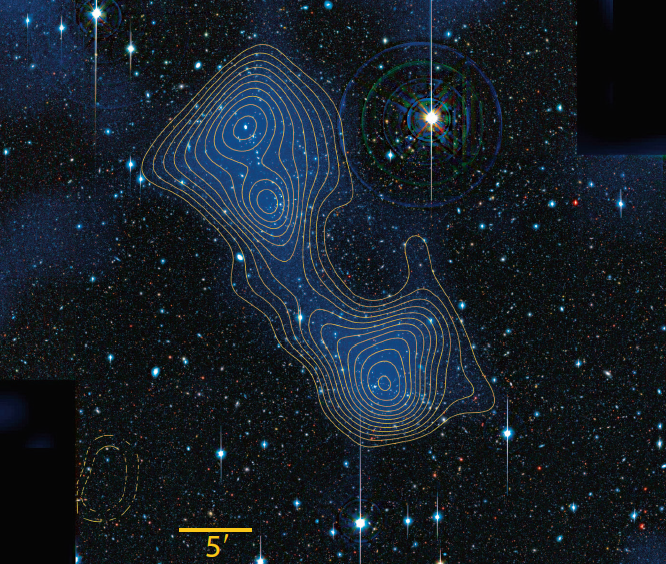
Dark-matter filaments, such as the one bridging the galaxy clusters Abell 222 and Abell 223, are predicted to contain more than half of all matter in the Universe (credit: Jörg Dietrich, University of Michigan/University Observatory Munich)
A “finger” of the Universe’s dark-matter skeleton, which ultimately dictates where galaxies form, has been observed for the first time.
Researchers have directly detected a slim bridge of dark matter joining two clusters of galaxies, using a technique that could eventually help astrophysicists to understand the structure of the Universe and identify what makes up the mysterious invisible substance known as dark matter.
The presence of dark matter is usually inferred by the way its strong gravity bends light travelling from distant galaxies that lie behind it — distorting their apparent shapes as seen by telescopes on Earth. But it is difficult to observe this “gravitational lensing” by dark matter in filaments because they contain relatively little mass.
By examining X-rays from plasma in a dark-matter filament, observed by the XMM-Newton spacecraft, the team calculated that no more than 9% of the filament’s mass could be made up of hot gas. The team’s computer simulations suggest that roughly another 10% of the mass could be due to visible stars and galaxies. The bulk, therefore, must be dark matter, says Dietrich.
Japan’s Astro-H X-ray space telescope, due to launch in 2014, will be able to characterize the ionization state and temperature of the plasma in the filament, which will help to discriminate between different models of how the structure formed.
Refining the technique could also help to pin down the identity of dark matter — whether it is a cold (slow-moving) particle or a warm (fast-moving) one, like a neutrino — because different particles will clump differently along the filament. The Euclid space mission, due to launch in 2019, will provide more lensing data. “This will complement direct dark-matter searches, for example at the Large Hadron Collider,” says Alexandre Refregier, a cosmologist at ETH Zurich, the Swiss Federal Institute of Technology in Zurich.
Comments (12)
by Mortran
I’d be rather willing to believe in the “dark side of the Force” than in dark matter.
The truth is our current equations don’t work for the large scale structure of the universe. So scientists simply add an unknown variable, so they can keep using Newton’s gravity law. However dark matter has not been observed, detected or reasonably described.
If we need 10 times the matter than we can actually observe to keep Newton’s equation working, then the equation is probably wrong.
It’s just that simple.
No dark matter, no dark energy,. If the gravitational constant is not a constant when it comes to large scale distances, then it could also explain the phenomenon. And we don’t need to invent invisible things.
Saying that dark matter is responsible for the vast majority of mass in the universe and holds the galaxies together is not better then saying it is some supernatural god who does it. Neither of them can be observed.
In fact Obi Wan Kenobi’s explanation about the “Force” from Star Wars sounds more convincing : “It surrounds us and penetrates us. It binds the galaxy together.”
Dark matter, the Force – it’s more or less the same pseudo-scientific babble.
by rob falgiano
@ Khannea. I have sometimes wondered if dark matter has been ‘engineered’ by highly evolved intelligent beings for the purpose of preventing the universe from slowing it’s expansion. Especially if we were headed for a “Big Crunch” as the result of the distribution of observable matter. I realize this is just idle speculation, but it makes for a nice sci-fi premise.
by Marcos Marin
On the contrary. It keeps galaxies from falling apart. The engineering part was closer though. :)
by George
A Big Crunch is required for a Chardin-Tiplerian Omega Point.
http://en.wikipedia.org/wiki/Omega_Point#Tipler
by Jamie
When I first started to read the article, I was under the impression that dark matter had actually been observed directly as it was seemingly implied, at least to me anyways. However, apparently it was deduced that once the visible portion had been elimimated, the remainder was dark matter.
However, is it still true that we still have no clue as to what it could possibly be?
by Marcos Marin
Yes.
by Gerald Larson
I have an ignorant question for any knowledgable physicist. Since we know the Higgs field is real, can dark matter be explained as density fluctuations of Bosons imparting more mass to the observable matter? In other words, the matter we observe in these filaments simply has more mass than we would expect because the Higgs field is more dense?
I am not a physisist so perhaps this sounds dumb?
by Marcos Marin
You were subjected to too much news out of the higgs boson “discovery”. :)
No, this would be too ephemeral.
by Bri
If Newtons laws work on earth, but not in space, to alter them to account for the observed problem, seems even more of a fudge factor. I thought the Higgs field was the “force”. Without it, everything would be zipping around like light. Passing through everything else. No galaxies, no stars. Not even a chance to pack, protons, nuetrons, and electrons into an atomic package, from solar fusion! Feel the force Luke!
by Bri
I’m suprised no one wants to answer this question. There is a tremendous amount of missing mass. Most of the mass necessary to hold a galaxy together just isn’t there! If you increase the effect of the Higgs field enough to replace this missing mass, then all the stars would collapse into black holes. Even small increases of strength would change the spectral absorbsion lines, as light( no mass) reacted with the denser matter. Dark matter works over long distance, not atomically. That’s why they call it dark matter. Ordinary matter isn’t affected, other than over vast distances, as it holds galaxies from flying apart. Higgs field affects anything that has mass, so it’s measurable. We can detect it’s effects, so it’s not “dark”. It’s because of it’s effects that we new how to find it, and it’s because of dark matter effects, that we know where to look for dark matter. Just like it was for the higgs, the hunt is on for dark matter!
by Khannea Suntzu
Hmm maybe someone should do a video of a quick moving traveller that crosses the intergalactic at tens of thousands Ly per second, in which you can see the gravitational lensing caused by dark matter halos. This would be quite insightful allowing an intuitive grasp of these mass clouds, relative to visible galactic bodies.
Also – dark matter is matter right? If advanced civilizations would be able to harvest this substance we could be arguing a Kardashev-IV new classification for a civilization, where a polity of intelligent beings would be able to churn up (and turn in to matter?) dark matter cloud particles.
Question remains, how do you create a big and impenetrable enough scoop to funnel in such loosely scattered material…?
by Marcos Marin
You don’t.
But hey, you are contradicting yourself. If you say dark matter is matter (as much as anything physicists can or cannot detect will be of course) then why would such smart people need to turn it into “matter”?!