Designing the interplanetary Web
April 17, 2012
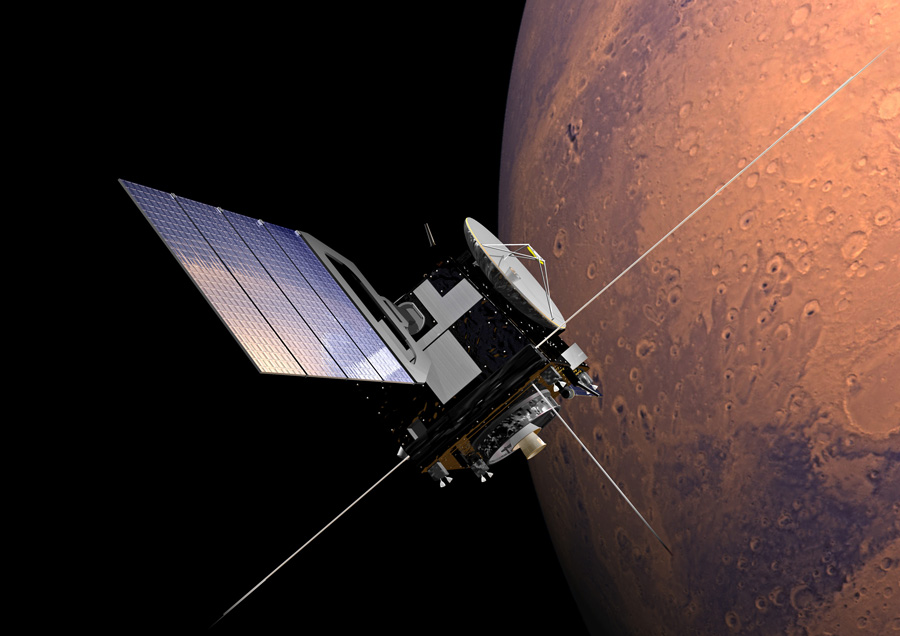
Networking in space: Mars Express (credit: Alex Lutkus/ESA)
Reliable Internet access on the Moon, near Mars, or for astronauts on a space station are some of the pioneering technologies that the European Space Agency (ESA) is working on for future exploration missions.
In the future, rovers on Mars, inhabited bases on the Moon, or astronauts on asteroids will be supported by orbiting satellite fleets providing data relay and navigation services.
“We are researching how today’s technical standards for devices like mobile phones, laptops and portable computers can be applied to a new generation of networked space hardware,” says Nestor Peccia, responsible for ground segment software development at ESA’s Operations Centre in Darmstadt, Germany.
“But our future focus goes well beyond just networking; we’re looking at how agencies like ESA and NASA cooperate in orbit and how to interchange data in real time between different organisations’ spacecraft and ground stations, as well as reliable technical standards for spacecraft navigation and flight control.”
In the future, inter-satellite communication requirements are predicted to grow, and spacecraft should be capable of establishing powerful radio links with each other — even while orbiting Mars at thousands of kilometers per hour.
In October, an astronaut on the International Space Station will practice remotely controlling a test rover located at ESA’s Operations Centre to simulate orbiter-rover communication links at a planet like Mars. This, too, requires robust communication links to allow astronauts, robots and control center to work efficiently together.
These and other topics are set to be discussed at the CCSDS conference in Darmstadt on 16–19 April, which will bring together international space organizations from 20 spacefaring nations including ESA, NASA, ASI, CNES, Roscosmos, DLR and JAXA.
Also see: Communicating with the universe