Disruptions: next step for technology is becoming the background
July 10, 2012 | Source: New York Times
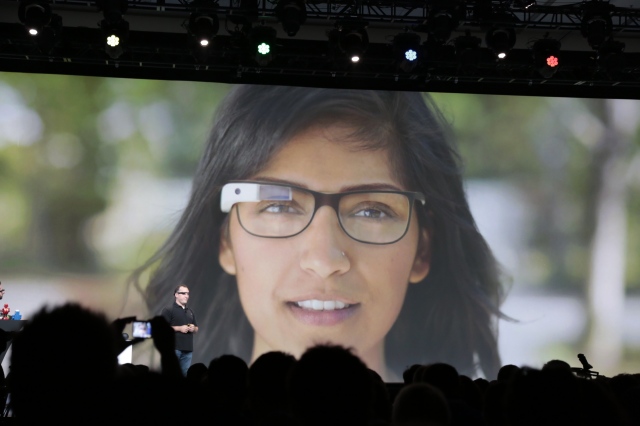
The invention of the motion picture enabled visual storytelling and at a mass scale unimaginable before.
The equivalent to that moment is happening right now with the advent of wearable computing. These wearable technologies like Google’s glasses that project information right where a person is looking will have the same effect on smartphones and computers as the motion picture did on books.
The screen of Project Glass sits off to the side, clear and unobtrusive. You interact with it when you need to. When an e-mail or text message comes in, you can look if you want, or simply ignore it.
When technology gets out of the way, we are liberated from it. Wearable computing will free us from peering at life through a 4-inch screen. We will no longer have to constantly look at our devices, but instead, these wearable devices will look back at us.

Comments (20)
by Tom Sherlock
I think we will need this type of display if we are ever going to be able to do any meaningful work on mobile devices. My present project SoLaTiDo requires a near eye display, in order to make a wearable computer capable as a word processor, CAD system, gaming platform, and musical instrument. With the present input/output limitations of mobile devices, we will only be able to download and tweet.
by Dayhawk
I dont see this as becoming something that ever one will want. Hell our cell phones are computers and people make better one all the time.
by Phil Osborn
This and the implications of it for society are covered in immense detail in Vinge’s “Rainbows End.” In RE, published 2007, Vinge predicts the Google self-driving car as well as “wearing” – a term that Google has been using just recently to describe wearable computing, integrated with their glasses. Vinge goes one step further, with haptics and instead of glasses, contact lenses. If there is any one book that I would recommend to the layman for a comprehensive overview of the near future, this is it. I also liked his version of UPS, circu 2025, in which packages are fired ballistically to their destinations, effectively parachuting right into the recipient’s arms – requiring, of course, a close coordination with other air traffic, but perfectly doable when virtually everything is wired.
And, of course, when you are “wearing,” then you can carry ghost riders who experience what you are experiencing, or do the same yourself, creating a new kind of profession, in which people compete for ride shares of their lives, making it important to pack one’s life with desireable experiences.
The main worrry that I have is that this can become yet another sensory overload, distracting us from serious thought. I recall in the early ’90′s using a system on my little Amiga 500 that could do realtime video capture at a rate of 1~2 frames per second. So I was streaming the stop-frame video of the TV news while retaining the full audio, and, right away, I started noticing that suddenly I could SEE the camera angles and other details that normally went right thru me. I realized later that the “normal” TV experience is calculated to keep you in a state of sensory/cognitive overload, in which all your processing is devoted just to following a fraction of the stream flooding through your senses. Slowing that flood and reducing the largely useless detail – like all the milisecond changes in expression of the newsreader’s face – freed up a whole lot of processing power, a factor in my decision to forego TV altogether and stick with the net. I fear that the glasses will cause a similar plumetting of available cognitive resources.
So, if you don’t wear – or turn off much of the system, then you pay the price that I do today in terms of not having the fashionalbe cultural/artistic references to the most popular TV shows. On the other hand, you may preserve more of your analytic capacity. I predict that many people will make their whole lives revolve around the wearable experience, while others will choose to be the new nerds, oblivious to fashion and focused on meaning. Shades of Pirsig’s “Zen and the Art of Motorcycle Maintenance.”
by Trismegistus
I can’t wait for this stuff. I’ve never been able to to truly immerse myself in a 14 inch computer monitor.
These glasses will make gaming, internet browsing, e-book reading much better.
by GMoney
nice bit of transitional technology but the ultimate method will be direct stimulation of the appropriate areas of the brain. eliminate the middleman entirely.
by MatthewQ
Been dreaming about that for so many years. Once we achieve that- that’s the singularity right there. We will become something new as a species at that point- even without AI or mind-uploading.
My thoughts directly into your mind. My thoughts directly into everyone’s mind. It should be possible to get all humans on the same ‘wavelength’ very often when that happens. Emotions and ideas shared by billions in the blink of an eye. Politicians getting instant support or outrage for proposals. A good idea being able to bypass alll the BS and red tape…
Well, I shouldn’t get started. I could go on and on. I’m sure everyone who reads this site has similar thoughts. That’s why we come here ;-)
by daleziemianski
I’m sure eventually your Google-Glasses type devices will also be able to warn you while you’re driving if you’re going out of the lane or if you’re gonna hit something – that is, if your Google-Car isn’t driving itself already
by MatthewQ
Be even better if they just make a car that drives you everywhere. I got better things to do with my time than navigate the streets. It’s a cool individual thing (driving) to be able to do but seriously, I could get so much reading/studying/work done during a one hour commute if I didn’t have to be the monkey holding the steering wheel.
Be nice to be able to take a nap or just kick back and watch the scenery as well.
by Ron Abate
I would worry about using these devices while driving.
by GatorALLin
reply to Ron….. I agree that we already have a problem with using our cell phones while driving. State of Florida for example has no laws against distracted driving yet…. I work close to a community college where you can look over by the road where students drive in… One day we counted 34 cars driving in and of just those 34 cars, 17 of them actually had their cell phone in one hand and steering wheel in the other hand (texting or holding the phone up to view screen). Maybe even more were on their phone, but phone was not above the steering wheel where I could see it. At least glasses would likely let you have 2 hands on the wheel. (I would vote for very strong distracted driving rules for FL btw). I don’t think the need for multi-tasking will ever go down…. I just hope the tools they create help make the use more hands free…
by Arn
“…like, officer, I thought that car was, like… on my screen,…I swear!…”
by Khannea Suntzu
I wager that as technology goes into full abundance, ubiquity and stealth mode, humans will slowly change their lifestyle from the current psychotic state of scarcity-trauma, and revert to a very relaxed Pleistocene tribal hunter-gatherer mentality. Hopefully a little Bonobo for good measure.
by Barrett Hoffarth
We certainly live in exciting times! I take 8th grade students to Washington D.C. in the spring every year. One of the best places we go is to the Gettysburg battle site in Pennsylvania. It would be truly amazing for the students to look at Devil’s Den, the Peach Orchard, Little Round Top etc. with these glasses. They could instantly see information about these places projected on their eye. This could all be done without intruding on the tour. This is just one small example of how this kind of technology will change the world. I look forward to watching these devices come to the mass market.
by GatorALLin
…reply to Barrett… I agree that it would be so helpful to have in a museum like setting where as you look it could give you more info…. they do that now on museum tours, but with a headset you wear and listen to info as you go. Some are on a timer to auto play when you pass certain points….some play automatically assuming you are walking forward in a set path…. visual ones to add to this would be the next upgrade. I understand that Google and others hope to do that for the Entire world using Google maps…. and not just the museum… . what if the entire world was your learning pod? cool!
by as always
“Gettysburg battle site” “Aim, pull the trigger, maim, kill.” What a terrible thing to teach children, or for that matter, anyone.
From history we learn that we learn nothing from history. Dumb cavemen and women that we are.
by MatthewQ
So… Are you saying we should not teach history?
History is more than just battles and war. War does happen though. Has always happened. Perhaps better to lie to people and pretend these things do not happen? You’re entitled to your opinion but I would prefer my children knew the state of the world and how we got where we are.
Also, the scenario the other ppster mentions doesn’t just apply to battle sites. If you use your imagination a little bit you could see how you could overlay information at any historic site. The other poster is using Gettysburgh as ONE example.
by as always
I get your point. I’m not against teaching history. Quite the contrary. It’s accurate history you want? Me too. Show them what war is. Show them the billions snuffed out of existence at an accelerating pace during man’s short history. Ask them do they think we still need more of it and would they like, perhaps, to participate? Make them see that a species is primitive if it is against its own species. There is no better proof of this than war.
But, as you know, they don’t. Somehow they manage to twist it and glorify it, leaving you with the impression that there’s something noble and honorable in the utter insanity that it is: murder.
They present it as a legitimate means to extend political power. War is politicians’ way of finishing the sentence: “Well, since you don’t agree with me and don’t do what I want…”
History is full of things more worthy and interesting than the production of dead bodies.
by Barrett Hoffarth
I was not suggesting that students would see a visual recreation of the Union and Confederate soldiers fighting at Gettysburg. I was referring to the concept where the students would be able to see the names of the physical features of the battle field. It is important to know these if you want to understand why the Union won this decisive battle. This is but one of countless examples that would be possible in a history class.
Don’t tell me that you are naive enough to believe that if we simply stop talking to the youth of America about war and violence then they will “forget” about their natural instincts to use aggression to get what they want. Do you truly believe that ignorance about the past events of history will allow peace to reign throughout the world? If you would spend a little time trying to understand what is going on with young people, you will know that there is a proliferation of bullying right now in our society. Those who forget the past will repeat the very same mistakes. It is essential that young Americans learn about the history of the United States and the rest of the world. As a teacher I am excited by the opportunity to use new technologies to make history more accessible to my students.
by infrastructure? what infrastructure?
“the very best thing that infrastructure can do is disappear completely”
http://www.joelonsoftware.com/articles/DevelopmentAbstraction.html
by Bri
Another Ray Kurzweil prediction comes true. In SN he said, augmented reality glasse should become available early in the teens. 2012 right on target!