DNA’s half-life identified using fossil bones
October 10, 2012
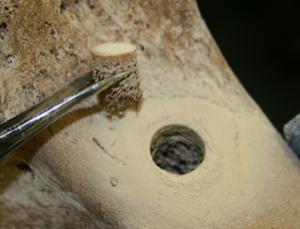
Moa bones give up their DNA Image (credit: M. Allentoft)
A study of bones from extinct birds suggests the double helix too has a measurable half-life — and that we have underestimated its ability to survive in the fossil record, New Scientist reports.
Part of the reason a DNA half-life has been so elusive is that it is hard to find a large enough cache of samples that have been exposed to similar conditions. The moa bones they used were all between 600 and 8000 years old, and came from a 5-kilometer-wide area of New Zealand’s South Island, key factors for helping identify a regular pattern of decay.
With an estimated burial temperature of 13 ºC, the DNA’s half-life was 521 years — almost 400 times longer than expected from lab experiments at similar temperatures, says Allentoft.
Half-life of 158,000 years
The oldest DNA to date belongs to insects and plants and was found in 450,000 to 800,000-year-old ice. Under subzero conditions, Allentoft and Bunce estimate that DNA’s half-life can be up to 158,000 years, meaning the last remnants would disappear around the 6.8-million-year mark. Allentoft does say that is an optimistic assessment, and doesn’t imply that samples of DNA large enough to measure could be extracted from such old bones.