Do we live in a computer simulation? How to test the idea.
December 13, 2012

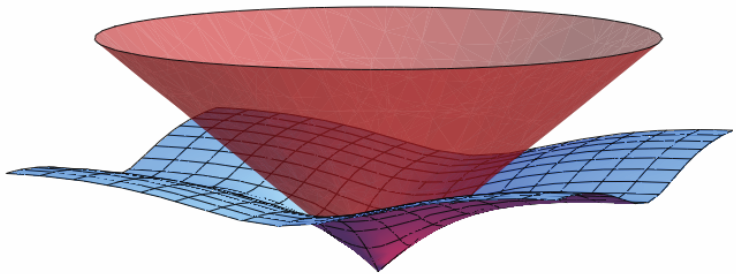
The energy surface of a massless, non-interacting Wilson fermion. The continuum dispersion relation is shown as the red surface. (Credit: Silas R. Beane et al.)
The concept that we could possibly be living in a computer simulation has been suggested by science writers and others, and was formalized in a 2003 paper published in Philosophical Quarterly by Nick Bostrom, a philosophy professor at the University of Oxford.
With current limitations and trends in computing, it will be decades before researchers will be able to run even primitive simulations of the universe. But a University of Washington team has suggested tests that can be performed now, or in the near future, that could resolve the question.
Currently, supercomputers using a technique called lattice quantum chromodynamics (LQC), and starting from the fundamental physical laws that govern the universe, can simulate only a very small portion of the universe, on the scale of one 100-trillionth of a meter, a little larger than the nucleus of an atom, said Martin Savage, a UW physics professor.
Eventually though, more powerful simulations will be able to model on the scale of a molecule, then a cell and even a human being. But it will take many generations of growth in computing power to be able to simulate a large enough chunk of the universe to understand the constraints on physical processes that would indicate we are living in a computer model.
However, Savage said, there are signatures of resource constraints in present-day simulations that are likely to exist as well in simulations in the distant future, including the imprint of an underlying lattice if one is used to model the space-time continuum.
The supercomputers performing LQC calculations essentially divide space-time into a four-dimensional grid. That allows researchers to examine what is called the strong force, one of the four fundamental forces of nature and the one that binds subatomic particles called quarks and gluons together into neutrons and protons at the core of atoms.
“If you make the simulations big enough, something like our universe should emerge,” Savage said. Then it would be a matter of looking for a “signature” in our universe that has an analog in the current small-scale simulations.
Savage and colleagues suggest that the signature could show up as a limitation in the energy of cosmic rays.
In a paper they have posted on arXiv, they say that the highest-energy cosmic rays would not travel along the edges of the lattice in the model but would travel diagonally, and they would not interact equally in all directions as they otherwise would be expected to do.
“This is the first testable signature of such an idea,” Savage said.
If such a concept turned out to be reality, it would raise other possibilities as well. For example, co-author Zohreh Davoudi suggests that if our universe is a simulation, then those running it could be running other simulations as well, essentially creating other universes parallel to our own.
“Then the question is, ‘Can you communicate with those other universes if they are running on the same platform?’” she said.
There are, of course, many caveats to this extrapolation. Foremost among them is the assumption that exponential growth of computers will continue into the future. Related to this is the possible existence of the technological Singularity, which could alter the curve in unpredictable ways.
And, of course, human extinction would terminate the exponential growth — or its simulation.
Comments (67)
by Believer
I believe in God.
by Amy
What they left out of the article was that they’ve PROVEN we live in a simulation. They’ve met the simulators. And yes, it is an advanced culture. The part they didn’t want to let you know was that we are an app, played on tiny devices written by the equivalent of a 13 year old. We are a science project and a Science fair and it didn’t win!!! We BORED the judges.
by Fortunado Smith
Tron?
by bill
Detecting that we are in a simulation is only possible if there is a bug in the simulator.
Add a sufficient financial incentive to locate and exploit any such bugs and the hacker community will take it from there. ;-)
Even then, it’s pointless, and we’d never know anyway. The authors of the simulator can fix the bug, reload from a snapshot and continue the simulation, preventing us ‘simuloids’ from using the exploit _WE_ found, or even being aware we had discovered it in ‘a parallel universe’ | ‘prior incarnation’ | [insert religious philosophy here].
Kinda nice for them, code that finds its own bugs.
by dayhawk
if our world is a simulation. what happens if you turn it off. dose it make us not real. then you have to ask your self who is running the simulation and why. my last question on this is who made the simulation. these are not easy questions . we may never find out and if we do will it be a good thing or a bad thing..
by dayhawk
simulation or not til we have the facts we are going to have deal with what we got for the moment. Its all ways been my thought that we each live in own universe with in our self. of course this just my opinion.
by Jerrik
Phillip K Dick already had the idea in the 70′ies
http://www.youtube.com/watch?v=jXeVgEs4sOo
by Swifty
I think that it is proposed that Bostrom is the first “professional philosopher” to support the concept, so now it’s not just geeks and matrix fans.
Anyhow, the principal questions are: what is meant by “computer” and what is meant by “simulation”? Simulation of what?
by egore
It would seem to me this is a way to prove God doesn’t exist. If you can make life out of nothing, then you might be able to prove this.
by Xavier
I am just curious and I am not saying one thing is right or wrong, but wouldn’t the possibility of creating life out of nothing prove that there is a “God”? I think that idea of “our/a creator” that people have will be proven scientifically possible.
by D
That proves no such thing. Who made the simulator?
Silly argument
by Xavier
Can you elaborate on your statement? Why it proves no such thing, what do you mean by who made the simulator, and why it’s a silly argument? I derive nothing from your statement but a lack of thought into the discussion. I am not saying you are dumb, ignorant, nor am I saying I am right. I am just curious of the possible outcome. Maybe by explaining, I will see what you see.
by Mr.X
@Xavier:
Really.If you’d really care about truth at all, you’d go out of your way and learn some basic stuff about reasoning, logic et al.And science (method, not content).
Unless you do this, there is no point in really adressing your claims, since you just wouldn’t get it.
Ps: Stop shifting the burden of proof.
Pps:
Why do people feel the need to repeat claims they picked up at church or sth like that, which have been adressed by smart people again and again, again and again!?
And why do you use all these guarding “terms”.Just be honest, and strip away all the verbiage.Your “arguments” alone give away your position.
by Xavier
I’m waiting to read an answer or point of view, not a response that explains nothing. What if I tell you that I don’t believe in god, that I don’t go to church, that I have a degree in a field of science, and that I have read multiple books and articles relating to the subject. It’s simple. Answer the question then, show me that you’re smart and don’t tell me that there are other people out there I should listen to. Why should I listen to someone who can’t provide an answer or at least attempt to. I am not trying to attack anyone, it was just a thought.
by Mr.X
Xavier:
Question answered between —————’s ;)
“What if I tell you…”
Then you’re a liar.Excuse my honesty, I am not trying to attack anyone.Your affilation doesn’t change anything, if you’d be after the truth of the matter you’d consider it irrelevant.
” tell you that I don’t believe in god, that I don’t go to church, ”
E.g why should you go to church as atheist^^ And if you do it for social reasons, why do you think this is something relevant to this discussion?Redundancy or lie, or faulty reasoning;)
I heard lying is a sin to some christians, and taken literally you didn’t even claim not to do these things.Trying to avoid something?^^
“have a degree in a field of science”
Why don’t you get more specific?
Btw: A scientist who reasons like a non-scientist is no better than the latter.This is the kind of monkey mentality which makes the scientific method a necessity.Either something is true as to what we can now right now, or it is not.It doesn’t matter who pronunces it.
You don’t even know why it is not logically entailed that the ability to create something by material manipulation doesn’t mean that everything has been “created.” You want to have a degree in some field of science!?This explains why intelligent people tend to favor auto-didactism.Or you’re a lying
Anyway: Which field would that be? E.g: Knowing how to stitch someone together doesn’t mean you understand science.There is a difference between content and method.
“that I have read multiple books and articles”
Btw: Reading doesn’t equal understanding.And books and articles already are plural, why do you add multiple!?To add some “gravitas”?
———————–
To answer your question: Of course, a god is a possibility.If you’d be a scientist, you’d know that the respective (that pertain to this matter) fields work with probabilities instead of certainties.
This means, that the possibility of a god proves exactly nothing, and can’t be proved.Nor entirely disproved.The likelihood is what matters.And you should do some meta thinking and see that there is a difference between your state of knowledge and the external world.Which means you don’t know in the sense the “normal people” would define knowing.Your “knowing” belongs to the fields of classical logic, which is built to resemble the structure of western minds (indo-european language) and not reality itself.
The ability of humans to create life means that you’d have to adjust your probability for a “normal” (pretty provincial, too, since there are many people who think in different ways about this) god downwards!
How about some micro clowns singing “the xavier song”, in the restaurant at the end of the universe, as creators of 56.7948% of the world.This is possible too, for all we know.
———————————-
“It’s simple.”
Well, not comment.
“Answer the question then, show me that you’re smart”
I don’t need your approval.I just said you can get moving and start some research yourself instead of pestering us with your ridiculous pre-enlightenemt notions.There are reasons this is taught in several COURSES.If you’d wanted “bulletproof” reasoning, you’d not expect to read thousands of sites condensed in one comment, or would you.
Or whom are you trying to convert!?
Have a nice day:)
Ps: Creating LIFE out of NOTHING?You’re arguing definitions… the exact reason why we had to throw off the yoke of christianity in order to progress.Do you know the fable of the invisible dragon?
by Sea Bass
Well, if I finally reached singularity and my knowledge of the universe is infinite …. I would be infinitely bored. The only logical next step would be to do it all over again, and see how it plays out.
I would make a universe within my universe, a simulation of my universe (inflation leads to a cold rip, cold rip isolates a seed used to start a Big Bang). Or destroy my universe to start a new one (big crunch collapses to a seed used to start a Big Bang).
I would use a Turing machine. In my new universe I could participate (God), observe (relativity), or do both (singularity).
by Anthony
Folks settle down………There is no evidence that a computer simulation can create real senscience/consciousness……not to mention the reality that we know. It may be likely that a computer simulation of the universe is dead.
The behavior of Quantum mechanics proves nothing except the behavior of Quantum Mechanics itself….in short, it may prove that the apparent instability of the universe on that scale is just the nature of Quantum Mechanics not the limitations of an artificial power source. Somehow, I just don’t think we live in a simulation, although simulations may be possible I doubt they will acheive real self-awareness and this kind of infinite sophistication.
by Arelkatz
If we are a simulation, thinking about it isn’t going to change anything.
by Editor
… unless it’s generated by our combined thoughts
by foo
Such inflated sense of humanity’s importance — “we are part of a simulation.” Whatever helps you sleep at night, dear. How about this theory — random cosmic fluke, followed by a random DNA mutation? Hello “intelligent” life form.
by Anonyville
The Universe is Physical. The real question is are we AI? Why build another universe when we can’t even expand Technology to explore our own. Until, we can escape the confines of our planet then it is pointless to even consider developing a alternate reality.
by nolvis
with respect to what you says:
I think distance has proved to be one of the most important constraints of the universe. The fact that we can´t go beyond the solar system is a real physical limitation. But at some higher level, distance may be a manifestation of something else, another abstraction can be used to explain and understand it.
So, may be, travel big distances is not more important than investigation of how the light interact with the othe matter at nanoscale, or discover new ways to obtain energy to keep the civilization safe and in constant progress.
The answers may be here, in the abstractions of our minds along with our tecnological advances aimed to carry new challenging experiments.
by Damon Montano
@Anonyville
I totally disagree. There is no rule that states, “Thou shalt not experiment with advanced computer science until your species develops a colony on another planet.” The two are obviously entirely independent.
by Dan Robinson
Of course “we” can’t write a program to simulate our observation of our own universe. This article was the holodeck reasuring it’s artificial characters that they’re real, while leaving just enough doubt to make us interesting. There can never be proof one way or another, whatever level of reality we’re in. “Computer, end progam.” … Nope, it never workes.
by Editor
First paragraph revised to correct origins of the “are we living in a simulation?” idea.
by Damon Montano
@Ray Kurzweil
Analogous to the X-Prize Foundation’s method of setting a goal, then rewarding the first party to achieve that goal, I extend that idea to computer science. As computer power grows to the level where universes can one day be simulated, a reward could be offered for the first team to evolve a “Simulation Infinity”, an initial universe simulation which produces an infinity of deeper level simulations within it. In the simulation, complex intelligences must arise who could eventually discover the scientific method, computation, and begin running their own simulations. Once a research team develops the ability to create a universe with digital intelligent entities within it, such a universe may or may not automatically generate a Simulation Infinity. To test the research team, you would only need to set up the initial parameters and then fast-forward the simulation (the entities within would still experience their own relative time) to see if these initial parameters produced the Simulation Infinity- endless simulated universes within universes, an infinite inward spiral of digital universes. A team that could accomplish this would have the capability to see into the simulations of “deeper” simulations embedded within the original, as they would be piggy-backing off of it. My question to you Ray is this- would a correctly coded universe, one that was designed and had succeeded in producing a Simulation Infinity Outcome, reveal its success by overburdening the hardware’s resources? Would a finite computer system be incapable of handling an infinite number of simulations produced within it by entities within it, or would the piggy-backing inner simulations only require the computer level above’s resources?
by MaxPanic
The arrogance of some of you technical people seems to be that you can’t understand why someone would simulate our universe. I can think of about a zillion possible reasons. for example, 1. To test all people and see which ones will display the correct abilities/talents/thoughts/humility, etc, etc… I am looking for. 2. Our universe could be a competitive platform for determining who will become the most rich or the most happy or the most ? 3. Our universe could be a test of human society to find out how fast our species can escape this simulation.
by arif
yes, thats it….
by Jim Mooney
Or Z’log threw his metaversal Gameboy on the 5d couch, it hit a button, and accidentally generated our universe. Until he comes back after lunch and turns it off.
by Karl Hiner
A test of human society?! Why would the “purpose” of the entire universe be some weird qualitative test for some very particular species existing in some very very small slice of time in some very small planet around some star in some galaxy, … existing within it? To test all people? We’re talking about the origins of the universe! Why would the origins of the universe be to test which human beings, right now, on our planet, are super nice guys or really good at basketball?
by smb12321
Hopefully the simulators did not “plan” such things as torture, mass slaughter, pandemics and child molesters. If this is a simulation, the moment we prove it, the game ends. We wake up, hang out with friends, and enter yet another simulated universe. The only rule is that you can never know who you are going to be. (Sounds like reincarnation – lol)
by Eray Ozkural
Completely incorrect cnceptualization of the metaphysical nonsense that is Bostrom’s argument, and conflation with digital physics as well (which is not nonsense). Not worth reading even.
by JC
I have to agree with you. What is the purpose of this simulation? Also, have you been to a Walmart store in America? What intelligent being in their right mind would waste valuable computer resources simulating the generally useless denizens that inhabit Walmart.
by Mr.X
@Jc: Only in America…
by jon
Isn’t that essentially what games like The Sims do?
by Sitcom
Maybe the simulation is a sitcom and these beings can watch us like we watch reality television. I could be a massively popular celebrity in another universe and not even know it!
by Bri
Let’s just skip to the chase in this simulated universe. It seems more and more apparent that this is a simulation. Let’s forget about trying to prove it and just try and figure out where the reset button is. From my perspective every ” pixel” is a computational substrate, so it’s rendered fully. I lean toward a copenhagen interpretation, but it’s the testing apparatus that collapses the wave function. Every atom has a sense of I, and through that it is an observer. It’s made up of infinitesimally small strings or ” pixels” that quiver with it’s vibrational energy. As it engages other compilations of strings they intereact constructively and destructively depending on the degree of energy forcing them to interact. In the long run it’s just information imprinting on energy. I wouldn’t ascribe to an alien intelligence creating this in a machine, but it is an illusion. Time and space are constructs of relativity. To steal a line from The Matrix, the rules can be bent, you just have to learn how to pluck those strings. Imprint new information into the virtual void. Everything is entangled. The EPR effect happens instantaneously because there really is no space between them. Look at how atoms behave in a Bose condensate. The relativity of space is being projected by the atoms themselves.
by Charlie
Sometimes I think that my insanely absurd dreams of the last few years might prove that we live in a computer simulation and my particular subroutine has Become buggy!
by Aaron Wright
If we are indeed in a computer sim, then what is to say the creators of this simulartion are not themselves part of a simulation. And we will eventually continue on to create our own simulations, and so on. It kinda makes you wonder if it is, in fact, “turtles all the way down”.
by gaoptimize
The computing resources available to those conducting the simulation will likely always outrun the computer resources used to detect the limitations of the simulation.by those being simulated. And who is to say those who are conducting the simulation we percieve as reality are not in a simulation conducted by those even more advanced, etc., etc.
I have a Skyrim character in a beautiful simulation that reminds me of Yosemite in my percieved reality. I suppose the hardware community and Bethesda software will keep improving the fidelity of their simulations as verious levels of realism and AI become feasible. And so, another level of the simulation-within-simulation is being born.
by Penguin Pete
When will there be a time when you all quit wasting our time blathering about this stupid, retarded, idiot nonsense?
by Yvonne
When you stop replying to it?
by Thomas Jensen
If this is a simulation, I’d say the graphics are pretty amazing, but my storyline sucks and there seems to be no way to reload the game. There are also too many NPCs with limited AI that always get in my way and mess things up. The lack of saving points is also a real pain in the a$$. And getting higher rank seems to almost wholly rely on you being an asshole to other players and NPCs. And if you’re not an a-hole, NPCs and players alike gang up on you. I give it a 5 out of 10, mostly because of the graphics.
by Art white
And the queen and all those imperialists parasites who have highjacked America are virus
by tdd
2003? The Matrix came out in 1999, and that isn’t living in a computer program I have no clue what people are talking about.
by Jim Mooney
It wouldn’t be the first time a philosopher had an unoriginal idea because he scorned plebeian movies (or even comic books ;’)
by James Ringo
Isn’t this test missing the (say) Kantian understanding of the source of sensation? So what if the scientists/programmers involved decide the universe is or isn’t pixelated? That ‘thought’ or ‘complex sensation’ could be part of the simulation. Correct me if I am wrong here, please.
by William Nelson
The concept does not come from Bostrom in 2003. People were thinking about that at least when I was in grad school in the early 90′s. There are papers by people like David Deutsch or Jim Hartle.
by Mortran
They highly overestimate the necessary computing power for such a simulation.
They forget that the universe is a First-Person-Shooter. Nothing that is out of sight of the player needs to be rendered.
And this is exactly how the universe behaves, if we consider the Copenhagen Interpretation of quantum mechanics. Particles have no definite state as long as they are not observed.
So the simulation doesn’t need to render the whole universe, just the direct environment of the player and only to a very limited resolution.
Therefore it shouldn’t come as a surprise that we seem to be alone in the universe. All the other stars are simply not rendered into detail.
by robert
While I agree that Quantum Physics is a symptom of the power limitations of the simulating computer….I wouldn’t go as far as to say that the other larger segments of our universe (such as other stars systems) are limited in resolution….rather that the resolution breaks down at the quantum level.
by robert
Mortran:
Dpn’t misunderstand my following comment because I think you have a great idea…for the Universal Simulation 1.0…but to paraphrase Feynman….”I fear this stage is a bit large for that play”
Why not have an infinite number of shooters to solve the problem? Also, I’m sure that both Hans and Nick would agree that the main challenge here is not just who thought of the concept but for the person (or group) who is able to form a testable theory of the Univeral Simulation.
By the way, Nick, I had the pleasure of a fleeting meeting with you at Foresight and I appreciate your past time and efforts!
Hey out there…any more contributions to this thought experiment?
Robert
by Derek
I’ve used this exact same argument to those who claim it’ll never be possible to simulate the universe, Mortran. Furthermore, the universe need only exist for one person…you. We’re all just NPCs here to add color and dimension to your world. I myself need be nothing more than a text-only avatar to deliver this message.
Doesn’t that make you feel special? ;-)
by ozzie.coto
Dr. Thomas Campbel has been doing applied research on this topic in The Monroe Institute. He has published his findings in a book titled “My Big TOE.” It’s a very thought provoking read. Check it out.
by robert
moravec actually proposed the simulation argument at least by 1991, in his essay “pigs in cyberspace.” bostrom is most certainly NOT the author of that idea, despite the fact that he claims it.
by anthrobotic
Considering the implications of our deepening understanding of quantum mechanics, so-called pixelation of the universe, and some supremely annoying simple-yet-profound probability (Bostrum), seems really feasible that we’re living computer simulation.
This would mean that God is an intensely needy & ferociously controlling cosmic cat lady playing the latest release of “Semi-Conscious Hairless Primates” on the 2042 XBOX-Watson³ Quantum PlayStation.
More snark: “Today, a Young Man on Acid Realized that all Matter is Merely Energy Condensed to a…” – http://goo.gl/nDd9V
-Reno at Anthrobotic.com
by Mike
I took a philosophy class in 1990 which included a story about a brain being harvested from a profoundly deformed newborn. The brain was kept alive and wires were attached to the brain and it was feed electrical impulses to simulate full life experiences. Basically, the author was saying that each of us might actually be the brain in the story and that we would not be able to know if this was not the case.
It was quite enlightening to read this back then. Bostrom’s paper in 2003 is basically the same concept.
by Robert
Clearly,the existence of Quantum Mechanics and the fact that its effects are mostly felt on a small scale is proof of our universe being a simulation. Quantum Physics is a symptom of the simulating computer’s power limitation.
by Erik
This idea that the universe is a computer simulation was proposed by Konrad Zuse in 1969 in his book “Rechnender Raum” (translated by MIT w/ the title “Calculating Space”) http://en.wikipedia.org/wiki/Calculating_Space. Following that, the idea was advanced by a number of others, including Edward Fredkin, Jürgen Schmidhuber, and, as noted by Camaxtli above, Hans Moravec
http://en.wikipedia.org/wiki/Calculating_Space
by SmartAndSober
Interesting that computer and the concept of a simulated-universe originated from the same man.
by Eric Tallent
An implication of living in a stimulation is Creation or ID in some form. Does being testable now move Creationism and ID into the realm of science?
by Mr.X
@Eric: Well, not in the sense these terms are used normally.Even if true, it would not automatically validate the kind of stuff that Christian fanatics preach.
Today (not testable right now) these things aren’t hard science, but philosophy;)
Ps: If these “ideas” become testable, that means they can be refuted.I wonder if the proponents of creationism et al would accept this…
by fattie
Indeed, the notion that the brain-in-a-box idea and/or universe-in-a-computer was “originated” in 2004 is incredibly poor editing.
by Camaxtli
The concept that we could possibly be living in a computer simulation does not come from Bostrom’s 2003 paper. He may have expounded on the concept, but he did not originate it.
Hans Moravec, in his 1998 book, Robot: Mere Machine to Transcendent Mind, wrote clearly about this possibility in the last chapter of that book.
It’s possible someone else had originated the idea, but it was not Bostrom if his first published writings on the subject are from 2003..
by Josh C
And see “Permutation City”, Greg Egan, 1994.
by Pete
Great minds are simulated alike!
by Pete
Right — in fact, the idea has been kicked around for a long time by sci-fi writers. A great novel, if you haven’t read it, is _Permutation City_, by Greg Egan, published in 1994.
by Steve
The concept has a long history in Science Fiction – Greg Egan’s 1994 Permutation City is a relatively recent example, older examples include the 1964 Simulacron-3 by Daniel Galouye. I recall kicking the idea that we might be in a computer simulation while at school in the 1970s around the same time as we were talking about solipsism, the concept that the universe only actually existed at this instant and similar basic “what is reality anyway” conversations.