Drug treatment corrects autism symptoms in mouse model
March 15, 2013
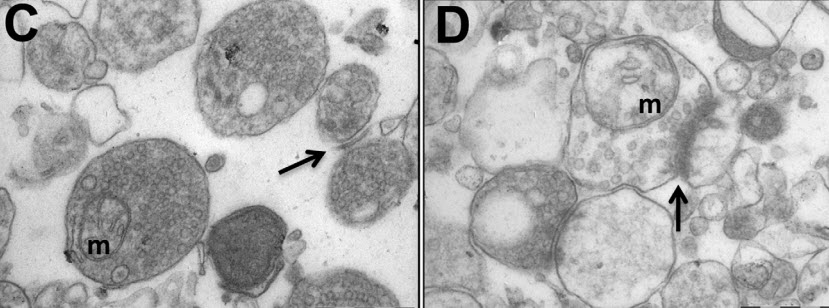
Cerebral abnormalities corrected by antipurinergic drug therapy. (C) Mouse given a viral infection, showing malformed, growth-stunted post-synaptic density. (D) Treated mouse restoration of near-normal post-synaptic density (arrow) and reduction in abnormal accumulations of electron-dense matrix material. m: mitochondria.(Credit: Robert K. Naviaux et al., PLoS ONE)
Autism is thought to result from abnormal cell communication. Testing a new theory, researchers at the University of California, San Diego School of Medicine have used a newly discovered function of an old drug called suramin — used medically for the treatment of African sleeping sickness — to restore cell communications in a mouse model of autism, reversing symptoms of the devastating disorder.
The findings are published in the March 13, 2013 issue of the open-access journal PLOS ONE.
“Our (cell danger) theory suggests that autism happens because cells get stuck in a defensive metabolic mode and fail to talk to each other normally, which can interfere with brain development and function,” said Robert Naviaux, MD, PhD, professor of medicine and co-director of the Mitochondrial and Metabolic Disease Center at UC San Diego.
“We used a class of drugs that has been around for almost a century to treat other diseases to block the ‘danger’ signal in a mouse model, allowing cells to return to normal metabolism and restore cell communication.”
“Of course, correcting abnormalities in a mouse is a long way from a cure for humans,” said Naviaux, “but we are encouraged enough to test this approach in a small clinical trial of children with autism spectrum disorder in the coming year.
“This trial is still in the early stages of development. We think this approach — called antipurinergic therapy or APT — offers a fresh and exciting new path that could lead to development of a new class of drugs to treat autism.”
Autism spectrum disorders (ASDs) are complex disorders defined by abnormalities in the development of language, social and repetitive behaviors. Hundreds of different genetic and environment factors are known to confer risk.
Cell danger response
Describing a completely new theory for the origin and treatment of autism using APT, Naviaux and colleagues introduce the concept that a large majority of both genetic and environmental causes for autism act by producing a sustained cell danger response — the metabolic state underlying innate immunity and inflammation.
“When cells are exposed to classical forms of dangers, such as a virus, infection or toxic environmental substance, a defense mechanism is activated,” Naviaux explained. “This results in changes to metabolism and gene expression, and reduces the communication between neighboring cells. Simply put, when cells stop talking to each other, children stop talking.”
Since mitochondria — the so-called “power plants” of the cell — play a central role in both infectious and non-infectious cellular stress, innate immunity and inflammation, Naviaux and colleagues searched for a signaling system in the body that was both linked to mitochondria and critical for innate immunity.
They found it in extracellular nucleotides like adenosine triphosphate (ATP) and other mitokines — signaling molecules made by distressed mitochondria. These mitokines have separate metabolic functions outside of the cell where they bind to and regulate receptors present on every cell of the body.
Fifteen types of purinergic receptors are known to be stimulated by these extracellular nucleotides, and the receptors are known to control a broad range of biological characteristics with relevance to autism.
Suramin corrects autism-like symptoms
The researchers tested suramin — a well-known inhibitor of purinergic signaling used medically for the treatment of African sleeping sickness since shortly after it was synthesized in 1916 — in mice. They found that this APT mediator corrected autism-like symptoms in the animal model, even if the treatment was started well after the onset of symptoms.
The drug restored 17 types of multi-symptom abnormalities including normalizing brain synapse structure, cell-to-cell signaling, social behavior, motor coordination and normalizing mitochondrial metabolism.
“The striking effectiveness shown in this study using APT to ‘reprogram’ the cell danger response and reduce inflammation showcases an opportunity to develop a completely new class of anti-inflammatory drugs to treat autism and several other disorders,” Naviaux said.
Funding for the project was provided by Autism Speaks, the UCSD Christini Fund, the Jane Botsford-Johnson Foundation, the Wright Family Foundation, the Lennox Foundation, the Larry L. Hillblom Foundation, the Gerber Foundation, and Hailey’s Wish Foundation.
Comments (9)
by Alan Welbeck
From personal experience defence inflammation is certainly the source of an incredible amount of problems.
As some one with both an autistic and asthmatic upbringing I found both my asthma and autism very much alleviated for a long while as an adult.
It returned with a vengeance with all round inflammation too. Arthritis, IBS and much swelling.
The clue was reduced oxygen supply from lack of exercise(pain) and below par heart/lungs.
By chance I realised the arthritis was mainly walking induced, not biking.
2 years on I now have little arthritic pain, lower stress, OK non primitive cognitive brain function, and no swellingly massive headaches from sleep asthsma/apnea. Obviously increased oxygen supply from lots of non impact exercise reduces swelling and makes for a return towards normality, a normality I ever never did have until my late 20′s !
With life being some sort of lesson, there is much positive in what happened.
by Scott
Yes I criticized Big Pharma, because any amount of investigative work will show that they have profit in mind WELL OVER human health. Just because my comment was sarcastic, doesn’t mean that people should act on group-think (i.e. sheeplish behavior), and start finger-waving. Sheesh…
Danny, please rescind your self-righteous attitude, in light of the fact I was not denigrating treatment for autistic children, rather the pharma industry itself. And as a caretaker for autistic children, which is something I HAVE done before, surely you are aware of the rise in autism spectrum children in the past oh.. let’s even say 30 years. And no, contrary to knee-jerk belief, it is not a phenomenon attributable to “improved diagnosis”. (Although I would conjecture, that some of it IS due to widening the clinical definition of autism)
Tom, brilliant commentary, and truly, I understand your points concerning social interactions based on emotional cues. However, I surmise that much human social interaction is simply a reaction to environmental cues, and not necessary for the productivity you mention.
Bruce, I understand your point. However, I would guess that most human disease in the modern era, is self-inflicted. I have no ready data to highlight my opinion, but “gluttony” alone in conjunction with poor food choices, account for many of today’s diseases. Of course, our processed food supply is a major source of this problem, and I will readily admit that there is a measure of culpability with the food industry. As with pharma, the food industry’s main concern is profit, A microcosm that demonstrates the validity of my claim, is to investigate how “foods” such as Doritos, or Pringles are made. Honestly, these foods are engineered through a very painstaking process to appeal to us in a manner that COMPELS one to over-eat. Sounds ridiculous? It is not:
http://www.cornucopia.org/2013/02/the-extraordinary-science-of-addictive-junk-food/
Anyway, I wish you all the best, regardless of your views. Thank you for the discussion!
by Dennis R.
Tiptoeing in here… but are we sure autism is a disease to be cured and not a mutation towards a more advanced state of being? Some forms of socialization are so highly emotional (elections, religious practices, military service, spring break, reality television, talk radio, etc.) that a mutation that would lessen emotional responses might be seizing an opportunity to swim in the gene pool.
I can certainly sympathize with adults whose children are “different” in such a manner. And their children’s long-term survival is probably threatened if they’re unable to navigate a world where social “norms” are so heavily proscribed. But I have to wonder if the rise of autism diagnosis is an over-reaction by some in an attempt to make us all the same and that true autistics might have talents that could counter their inability to socialize in a way that older generations view as normal.
by Tom Billings
I’m on the Spectrum, and a few notes about your questions might help. First, “a more advanced state of being” is a very vague phrase. The activities you mention are all swayed by emotions, true. However, they are not the majority of life. The socializing humans use to make productive networks takes up much of their waking hours. Those productive networks are a *hugely* successful adaptation to the higher population densities humans experience after 10,000 years of agricultural revolution, and are the true basis of the last 250 years of the continuing industrial revolution.
The problem for autistics is that the majority of social communication’s information exchange is *not* intellectual, but consists of exchanging emotional cues. Autistics end up with far slower emotional affect than neurotypicals expect (autistics being only 1/100th of the population), which inhibits the willingness of neurotypicals to include them in social networks of any sort. Thus, autistics often have grave difficulty in participating in the highly productive networks of industrial society, both in contributing to a network’s productivity and in benefiting from it.
This is counter-adaptive, and a *long* way from being “more advanced”, even though the intellectual abilities of autistics are often quite a bit higher than the neurotypical population’s averages.
Thus, almost anything that allows autistics to keep their intellectual abilities, at the same time as they speed up their emotional affect to the neurotypical norms would be a great contribution to the welfare of those autistics, and to the society that gains their contributions to the highly productive networks of the growing worldwide industrial society.
by Scott
Ohhhh WOOOOW! Lookee here, a drug with a broad inhibiting action on purinergic receptors! I just LOVE big pharma!
You know what, maybe I should just forget about being fit, and eating a (very) clean vegetarian diet. Maybe, I should go ahead and smoke, eat lard everyday, drink diet pop, and refuse to exercise. After all, there is a drug out there for everyone of my potential SYMPTOMS, so that I never have to feel the effects of disease.
by Joel C.
We need Big Pharma until we have the required augmented intelligence to treat ourselves of our medical problems. Until then, we’re stuck with this necessary evil. :-) Sometimes, I think these companies shouldn’t be considered such… look at some of the things they really helped us.
by Danny
Scott, as an educator who works with autistic children on a daily basis and as a family member of a person with Autism Spectrum disorder, I would like to say that your comments were rude and insensitive at best. Yes, “Big Pharma” may play a role in helping those who suffer from this disorder. While I applaud your healthy life choices, surely you know that there is no ultimate protection that you can wield that would protect you from many diseases. God forbid that you have a gene that predisposes you to develop a life-threatening form of cancer. No clean diet and exercise will be able to prevent it from happening, nor will it act as a cure. I think that with that diagnosis, you would gladly turn to “Big Pharma” and ask them to help save your life.
I have dealt with many parents and families who have had their lives turned upside down by Autism. Imagine having a wonderfully healthy baby only to watch the slow progression of a disease that robs them of their ability to function socially, learn, and become an independent adult. These are things that we all want for our children, and Autism takes that away and leaves them permanently damaged and unable to care for themselves.
While your point may be well-taken that people should look to their own behavior for prevention before turning to many of the so-called “solutions” of Big Pharma, I believe that you should consider the effect of such a terrible disorder and the positive benefits that such a drug would have on the lives of those who suffer. I, for one, can’t wait to tell my niece what I read today! It will make all of those Autism Speaks walk-a-thons that we have attended for years, mean even more! We are living in exciting times!!
by Bruce Hart
You seem to have a philosophy that health should be hard-earned. But why would becoming more advanced so we have to put in less effort to stay healthy be a bad thing?
And many people can do little to nothing to help their disease no matter how much they’re willing. Almost all I can do is wait and hope for a more effective treatment for my disease.
by Pete
That’s right. The belief that health should be hard-earned is no different from the belief that knowledge should be hard-earned (a belief that will be obsolete when everyone has cyborg implants allowing net-access and look up info on Wikipedia and other sources).