Earth-sized planets in habitable zones are more common than previously thought
March 14, 2013
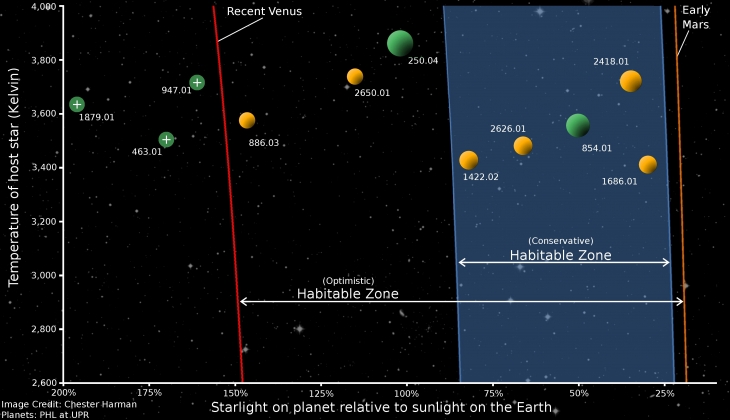
The number of potentially habitable planets in our galaxy is greater than previously thought, according to a new analysis by a Penn State researcher, and some of those planets are likely lurking around nearby stars.
“We now estimate that if we were to look at 10 of the nearest small stars we would find about four potentially habitable planets,” said Ravi Kopparapu, an Evan Pugh Professor in Penn State’s Department of Geosciences. “That is a conservative estimate,” he added. “There could be more.”
(Those additional ones might include habitable planets, if any, of the third-nearest star system, WISE J104915.57-531906, just discovered — see The closest star system found in a century).
A paper on Kopparapu’s findings, will be published in Astrophysical Journal Letters. In it, he recalculated the commonness of Earth-sized planets in the habitable zones of low-mass stars, also known as cool stars or M-dwarfs.
According to his findings, “The average distance to the nearest potentially habitable planet is about seven light years. That is about half the distance of previous estimates,” Kopparapu said. “There are about eight cool stars within 10 light-years, so conservatively, we should expect to find about three Earth-size planets in the habitable zones.”
Scientists focus on M-dwarfs for several reasons, he explained. The orbit of planets around M-dwarfs is very short, which allows scientists to gather data on a greater number of orbits in a shorter period of time than can be gathered on Sun-like stars, which have larger habitable zones. M-dwarfs are also more common than stars like the Earth’s Sun, which means more of them can be observed.
These new estimates are based on an updated model developed by Kopparapu and collaborators, using information on water and carbon dioxide absorption that was not available in 1993.
“I found that there are nearly three times as many Earth-sized planets in the habitable zones around these low mass stars as in previous estimates,” Kopparapu said. “This means Earth-sized planets are more common than we thought, and that is a good sign for detecting extraterrestrial life.”
References:
- Kopparapu, R. K., A Revised Estimate of the Occurrence Rate of Terrestrial Planets in the Habitable Zones Around Kepler M-Dwarfs, Astrophysical Journal Letters, 2013, in press
- Kopparapu, R. K., A revised estimate of the occurrence rate of terrestrial planets in the habitable zones around kepler m-dwarfs, arXiv, 2013, arxiv.org/abs/1303.2649

Comments (13)
by C
Robin Hanson wrote the first paper on the great filter. Nick Bostrom has expounded on the idea and is big believer of the filter.
by Derek New Orleans
I always believed there was life in the universe. Just not sure about truly intelligent life!
by trakk
You dont consider ourselves intelligent? :)
by JFH
The multiple new findings supporting the vast abundance of organic chemistry coupled with the ever growing number of potentially habitable planets does not bode well for either the SETI project or Humanity in general. The fermi paradox and the great filter loom larger and larger. The silence is becoming deafening.
http://en.wikipedia.org/wiki/Great_Filter
by GatorALLin
…cool link on Great_Filter btw…thanks for sharing that…… I agree the silence is deafening.
Growing up I always heard the crazy big numbers of how many stars are in the universe and then how many more planets there are each time we look, and if just a fraction of them have life then there must be billions of planets with life and then there must also be many with advanced life (even ones with advanced life forms living for millions of years before us, so they have likely figured out all the secrets and possible knowledge of the universe).
I can appreciate the math that gives the huge numbers and easy to assume we can’t be alone… I think on earth when we find life in places we never expected it makes that jump to assume life is also abundant on distant planets is easier than we previously thought (and I want them to be right).
I guess if you believe in math that the same giant number can just as easily be cut down to Zero or less…. (we know at least there is Earth, so it has to be a minimum of 1). Are we one of 1/1000 that have the perfect orbit around the right type of sun, or is it much, much more complex than just simple fractions of how rare an chance is…..? The timing of everything has to be in snyc also… we have to get hit by a few mass extinctions at just the right time (but not too big a mass extinction of course). If not for the 65 million year ago asteroid, would Earth be mostly lizards still? If our ice age was just a few thousand years longer or 4 degrees colder would humans died out. And even when you have life as abundant on earth, why are humans the only one writing down languages and also using tools/fire to pass on knowledge out of millions of past species on Earth we are the ONLY known one (and it took us over 4 billion years to get here…what if we are 1 billion years early or half a billion years late?). What if Humans on Earth did not develop until 5.3 billion years total? They suggest that the oceans in 500 million years from now would normally evaporate off from the slight increase in our sun size over time, so would that be our next mass extinction to switch earth to a mars like environment and we just got lucky life started as soon as it did on Earth? We have great reasons to think our Global Warming could be our next mass extinction, or as we invent bilogical 3d printers we let ever college kid create the next airborne version of Aids, or nuke eachother (insert North Korean Joke here). There are easily 15 factors where we seem extra rare and if each is ONLY 1/1,000 chace that cuts the chance of intelligent life in the entire universe to way less than zero.
I always liked the idea that we may get a future visit from super intelligent life form that would unlock all of the possible secrets to the universe. But now I think that is a lazy way of thinking (hoping someone else will hand us the answers). Of course if it could happen here, it could happen lots of places… what if we are first…. we can control much more of our destiny …(we have to do all the work of course and take all the risk, but there in lies the rewards). And yeah I get the idea we must be arrogant to think we are the best the universe has to currently offer on intelligent life….
…Not saying we are the only one ever… just what if we are first. What if it is up to us to share life outside of our solar system or galaxy, etc…
by Ryan
There are simply too many variables to factor and our collective knowledge, let alone our technology, is almost certainly not sufficient enough to make such prognostications as of yet. I see us as akin to a native tribe living in some remote area, never having been exposed to outside society, and believing that there can’t be any outside advanced societies because there have never been any responses to their smoke signals. Just because we haven’t seen anything with our, rather limited technology no matter how great it appears to us, doesn’t mean there aren’t any other intelligent species out there or that there can’t be ones that are far more advanced than us. Again there are so many factors that making a call, or even a guess with our capabilities is foolhardy. It could be that sapient life that makes it offworld is rare. Maybe only a single species per galaxy in a hundred million years makes it. It could also be that advanced life is everywhere but primitives like us simply lack the capacity to see or interact with it (or they go out of their way to ensure we don’t see them because we aren’t yet at a level deemed intelligent life). Don’t assume just because we have some grand notions of what an advanced species should be doing we have any clue what such a species would actually do or what effects they’d leave that we could notice given our current abilities. Heck, it could be that all advanced life reaches a singularity point, discovers that our universe is actually the proverbial mud puddle in the back end of reality and bails out of here as soon as they can to places we have zero chances of interacting with as we currently are.
by Pete
Instead of waiting for replies, we should spread out to the galaxy now.
by Ryan
I would love it if we did that. Given our current abilities however it might be a while unless we really do hit a singularity event.
by edrex
I agree totally. Why would a hyperadvanced pangalatic civilization necessarily even be using radio waves to communicate in the first place? How about smoke signals instead? Kinda reminds me of the 90′s when scientists were going around straight faced, saying we had already discovered everything, all the big stuff, and from hear on out science was simply a “mopping up” operation, tieing up loose ends and such! Was it Fukishima or someone who wrote “The End Of History”?
by Carl Brooks
I think it a bit presumptuous to assume anything on information we dont yet have. The only thing we do know is our own perspective. We know of our existence so that is the best measure of the difficulty for intellegent life to evolve. So what is the probability of our exsistance?
Lets consider each step life has had to take to get to here. Lets say, you need a planet, a planet the size of earth in the green zone from its parent star. With a moon that gives similar tidal forces to that of our own moon. This planet needs all its elemental components to be similar to our own. Lets call this probability No1(P1), We dont know what this probability is but lets guess, for a bit of fun. I’d say its not as low as 1 in a Billion but not as high as 1 in 1000 so lets split the difference and say 1 in Million stable star systems has P1. We now multiply this probability with the probability of the next step which is, life begins (P2), once again we have no idea what this probability is, so lets guess again. I’d guess that once you have P1, P2 is fairly common place, so lets say 1 in 10 P1 planets, life begins and with life comes evolution. So, what is the probability of life evolving into multi-cellar organisms (P3)? I’d wager, once again, that its fairly common place once you have P1 and P2, so lets say its 1 in ten again. So thats P1xP2xP3. What would P4 be, Cambrian explosion maybe?(iv not taken into consideration the likely-hood of the Ribosome spontaneously coming into existence in this scenario) And once again, i reckon if you have P1,P2 and P3, P4 is common place, so lets say 1/10 again. How many more steps till you get to humans??? because already at P4 we’re at 1 in a Billion. Obviously this is all guess work but it kind of gives you an idea of the extreme probabilities we’re dealing with here. If i where to put my money where my mouth is, i’d say we are probably the only intelligent beings in the universe.
by Ryan
Therein lies the problem however. You’re making assumptions as well based on data we don’t have or tools to verify such notions. We’re just reaching the point that we are able to conclude that there are Earth sized planets around other stars. I remember when I was younger that I knew people that were absolutely certain that this was the only star where planets orbited and others that felt that Earth sized planets would be incredibly rare or nonexistant elsewhere, convinced mostly on the notion that we were somehow special (of which there has never been any proof whatsoever). Now, as we progress, we’re finding more and more planets to the point where they will probably end up being dirt common across the universe. Note, I’m not saying that intelligent life is a given as it barely exists here. However, applying special rules such as what you were doing and saying well, that means life must be really rare is also the wrong conclusion as you have no evidence to back up such assertions. We lack the capacity or tools to make such estimates, in either direction of this topic. You can come up with trillions of ideas of why intelligent life would be rare and in the end we could end up tripping over such life when we finally leave our crib. Again, I never said intelligent life is common. I even stated that it could be so rare that it only appears every hundred+ million years in an individual galaxy and by the time the next one pops up the prior is long gone with perhaps some artifacts left behind to intrigue the new ones. The problem with your assertion that we should take a bunch of variables and decide that life is unlikely is that we simply do not understand reality as well as too many people like to assume. Far too often we look at things and go ‘well, it works for us so that must be the defacto standard’. We have no real basis to make that assumption. It could be the variables for reaching intelligence are lenient or harsh. We certainly don’t have much of any clue how our own basis for intelligence emerged as a dominant trait in our species, not yet at least, and we certainly don’t know what factors contributed to or hindered that development. And who knows, perhaps our position in our solar system has actually delayed development. If we hadn’t had multiple mass extinctions in our history perhaps our world would have developed intelligent life much earlier. We don’t have enough information to say for certain. We only know what worked here so far and we don’t even truly understand why it worked here or what factors are truly involved or whether said factors actually limited development here instead of making it easier. All we can say for certain is that we exist. Given the size of the universe as we understand it I lean towards the probablity of intelligent life existing elsewhere as pretty much a given. That however doesn’t mean it happens enough to be close enough to us or exist within a timeframe where we could interact with it.
by Carl Brooks
Totally agree, i didn’t say any of those thing to be read as gospel, like i say in the first paragraph its all a guess. I should have probably concluded with something close to your last sentence to be honest. intelligent life is just about rare enough as to not make it prevalent in the universe (this is how i should have ended it).
If you think about it, there must be such a thing as intelligence density, and it must be a constant of the universe. It has units of Einsteins per cubic light year per unit time. I have know idea how to figure this constant out but it must exist, what do you think?
by C
I believe the silence is frightening and telling us something. This project is a project about our future and who we are.
The evidence is showing us the GREAT FILTER is BEHIND US.
This means the future is open to space exploration and posthumanism. It’s ours for taking if we are the first and past the nasty filter.