Evi trumps Siri for general knowledge
January 30, 2012 by Amara D. Angelica
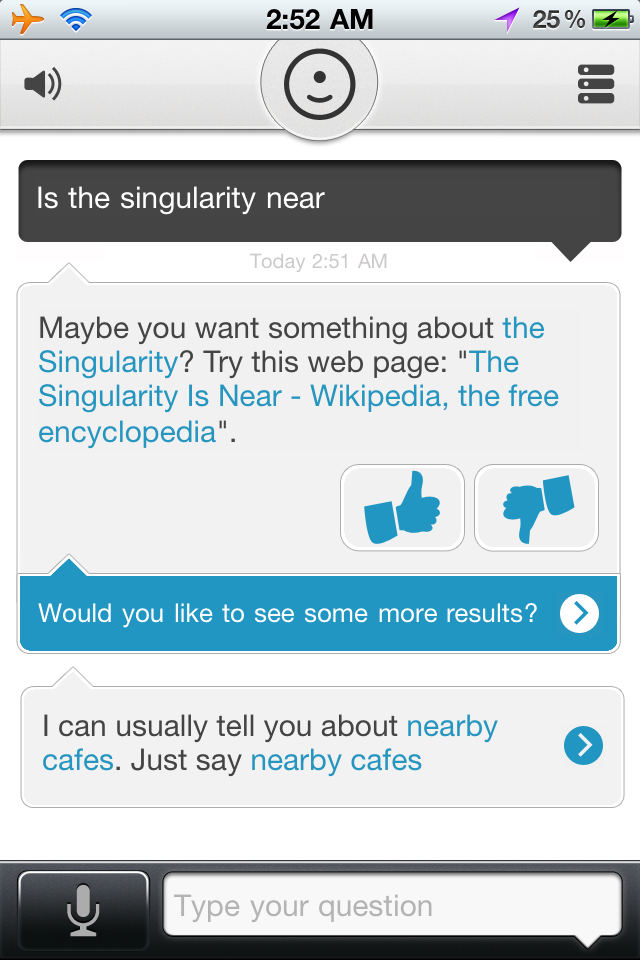
Evi on iPhone 4
Move over Siri, Evi is the new kid in town.
It’s no Watson, but Evi, created by True Knowledge, a Cambridge, U.K.-based semantic technology startup, like Siri, can answer questions posed by voice (using Nuance software) in a conversational manner or by typing.
But unlike Siri (only available on iPhone 4S), Evi runs on the iPhone, iPod touch, and iPad (with iOS 4.0 or later), and on phones running Google’s Android software.
The True Knowledge page claims 635,025,637 facts on 27,805,648 things that True Knowledge has developed over several years (initially for Web search). “Information in this database has been tagged to add meaning and context,” it says.
Evi can’t help you set up an appointment, but it does a great job with general facts, and includes international information, unlike Siri. It also handles Yelp-like queries (it accurately located the 11 restaurants nearest me).
In a quick test, it gave me Wikipedia links or web pages for simple questions:”What is Planck’s constant?,” “What time is it?,” “Is there a God?” (answer: “I don’t know about God myself and different people seem to think differently on the subject…”), and “What are three things that are good to eat?.”
Many users have found Evi has been plagued with server access problems, but it worked OK for me in late-night tests. More later after I test Evi on more complex questions and see where it breaks.
What’s been your experience?
Comments (10)
by avdude
How does it compare to Dragon Go
by Aezel
After reading this article I was pumped because I have Siri on my 4S and I want it on my ipad. However, after trying Evi, it is a poor poor substitution. Siri is true AI: I ask it about the weather and it tells me about the weather. You ask Evi about the weather and it suggested some weather websites to me through text. Evi is more like a voice activated search engine thany anything else. I was extremely underwhelmed with it’s performance vs. Siri.
by Evi user
It can find the weather like Siri, you just have to phrase it the right way.
by star0
And by “answer” I mean something like “yes, in many contexts” (and these could include the examples you cite, depending on the definition of “authors”.) or “yes, with few exceptions.” I suppose one should be careful about using universals like “for all” or “for every” when making factual statements.
by Mark Harrison
Star0,
Good luck in your project, though I do fear that you are in danger of creating an AI that talks like a lawyer :-)
by star0
@Mike Ellis
I am well aware of the difficulties of context, having spent a little time studying the basic philosophy of CYC and IS-A and HAS-A hierarchies (as well as how tense and modality influence things). I still think it’s the kind of thing one would expect a better-than-basic, but not-overly-deep question-answering system to answer. I am right now trying to code up some heuristics for how to do some of these things; so I suppose I will see just how hard it is! (It’s always easy to criticize until you try to do it yourself.)
by star0
I have to say that I wasn’t that impressed. I asked it, “Do books have authors?”, and it couldn’t provide an answer. Now that’s the sort of factual knowledge that a question-answering system should be able to discover on its own, given access to enough webpages. By god, I’m going to write one of these myself on day!
All they have to do to make the machine discover that books have authors is to scan a dictionary. Some dictionaries define author as “one who writes a book”. By itself, that wouldn’t be enough information to tell whether “all books have authors”; so, what one could do is to have the system check a long list of books to see whether they have authors — and then, if so, it could reach a high level of confidence that “all books have authors”. The exact same procedure should work to discover that statues have sculptors or creators; planets have orbits; houses have rooms; animals have habitats; etc. etc.
This strategy wouldn’t work with a statement like “all humans have hands”, because some humans are handicapped and have no hands. The way to solve this problem is to sub-divide the category (micro-context) “humans” into the two sub-categories “non-handicapped humans” and “handicapped humans”, and then the claim “all (non-handicapped) humans have hands” would be a true statement in the former category, while only sometimes being true in the latter.
by Zella
That was a stupid question.
by Mike Ellis
You are describing the semantic web. This is a very hard problem for computers and there is a lot of research and activity going in this area right now.
Now, do all books have authors? What about a picture book with no text, does that have an author or does it have an editor? What about a computer generated book? What about an academic book with different chapters authored by different people. That book does not have an author, it has an editor. So, you see, your question isn’t that simple or factual.
by Cybernettr
This is the type of “common sense” problem that Douglas Lenat has been working on for years, and it is actually quite a bit harder than a simple fact search. In fact, as Lenat pointed out, even IBM’s Watson can’t handle common sense questions, and this article admitted that Evi isn’t as sophisticated as Watson. I’m sure it’s coming, but it would be a bit premature to expect that common sense ability will be here immediately.