Evidence that comets could have seeded life on Earth
March 7, 2013
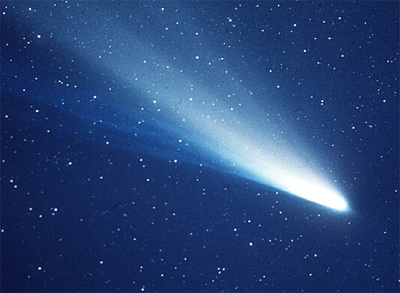
Comets like Halley’s can be a breeding ground for complex molecules such as dipeptides. Comets colliding with Earth could have delivered these molecules and seeded the growth of more complex proteins and sugars necessary for life. (Credit: NASA)
A new experiment simulating conditions in deep space reveals that the complex building blocks of life could have been created on icy interplanetary dust and then carried to Earth aboard a comet or possibly meteorites, jump-starting life.
Chemists from the University of California, Berkeley, and the University of Hawaii, Manoa, showed that conditions in space are capable of creating complex dipeptides — linked pairs of amino acids — that are essential building blocks shared by all living things.
These molecules then catalyzed the formation of proteins (polypeptides), enzymes, and even more complex molecules, such as sugars, that are necessary for life.
The discovery of complex molecules
In an ultra-high vacuum chamber chilled to 10 degrees above absolute zero (10 Kelvin), Seol Kim and Ralf Kaiser of the Hawaiian team simulated an icy snowball in space, including carbon dioxide, ammonia and various hydrocarbons such as methane, ethane and propane. When zapped with high-energy electrons to simulate the cosmic rays in space, the chemicals reacted to form complex, organic compounds, specifically dipeptides, essential to life.
At UC Berkeley, UC Berkeley chemists Richard Mathies and Amanda Stockton then analyzed the organic residues through the Mars Organic Analyzer, an instrument that Mathies designed for ultrasensitive detection and identification of small organic molecules in the solar system. The analysis revealed the presence of complex molecules — nine different amino acids and at least two dipeptides — capable of catalyzing biological evolution on earth.
While scientists have discovered basic organic molecules, such as amino acids, in numerous meteorites that have fallen to Earth, they have been unable to find the more complex molecular structures that are prerequisites for our planet’s biology. As a result, scientists have always assumed that the really complicated chemistry of life must have originated in Earth’s early oceans.
The paper was published online last week and is scheduled for the March 10 print issue of The Astrophysical Journal.
The research was supported by the National Science Foundation and the Mathies Royalty Fund at UC Berkeley.
In related news last week, researchers announced that they had discovered DNA and amino-acid precursor molecules molecules in interstellar space that may have formed on dusty ice grains floating between the stars.