Facebook, CNN, and the rise of social voting
July 13, 2012 | Source: Technology Review
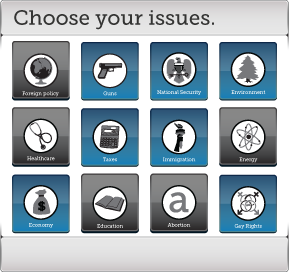
CNN and Facebook have joined forces to make the “I’m Voting” Facebook app, which enables Facebook users to endorse candidates and issues, and to commit to voting.
If you use the app and commit to voting for someone, that information appears in your timeline, news feed, and real-time ticker.
During CNN’s political coverage this fall, CNN personalities will use the app to poll users on issues.
“We fundamentally changed the way people consume live event coverage, setting a record for the most-watched live video event in Internet history, when we teamed up with Facebook for the 2009 Inauguration of President Obama,” CNN’s KC Estenson said.
“By again harnessing the power of the Facebook platform and coupling it with the best of our journalism, we will redefine how people engage in the democratic process and advance the way a news organization covers a national election.”
Is this the rise of social voting? During the midterm elections, Foursquare dipped a toe into the idea that voting could be made “more fun and social.” Foursquare launched a special elections page, reported ReadWriteWeb, awarded badges to those who checked in at polling places, and promoted an #IVoted hashtag. And Facebook had a Facebook Polling Place Locator live during the 2010 midterms.
ElectNext takes the principle of a dating website and applies it to politics. Tell ElectNext how you feel about certain issues, and it will “match” you with candidates that fit your political beliefs. The Sean Parker-funded Votizen lets you publicly endorse certain candidates to your friends, turning your social networks into a digital soapbox of sorts. And once you’ve put your candidates in office, PopVox helps you keep them accountable, by giving you tools to track legislation and tell your representative just how you feel about it.

Comments (14)
by josdorpjossie
This has nothing to do with democracy because of the privacy aspect.
by Sam Wallace
Amara,
Do you know of any sold neuroscience studies as to why the internet is allowing the libertarian, singularity/transhumant, and non-religious movements (which have significant overlap) to become a much more informed and impassioned 15 percent while the rest of society is apearing to grow more susceptible to this kind of social engineering? I know there has been work in this area by people like Michael Shermer in his books and work at the skeptic society. But as someone who has ADHD I often wonder what effect divergent vs. convergent thinking has on people’s innate ability to question the world around them to include their own cognitive biases.
When I read something like this I immediately start to think of “brave new world totalitarianism” and how removing anonymity of speech will only decrease divergent thought and intellectualism. This kind of social engineering will most likely hurt the singularity movement, and will set up society for chaos as we get closer to a singularity. Image if the aging process were suddenly cured tomorrow. I would argue that at least initially, more people would kill each other trying to stop it out of fear and shock than there would be people to benefit.
This collectivist mentality (surprisingly coming from some libertarian-ish silicon valley entrepreneurs) is that all information should be open and free, that there should be no anonymity on the internet, and that we should share all information openly with everyone. If the founding fathers had the newest version of FaceBook I don’t think there would have been a revolution, and I kind of get the inkling that is the point.
by Editor
Sam, agreed. It’s a small step from total openness to total control. I’ll look into this, and I welcome all suggestions.
by trakk
When everything is going online these days, even this was bound to happen eventually
by anthrobotic
It’s a Terminal Anachronism – here in 2012 we still have to physically go to a location to cast a ballot for almost any election. Why is that acceptable? Here’s the plan: first, pulling on some patriotic heartstrings, convince a bunch of America’s top tech companies to develop the system pro-bono! – http://goo.gl/QdesU
by Bri
All polling is skewed, unless you poll everybody. I think it could be a good platform for social debate. As much as peer pressure is a powerful factor, it still doesn’t stop every kooky group, from promoting their fringe causes. They abound, at times it seems like, if you believe the Smirfs should be president, you could find people who agree, and form an organization!
by Mental Vegetables
People who use Facebook because they do not understand it is a sick grotesque spy tool & they also watch CNN not understanding it is misinformation & propaganda? I pity them. They should all be banned from voting as they are obviously in a mentally vegetative state. Unfortunately sheep are allowed to vote :(
by Gorden Russell
I don’t want to waste time at Facebook. It takes all the time I’ve got to spare just to keep up with Kurzweil, Space.com and Live Science.
by Brian
The idea of voting includes privacy! It is a key element in the political process. This is persuasion through intimidation.
by steve
Smells like voter intimidation through peer pressure. Further more, deriving polling data from an app like this would be almost useless because your sample population would be skewed by only including FB & CNN users.
by Editor
Right
by trebaryar
This is a game-changer beyond what is may first appear!.
Consider the implications of divisiveness this will engender……
by Giulio Prisco
They say “CNN and Facebook have joined forces to make the “I’m Voting” Facebook app”, I guess they are developing it and it will be available soon. We’ll track this and update.
by Sara Peterson
I can’t find anything on facebook under any of the various pages that links cnn and FB. Is there an app page that I don’t know about that I need to look at?
Thanks