Fast, cheap water desalination using graphene
July 2, 2012
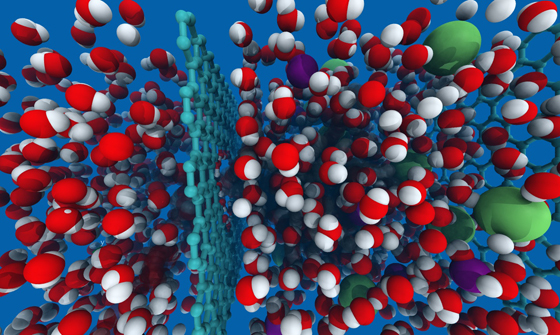
When water molecules (red and white) and sodium and chlorine ions (green and purple) in saltwater, on the right, encounter a sheet of graphene (pale blue, center) perforated by holes of the right size, the water passes through (left side), but the sodium and chlorine of the salt are blocked (credit: David Cohen-Tanugi/MIT)
MIT researchers have invented a new kind of filtration material for desalination: sheets of graphene, a one-atom-thick form of the element carbon, which they say can be far more efficient and possibly less expensive than existing desalination systems.
The availability of fresh water is dwindling in many parts of the world, a problem that is expected to grow with populations. The world’s supply of seawater is virtually limitless, but desalination technology has been too expensive for widespread use.
Jeffrey Grossman, the Carl Richard Soderberg Associate Professor of Power Engineering in MIT’s Department of Materials Science and Engineering and graduate student David Cohen-Tanugi aimed to “control the properties of the material down to the atomic level,” producing a graphene sheet perforated with precisely sized holes. They also added other elements to the material, causing the edges of these minuscule openings to interact chemically with water molecules — either repelling or attracting them.
One common method of desalination, called reverse osmosis, uses membranes to filter the salt from the water. But these systems require extremely high pressure — and hence, energy use — to force water through the thick membranes, which are about a thousand times thicker than graphene. The new graphene system operates at much lower pressure, and thus could purify water at far lower cost, the researchers say.
The new graphene-based system works “hundreds of times faster than current techniques, with the same pressure,” — or, alternatively, the system could run at similar rates to present systems, but with lower pressure — Cohen-Tanugi says.
The key to the new process is very precise control over the size of the holes in the graphene sheet. “There’s a sweet spot, but it’s very small,” Grossman says — between pores so large that salt could pass through and ones so small that water molecules would be blocked. The ideal size is just about one nanometer, or one billionth of a meter, he says. If the holes are just a bit smaller — 0.7 nanometers — the water won’t flow through at all.
Other research groups have worked to create pores in graphene, Cohen-Tanugi says, but at very different sizes and for very different purposes — for example, making much bigger holes to filter large molecules such as DNA, or to separate different kinds of gases. The methods used for those processes were not precise enough to make the tiny holes needed for desalination, he says, but more advanced techniques — such as helium-ion bombardment to make precise holes in graphene, chemical etching and self-assembling systems — might be suitable.
For now, Grossman and Cohen-Tanugi have been doing computer simulations of the process to determine its optimal characteristics. “We will begin working on prototypes this summer,” Grossman says.
Because graphene is the subject of research into many different applications, there has been a great deal of work on finding ways of making it inexpensively and in large quantities. And for desalination, because graphene is such a strong material — pound for pound, it’s the strongest material known — the membranes should be more durable than those presently used for reverse osmosis, Grossman says.
In addition, the material needed for desalination does not need to be nearly as pure as for electronic or optical uses, he says: “A few defects don’t matter, as long as they don’t open it up” so that salt could pass through.
The work was funded by the MIT Energy Initiative and a John S. Hennessy Fellowship, and used computer resources from the National Energy Research Scientific Computing Center.
David Cohen-Tanugi, Jeffrey C. Grossman, Water Desalination across Nanoporous Graphene, Nano Letters, 2012, DOI: 10.1021/nl3012853
Comments (16)
by Gergana Rusenova
Hi!
My name is Gergana Rusenova, I`m an architecture student at the University of Stuttgart, Germany. Your idea inspired me and my colleague Desislava Angelova – we want to take part in the World Scyscraper Competiton, working on the topic “Desalination of seawater” . We were just wondering if it`s possible in your oppinion to use your new approach to water desalination in a vertical direction, as we`re required to design a skyscraper? We`d like to combine a reasonable (and cheap) method for desalination and renewable energies, in order to produce fresh water without causing increase in CO2 emissions. As we`re only at the beginning of our research, we`d like to know what`s your oppinion about the project and our idea in generall?
Thank you! I hope this layman-question is not too unprofessional for you..
by Dan Robinson
All of these ideas of course make sense. But I constantly wonder why, or if, an even more efficient “electrostatic filter” isn’t possible, treating salt ions as electrically charged particles in a relatively unionized medium. I came up with a design for this years ago, but found difficulties with building it on a very low budget. Then I decided that if we solve just one environmental problem, it will just be an excuse to continue expanding the population until we have a lot more problems (as we seem to continue to do) so my interests went elsewhere. I’ve pretty well disproven the one valid argument against it, that charged particles would coat insulation of oppositely-charged conductors and cancel the charges. (In the process of testing this, I also started on the road to a simple and apparently unique method of generating high voltage electric power from wave action or otherwise.) If you want more details, please write to danrob at efn dot org.
by Jessee McBroom
This is another piece of excellent work by MIT. This looks very promising. I’m sure the worlds populations well benefit from this work. My sincere thanks to the crew at MIT that produced this membrane model .
by asiwel
There are many exciting advances being made in desalination, but somehow this does not yet quite seem to be one of them. To say that “MIT researchers have invented a new kind of filtration material for desalination” and then to read further and find out this is still only a computer simulation is promising but disappointing. That simply is not an “invention” at all … at least not yet. But perhaps they have developed prototypes .. the article seems to imply this; prototypes that can be optimized through simulation. I hope so.
by aus
Foye, I’m not sure about the engineering issues, but from what I remember of the basics of climate science in college, messing with the humidity in one region could affect climate in other regions. Remember the Earth’s weather is an interconnected system, so you could end up with unexpected and unwanted results elsewhere.
Perhaps a meteorologist would be able to predict what changes would occur.
by Louis Parsons
This is the type of thing that matters now!
I wish Grossman had a billion dollars to work with.
by Foye Lowe
In the meanwhile, non-engineer that I am, I’ve wondered about the feasibility of using the energy of ocean wave action to pump salt water to far-inland evaporation ponds, so at least there would be water vapor in arid regions. Is such a low-tech project at all practical?
by Ken Arnold
That would be easy with a “Water Ram”. Pump it’s operated buy moving water and used mostly in Rivers/Streams
simple version
http://www.youtube.com/watch?v=VlMp3fvfHx0
by Gorden Russell
I am so glad that Ayaz Manji found this newsletter. This is why I am always posting comments about self-assembling photo-voltaic carbon nanocells that take carbon dioxide out of the air and weave it into carbon nanotubes and graphene.
When desalinization plants can be grown like green plants, this great global problem of fresh water scarcity will be solved. When this happens the Sahara will be green again, there will be no more famine in Ethiopia, and the islanders of Pate will have abundant fresh water.
by Editor
“When desalinization plants can be grown like green plants…”: interesting idea, and possibly feasible. There is research at Stanford on Chemical Self Assembly of Graphene Sheets and the news item mentions the concept of self-assembling systems for punching precise one-nanometer holes.
Submitted by Gordon Russell at http://www.kurzweilai.net/the-cambridge-project-for-existential-risk on 2012/06/29 at 3:09 pm:
I do beleive that ” the extreme effects of anthropogenic climate change” can be reversed by nanotechnology. When self-assembling photovoltaic carbon nanocells can take carbon out the atmosphere to grow into carbon nanotubes, graphene, buckminsterfullerene, fiberdiamond and any other number of useful carbon compounds, then all those extreme effects will be reversed.
by gorazd
Bri, are you thinking about Dean Kamen’s Slingshot?
http://en.wikipedia.org/wiki/Slingshot_(water_vapor_distillation_system)
I am really not sure this is close to being in production. Would be great though… If… claims are true.
by Ayaz Manjia
Dear Sir/Madam,
My name is Ayaz Manji and I am the Water and Sanitation Advisor at the Kenya Red Cross Society. I have read this bulletin of using Graphene for Water Desalination with great interest. In my country we have huge water scarcity and at the costal lands, we have largely salt water deposits in ground and surface water sources. I have personally tried to setup desalination plants on an Island called Pate where the residents have no choice but to get water by boat as there are no fresh water sources on this island. The desalination plants (as correctly reported in this bulletin) require a lot of energy and high maintenance which also limited the amount of fresh water we could access from them. This lead to the designated water being even higher in cost than boated water and also there were production limitations.
To date I am scouting the globe for a solution for this very vulnerable population and I was very excited to read this publication.
Would it be possible for you to connect me with the researcher from MIT who is championing this grapheme as I would like to explore the possibility of setting up such a unit in Kenya and they could possibly get some benefit from the research they may be able to carry out here.
Kind Regards,
Ayaz Manji
by Editor
Hi, Ayaz. Sure, I’ll send you an email. I hope you’ll let us know how it works out.
by Bri
In Peter diamandis’s book Abundance, he cites another” suitcase” size tech. I think it is ready to go, were as this tech isn’t even in production yet.
by David U
Yes, Dean Kamen invented the SlingShot.
http://www.youtube.com/watch?v=VOQbVD7F1f4
I believe CocaCola bought a few hundred SlingShots and is trying them out in Africa.
by Tom Moriarty
Ayaz:
A solution to your problem may be to consider an OTEC solution for Pate island. The requirement for OTEC is a 20-25 C temperature differential between the surface temperature and and the water temperature at 1000M.
The OTEC process is used to create electricty and one of the by products is millions of gallons of fresh water. Westinghouse has plans for 2 50Mw pilot plan and there is a plan for a plant in Bernmuda. There s a pilot plant in Hawaii.
Tom Moriarty