Gene therapy shows promise in neuron repair and pain relief
August 28, 2012
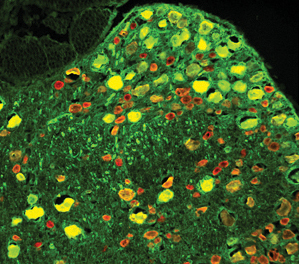
This image shows yellow/orange stained neurons that have been repaired by gene therapy while remaining neurons appear red. The novel technique dramatically reduced pain in animal models and is a potential treatment for hard to treat neuropathic pain associated with diabetes and nerve damage. (Credit: Yale University)
Using gene therapy, Yale neurologists have managed to repair neurons associated with traumatic nerve injury pain in rats.
Neuropathic pain associated with diabetes, shingles, and traumatic injury affects up to 18 percent of the population and can be difficult or impossible to effectively treat.
“Since the therapy targets only cells in the pain-sensing neurons outside the brain and spinal cord, this method can avoid some of cognitive problems associated with other pain therapies that also work on the central nervous system,” said Omar Samad, research scientist in neurology and lead author of the paper published online Aug. 21 in the journal Molecular Therapy.
The work was conducted in the laboratory of Stephen Waxman, the Bridget M. Flaherty Professor of Neurology and director of the center for neuroscience and regeneration research, and it was supported by the Department of Veterans Affairs and the Nancy Taylor Foundation for Chronic Diseases.
Comments (9)
by Bri
Thanks Melajara, it’s hard for me to allocate more time to research this stuff. As it is I spend too much time on links. That one paragraph answered all my question and then some!!! Group mind!!!! Talk about crowd sourcing!!!
by Bri
It would be nice if they explained the nature of the gene therapy. There is a lot of research on pain. The pain circuit is separate from other nerve circuits. There was a boy born in Pakistan that couldn’t feel pain. He would jump off buildings for spectators to earn money. Unfortunately he died doing this before researchers could get to him. They tried to get DNA samples but the moslem religion stopped them. If pain could be eliminated it would be amazing. The article really doesn’t give any info as to what they were affecting to get this result.
by melajara
I’m finding the original article abstract quite explicit about what they are doing, knocking out one of the sodium channels signalling pain to the CNS ( here the Nav1.3) and doing so in targeting for the blocking/injection site a primary nexus from the periphery to the spinal cord across (lumbar) vertebrae, the lumbar dorsal root ganglion (DRG).
The injection contains RNA interference (RNAi) gene silencing vectors encoding Nav1.3 short-hairpin RNA (shRNA, see http://en.wikipedia.org/wiki/Small_hairpin_RNA for the silencing process itself) and http://www.youtube.com/watch?v=gZZyxVP02UU&noredirect=1 for a nice video of RNAi role in gene expression.
More details about this knockout procedure when targeting DRG can be found e.g. in this article introduction: http://www.plosone.org/article/info%3Adoi%2F10.1371%2Fjournal.pone.0032581
On the various sodium ion channels relaying pain, interesting background material (albeit somewhat dated) can be found here:
http://www.icagen.com/media/pdf/Kraftebannonsodiumchannels-sciencedirect.pdf
Another very recent article for direct human application:
http://www.news-medical.net/news/20120813/Chronic-nerve-pain-researchers-identify-which-sensory-nerve-cells-are-responsible.aspx?page=2
Hope that helps ;-)
by Editor
Thanks, excellent info. Note: PloS (the plosone.org article) is open-access.
by Pat Cohen
I have been diagnosed with idiopathic (i.e., not diabetic, cause unknown) peripheral neuropathy for over 10 years. It is such an “unsexy” illness that little research is being done, and since there are over 30 types, and NO cures, any research of an individual case is not cost effective, so we just go to a pain clinic and try to survive the pain with opiods. What a way to live, and survive the pain, huh? Anyone have any bright ideas on how to make this illness better know, and more interesting to research?
by Bri
It may sound trite for me to say this but good meditational practices can help. Remember the images of monks sitting in the lotus position,committing suicide by, being set on fire. They literally didn’t feel a thing. The mind can be amazingly powerful. Unfortunately it takes a lot of hard practice. It does have a lot of side benefits. It’s a lot better than opiates.
by Gorden Russell
Did you read yesterday’s article (at this, the Kurzweil Newsletter),
” A chance to finish life?” It’s about a young woman dying of brain cancer. She wants to take a chance on cryonic preservation so that she may be revived when there are nano-doctors that can move along the length of a neuron to repair the damage done by freezing.
She needs $28,000 to pay for the cryonics. If only 1,400 people donate $20 apiece, she will have a hope to see the singularity.
Donate to the Venturist Cryonics Charity Fund for Kim Suozzi, checks can be mailed to:
The Society for Venturism
11255 SSR 69,
Mayer AZ, 86333,
U.S.A.
by Mrs. Jo Dermody
I have major burning from both my knees down into my feet and toes.
A slight amount of cool air hurts me terribly. I have asked doctors what
causes this? Well, I have heard my Sjogren’s, they do tend to use this
as a catch all for every pain I have and I have heard maybe the three
lower dics in my spine, they lay on each other. So I get no relief
and spend a lot of time hurting a whole lot. I’d love to see this go
beyond mice and come to people like me Thanks for asking.
by GatorALLin
….if you don’t get an answer you like from this doctor, then keep talking to other doctors…and keep searching online for any support groups that share info/ideas on the same subject. There is an answer, even when a doctor does not know… (especially when they don’t don’t know).