Genetic variants build a smarter brain
June 21, 2012 | Source: Science Now
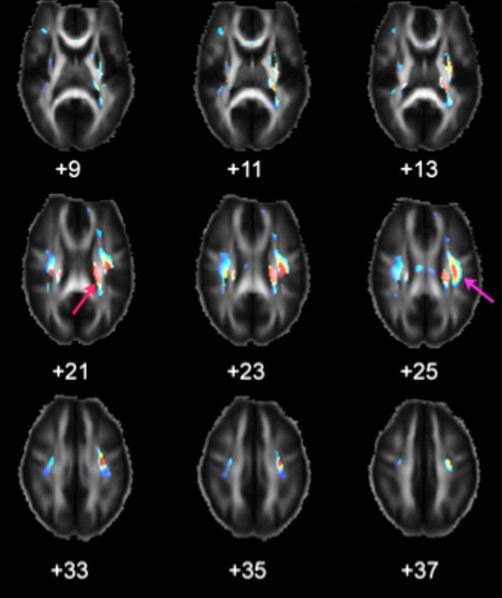
Brain scan data showing regions where two of the newly identified SNPs interact with each other to affect white matter tract integrity (credit: Paul Thompson/UCLA)
Taking a step in understanding how genes influence intelligence, an international team of scientists has identified a network of genes that may boost performance on IQ tests by building and insulating connections in the brain.
Intelligence runs in families, but although scientists have identified about 20 genetic variants associated with intelligence, each accounts for just 1% of the variation in IQ scores.
Because the effects of these genes on the brain are so subtle, neurologist Paul Thompson of the University of California, Los Angeles, devised a new large-scale strategy for tackling the problem.
In 2009, he co-founded the ENIGMA Network, an international consortium of researchers who combine brain scanning and genetic data to study brain structure and function.
Earlier this year, Thompson and his colleagues reported that they had identified genetic variants associated with head size and the volume of the hippocampus, a brain structure that is crucial for learning and memory. One of these variants was also weakly associated with intelligence. Those carrying it scored on average 1.29 points better on IQ tests than others, making it one of the strongest candidate intelligence genes so far.
The researchers have now used the same strategy to identify more genetic variants associated with brain structure and IQ. In the new study, they identified 24 genetic variations within six different genes, all of which were linked to differences in the structural integrity of major brain pathways. “We measured the insulation of the neural pathways,” says Thompson. “This affects how fast nervous impulses are routed around the brain. If the pathways are insulated poorly, the brain functions less efficiently and is less resistant to disease.”
Many of the genes were already known, but “most haven’t been linked to brain integrity before,” says Thompson. He adds that the genes “help to make cell membranes and connections” in pathways that are involved in spatial abilities and working memory, which allows us to store information for short periods of time while performing mental tasks.
The researchers also found that some of the variants are associated with intelligence, in that individuals carrying them performed several points better on standardized IQ tests than others.
Comments (10)
by trakk
Its actually a combination of both nature and nurture. Our environment shapes our genes and our genes shape our environment. And both shape us.
Our intelligence, our personality,our physique,our capabilites are a PRODUCT of the interaction between our genes and our surroundings and environment( influences)
by Chrispium
The nature vs. nurture debate is not scientific, it’s political. It’s time for science to step in and clear away misconceptions and superstitions, whatever they may be.
by eldras
Nuture Nature debate is ancient. ‘Intelligence runs in families’?, then so does national language.
by Chrispium
Gene-therapy is basically genetic re-engineering in vitro, so we who are born already should be able to be upgraded too.
by Gorden Russell
You handled that well there Bri. I always like your posts.
As for this article, this research will lead to genetic surgery for super-babies. Parents will set out to get little Einsteins. And why shouldn’t they? You want your kids to have all the advantages.
As for the rest of us, those who are already born, we will have to depend on getting carbon nanotube computers hooked up to our hippocampi. I want one now. I’m 60-years-old and keep having those damn middle-age moments.
by Bri
Honestly, you have no idea, how fast it will be before robots are doing everything for us. As Ray say’s, those little nanobots, will be creating and dissolveing, neuronal connections, in less than thirty years. Like in the movie, Total Recall. If you want to play the cello, like Yoyo Ma, no problem! Play golf like Tiger woods. All the physical attributes can be synthesized by recalibrating the gene expressions, or inserting new code. In ten years they say, the cell phone will be the size of a blood cell, and many times more powerful. You woulnt need to go to college. It would always be with you. Every subject, you would be the jeopardy champ! Thie information in this research will become so moot, so fast. It’s just foundation. Thanks for the complement. I write because, I’d like to hear discustion on the ramifications of this knowledge. Too many ludittes out there. Too much aggression. Like the child being punished. Yes there is danger in a child run amuck. Instead of limiting, benevolent oversight is required. This is true even for the adult researcher. My job at the store was to maintain stock. I could have been angry with the child, say like DARPA and AMD and their smart dust factory in upstate NY. Instead it is better to try to understand why the child is causing such disarray. I could be pissed of and say, try and shoot that invisible drone. Smart dust. Ray wrote about it in SN. They are making it . The people shooting drones are like the mother. She slapped and hurt her own child. She loves her child, and her child loves her. They just don’t see eye to eye. If she got down to her Childs level, she’d see, and the child would see her. So I smiled at the child, and it at me, and I got down to it’s level, and showed the order that our society is imposing on the nails, and conduct in a store. The people on prison planet don’t realize that DARPA and AMD and the government, are children that we’ve created and are running amuck in the store. We need better intelligence yes, but the gene difference isn’t what drives our species success. It’s our ability to pass wisdom down through generations, or to organize wisely, societal protocols. What’s so funny bout peace love and understanding( Elvis Costello just can’t singing in my ear.)
by Bri
I think sociological influences are more responsible. While working in a hardware store, I came across a child taking all the large nails out of their bin, and putting them in all the other bins. I looked at him and smiled. I got down to his level, and held up, one of the large nails, that he had loved in the wrong bin. Without saying a word, I held them up, showing their respective size, and the sizes in the bins. He figured it out immediately! He wet to each bin, where he had placed the large nails, and removed them, placing them back in the proper bin. I smiled at him, and he at me. A few moments later I heard the crack of his mother hitting him! He was exploring something else, and his mother told him not to touch anything. So he’ll learn not to explore his world!
by Richard
That was a very good example, of how a naturaly inquisitive mind can learn not to learn. Thanks for that.
by NakedApe
Good for you, Bri. Shows you are a mature and intelligent person. I once saw a couple yelling at a 5 year old girl for squirting too much ketchup out of a glass bottle. Poor girl looked ashamed and frightened for having wasted half a cent’s worth of ketchup. She may think of herself as incompetent and stupid for the rest of her life. Nice way to go, morons (her parents).
by Guillermo
I am so happy to know that not all people are like that, Bri! I hope this message gets spread. I too agree that sociological factors are way more important in intelligence and brain development, what’s so amazing about the brain and what makes it so powerful is its malleability. However, this is also a risk (as any technology, this is a double edged sword).
I think this very message itself is extremelly important to spread, because MOST people in the world think intelligence is genetical, and so they’ll never try to push their limits. And of course, this is all the result of parents inhibiting the inquisitive desire of children, which as NakedApe said, turns them down and makes them think and even accept that they are stupid. This is horrible, its turning off the natural desire and joy of exploring, discovering and learning, which is one of the most distinguing traits of humans. This is actually what’s in our genes, and we dont let it develop. People are looking for the genes for intelligence and dont we realize that the most important genetic variations for intelligence are already in all of us, namelly curiosity?