Genome hunters go after martian DNA
October 18, 2012

Two high-profile entrepreneurs say they want to put a DNA sequencing machine on the surface of Mars in a bid to prove the existence of extraterrestrial life.
In what could become a race for the first extraterrestrial genome, researcher J. Craig Venter said Tuesday that his Maryland academic institute and company, Synthetic Genomics, would develop a machine capable of sequencing and beaming back DNA data from Mars, Technology Review reports.
Separately, Jonathan Rothberg, founder of Ion Torrent, a DNA sequencing company, is collaborating on an effort to adapt his company’s “Personal Genome Machine” for Martian conditions.
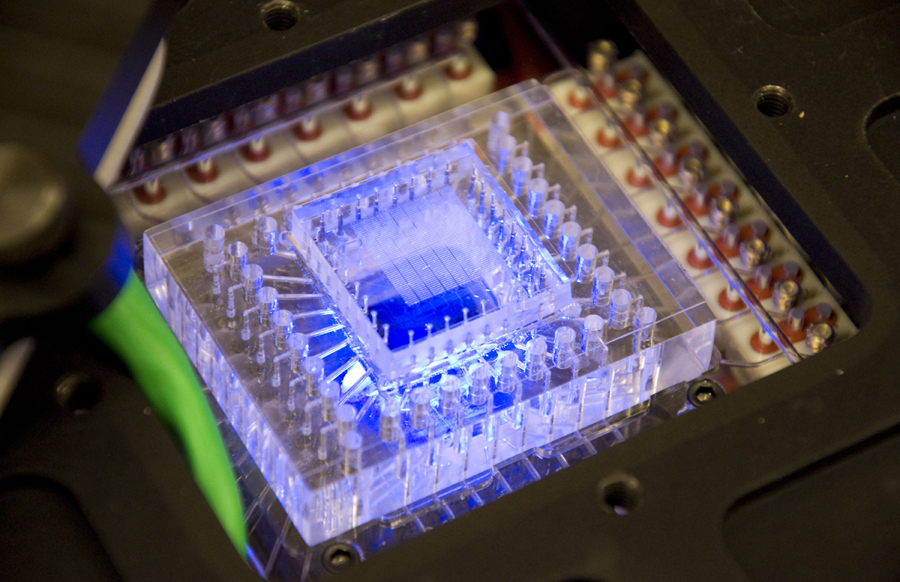
A micro-fluidic device developed at MIT designed to automatically run DNA experiments on other planets( credit: Christopher Carr, MIT)
“There will be DNA life forms there,” Venter predicted Tuesday in New York, where he was speaking at the Wired Health Conference.
Venter said researchers working with him have already begun tests at a Mars-like test site in the Mojave Desert. Their goal, he said, is to demonstrate a machine capable of autonomously isolating microbes from soil, sequencing their DNA, and then transmitting the information to a remote computer, as would be required on an unmanned Mars mission. (Hear his comments in this video, starting at 00:11:01).
Meanwhile, Rothberg’s Personal Genome Machine is being adapted for Martian conditions as part of a NASA-funded project at Harvard and MIT called SET-G, or “the search for extra-terrestrial genomes.”
NASA, whose Curiosity rover landed on Mars in August, won’t send another rover mission to the planet before at least 2018 and there’s no guarantee a DNA sequencing device would go aboard.
Many scientists are lobbying NASA for what’s called a “sample return” mission — one that would make a round trip, bringing back soil and rocks for analysis. However, taking a DNA sequencing machine to Mars could be a better way to search for life.
Venter also said it might be feasible in the future to reconstruct Martian organisms in a super-secure laboratory on Earth, using just their DNA sequence. The idea would be to use the DNA data to rebuild their genomes, then inject those into an artificial cell of some kind. It’s an idea he calls the “biological teleporter.”
“People are worried about the Andromeda strain,” says Venter. “We can rebuild the Martians in a P-4 spacesuit lab, instead of having them land in the ocean.”

Comments (12)
by Conrad Green
simple bacteria? what if the bacteria no matter how simple it appears could be more complex than us. just because something doesn’t have bi pedal shape and has developed a language we can’t translate through current communications is no reason to look down on it. Don’t drop your guard because its a single celled organism because its a aneba and doesn’t have guns and bombs….no if possibly similar to our bodies in the slightest way it could be a bio weapon that doesn’t need skin contact to kill on contact but maybe a electrical transmission which are body runs on and conducts with other lesser and forms of conductivity through second hand transfers.
by spaceman
they wont find life, and if they do, it will be a simple bacteria or virus that noone cares about. Theres better, more cost-effective places to spend the money on scientific research. If finding life on mars inspired the public interest, it would be worth it. But the public doesnt care about some esoteric 10 million year old fossilized bacteria that they have a 1% chance of finding.
by Mike Davidson
What do you mean “if they do, it will be simple bacteria or virus that no one cares about”? Finding ***ANY*** life on Mars would be one of the greatest discoveries in all of human history!!!!!!!!!!!!!!!!!!!!!!!!!!!
by PirateRo
This is a nonsensical point of view worthy only of scorn and humiliation.
by Gabriel
When you start learning about the Singularity, it’s easy to be swept up in it especially if it’s supposedly coming relatively soon….so looking at things like searching for alien lifeforms seem stupid….That’s not the case at all.
Shoot, maybe it’s like Ben Goertzel said in that we just aren’t intelligent enough to find proof and know they are there because they have already moved on in some sense…even someone like Ray Kurzweil, who presents his cases so darn convincingly, isn’t psychic.
A negative result is just as informative as a positive result — whatever these guys end up finding out will benefit us all the same.
by Bruce Wright
An interesting idea, but I think it’s premature to do anything like this in the near future. We have no evidence that there’s DNA-based life on Mars, and no solid evidence that there’s life at all. Moreover, if there is life on Mars that’s based on a genome structure that uses something other than DNA, this will in all probability completely miss it unless it uses a very similar molecular structure like RNA.
I’d like to see samples brought back to Earth for detailed analysis – it’s hard to put enough diagnostic equipment in a small probe when you don’t even know the right questions to ask yet, or where the best places to look are.
by GatorALLin
I love the idea of a race between these two companies… and love the excuse to send more research equipment to other planets to learn more. I would think that part of this is just a marketing angle to promote their DNA sequencers (which is fine for me). It will be interesting if they find much…. it sure would be a big deal to prove there ever was life that started on its own on Mars before it lost its’ oceans, or surface water. I would want them to check the ice first, or at least do some shallow drilling to see if any water or moisture below that desert surface on Mars.
by John Middlemas
Is this a joke? Its obvious all there is on Mars is dust. Anybody can see that from the photos. If there ever was a life form it’s DNA is also dust by now. Why do people waste their time?
by Giulio Prisco
They call it science.
by Timothy
Right. And in glaciers all there is is ice. At the bottom of the ocean there’s only mud. In thermal springs there’s only boiling water. In the desert there’s only…dust. No chance of life in any of those places.
I’m glad you’re not the one who makes the decisions about where people “waste their time”. We’d still be in caves, squinting up into the night sky with only our eyes.
by Camaxtli
Oh, you mean like this kind of ‘dust’?
http://imgur.com/kmOWT
by Gorden Russell
It’s not really a waste of time, Middlemas. Bacteria have been found deep in mines, living on chemical reactions with the rocks. So it Mars had water long enough for life to evolve, it could be living beneath the soil.
The big question is, “Just how long was water on the surface of Mars?”