Giant laser creates an artificial star to clear the sky
February 27, 2013
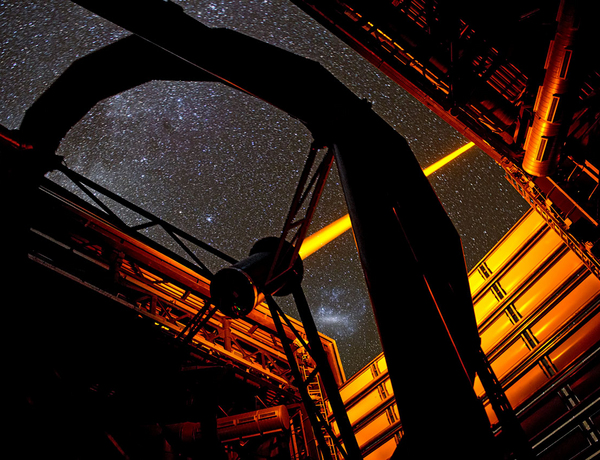
(Credit: ESO)
Death Star’s superlaser? No, a new, improved laser that acts as an artificial star, as a reference to monitor atmospheric turbulence for the Very Large Telescope in Chile, compensating for the atmosphere’s distortions and creating much sharper images, reports New Scientist.
The laser shoots 90 kilometers into the atmosphere, where it interacts with the 10-kilometer-thick layer of sodium atoms left around our planet by meteoroid impacts. The laser makes the sodium fluoresce, producing a bright point of light
Comments (8)
by Astrojensen
I wonder, when this techology will be available to amateur astronomers? :-)
by JasonN
Speaking of lasers… They can also be used as weapons.
I wonder how far the weapon-aspect of laser has been advanced so far.
by Bri
They have pumped them up to the limits of what the atmosphere can take. The gases turn into plasma. It’s opaque and so it absorbs all the energy and the beam can proceed no further.
by Sno
The only news here is that they’re using a new laser “more flexible and reliable than the previous one”. The technique itself is kinda old news, but here’s how it works : They measure the atmospheric distorsion and compensate for it by deforming the surface of the telescope’s mirror in real time. It’s called adaptive optics.
http://en.wikipedia.org/wiki/Adaptive_optics
by DS
guidestars create a reference point in the sky so adaptive optics can measure distortion and using that data to adjust an image so it is clear….in a nutshell
by Jeff Simmons
Interesting, but the article falls short in explaining how a bright point of light enables sharper images.
by TK
Click on the New Scientist link in the middle of the article for a more thorough explanation
by Brad
The bright point of light wavers due to atmospheric distortion. This distortion can be accounted for by moving parts of the telescope mirror in real time. This way much of the atmospheric distortion is eliminated.